
Law, Justice and Parliamentary Affairs Minister Md Asaduzzaman has said the Rohingya crisis is not solely a problem for Bangladesh but an international one, stressing the need for effective engagement of the international community to ensure the safe, voluntary, dignified and sustainable repatriation of forcibly displaced Rohingyas from Myanmar to their homeland.
He said their security, citizenship, human rights, education and dignity must be guaranteed as part of the repatriation process, adding that simply sending them back to Myanmar would not resolve the crisis unless their full rights and security as citizens were ensured there.
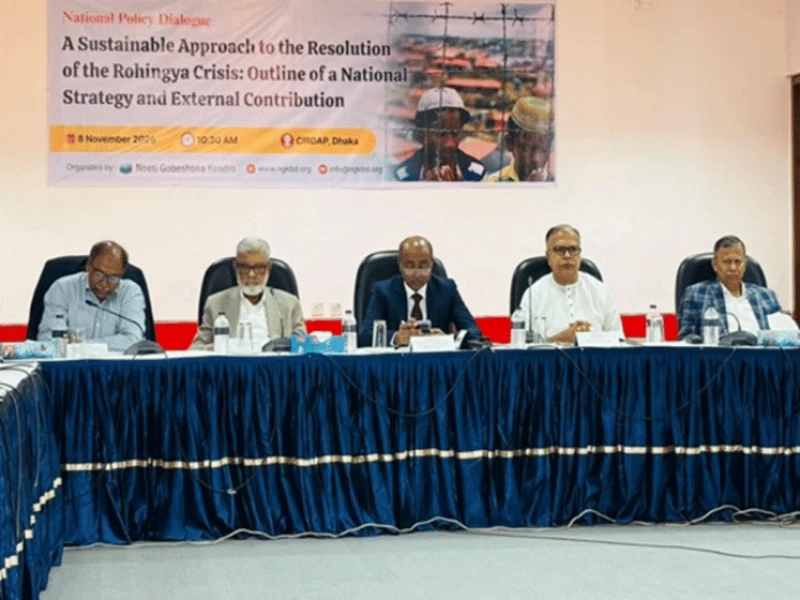
The minister made the remarks while speaking at a policy dialogue on the Rohingya crisis organised by the Centre for Policy Research at the CIRDAP auditorium on Topkhana Road in the capital today.
He said resolving the Rohingya crisis should not be viewed merely as a matter of bilateral negotiations between Bangladesh and Myanmar. The crisis originated in Myanmar, and the country must take responsibility for resolving it. At the same time, the international community must be actively involved in finding a lasting solution.
He noted that the Rohingya crisis had also featured as an important agenda at the United Nations General Assembly, while the UNHCR and other relevant international organisations had expressed concern and remained engaged with the issue.
The minister said Bangladesh remained committed to protecting the human and citizenship rights of the Rohingyas. Their rights to education, security, dignity and citizenship, as well as to return to their homeland safely and voluntarily, must be ensured. Repatriation must be dignified and sustainable, with the international community playing an active role in securing these rights.
Referring to a meeting with the UNHCR on the sidelines of the UN General Assembly session, Asaduzzaman said forcibly sending Rohingyas back to Myanmar or imposing any decision on them could not be a solution.
Every Rohingya must be given the opportunity to return home with security and dignity, with their citizenship, human rights, right to education and all other entitlements as citizens guaranteed in Myanmar, he added.
Highlighting the challenges posed by the Rohingyas' presence in Bangladesh, the minister said the country was currently among the world's leading refugee-hosting nations. Hosting around 1.2 million Rohingyas was placing considerable pressure on a country with limited economic resources.
He said between 82 and 90 children were born every day in the Rohingya camps, warning that a prolonged crisis would further increase demographic, economic and social pressures on Bangladesh.
He also said the crisis involved not only humanitarian concerns but also issues relating to Bangladesh's national security, law and order, and social stability. Therefore, it needed to be addressed through a comprehensive approach.
A national committee has been formed under the leadership of Prime Minister Tarique Rahman to address the issue, he said. The committee would work on formulating a national policy to deal with the Rohingya crisis and reviewing ways to pursue effective initiatives at the international level.
Responding to demands raised during the discussion for ensuring education and other facilities for Rohingyas, the minister said proposals aimed at protecting their dignity and rights were reasonable. However, Bangladesh's economic capacity, social realities and national security concerns also needed to be taken into account.
He said effective and realistic decisions would have to be made after reviewing all these considerations.
The minister said the present government wanted to pursue an effective resolution of the crisis by drawing on the initiatives and experiences of the governments led by former Prime Minister Begum Khaleda Zia and Shaheed President Ziaur Rahman.
Welcoming the initiative of the Centre for Policy Research, Asaduzzaman described the Rohingya crisis as a complex policy and international issue. He said the government was keen to learn from experienced researchers and experts and move forward by taking their advice.
Institutions like the Centre for Policy Research could support the government by playing the role of watchdogs and providing policy guidance, he said, adding that the government would give due consideration to any constructive recommendations on the issue.
He further said the government would consider any specific proposals or presentations on resolving the Rohingya crisis and try to take necessary initiatives accordingly.
The dialogue was moderated by Centre for Policy Research Executive Director Dr Shakil Ahmed, while its adviser, Ambassador Mohammad Sufiur Rahman, presented the keynote paper.
Organisers, researchers, experts and invited guests attended the event.