
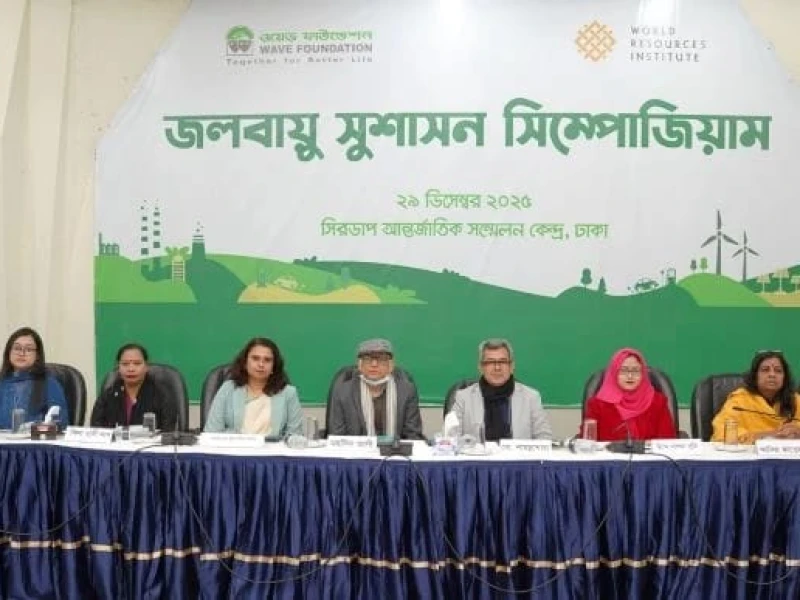
Wave Foundation has called for ensuring meaningful participation of local communities to strengthen climate governance at the grassroots, stressing that a top-down approach continues to limit public engagement, create mismanagement in infrastructure development and hinder the effective implementation of environmental justice.
The call came on Monday at a day-long national-level Climate Governance Symposium organised by Wave Foundation at the CIRDAP International Conference Centre in the capital.
Speakers emphasised the need to expand opportunities for citizen participation, adopt a bottom-up approach and ensure gender-responsive inclusion to make climate governance more effective and people-centric.
With support from the World Resources Institute (WRI), Wave Foundation has been implementing the Strengthening Climate Governance through Grassroots Participation (SCGGP) project in four upazilas and 32 unions of Patuakhali and Barguna districts under the Barishal division. The symposium shared findings from a social audit conducted in the project areas, identifying key gaps in grassroots climate governance.
The audit highlighted challenges related to climate change adaptation, local development, public participation, policy implementation and gender-based discrimination, and placed several short-, medium- and long-term recommendations.
The day-long event featured two thematic panel discussions, an exhibition showcasing project activities and a cultural programme.
Panel discussions
The opening panel discussion, titled “Challenges and Ways Forward in Strengthening Local Partnerships,” was chaired by Wave Foundation Executive Director Mohsin Ali. Environment, Forest and Climate Change Ministry Joint Secretary (Law Wing) Shahanara Yasmin Lili attended as special guest.
Ahmed Borhan, Research Director at the Centre for Social Research (CSR), presented the keynote paper, while Wave Foundation Deputy Executive Director Nasifa Ali shared an overview of the project and its achievements. The session was moderated by Wave Foundation Deputy Director Kaniz Fatema.
Speaking at the discussion, Shahanara Yasmin Lili said the government is working within its financial capacity to address the shortage of safe drinking water in rural areas, but stressed that citizens also have responsibilities. “We must change ourselves and take responsibility,” she said.
Nahid Sultana, Assistant Project Director of the Green Climate Fund at the Department of Women Affairs, said collective efforts are essential to promote greening and tackle the impacts of climate change.
CRPD Chief Executive Mohammad Shamsuddoha said climate governance depends on both sound planning and effective implementation. He pointed to weak coordination between planning and implementation teams as a major challenge, resulting in inefficient use of budgets. He stressed strengthening union parishads to address climate challenges at the grassroots, which would have positive national-level impacts.
Additional Director of the Department of Social Services Shila Rani Das noted that Bangladesh’s coastal regions are highly disaster-prone but said the country’s disaster management capacity is stronger than many other countries.
In his closing remarks, Wave Foundation Founder Executive Director Mohsin Ali said Bangladesh ranks among the top climate-vulnerable countries globally, yet those most responsible for climate change are not taking adequate responsibility. He also highlighted the improper use of available climate budgets, stressing the need to enhance the capacity of union parishads, increase allocations, ensure accountability and strengthen monitoring.
Climate migration and compensation
The second thematic discussion, titled “Climate Migration and Compensation Mechanisms,” was moderated by Wave Foundation Assistant Director Aniruddha Ray.
Jamuna TV Senior Reporter Raihan Ferdous said the term “climate migration” is still absent from national laws and needs greater recognition. He also stressed enhancing youth capacity to develop environment-focused projects for accessing global climate funds.
Abu Aslam, South Asia Portfolio Lead at Water.org, said ensuring safe drinking water and sanitation for all could help address many environmental crises.
The session was also attended by Helvetas Swiss Intercooperation Bangladesh Programme Director Farhana Afroze, BLAST Climate and Displacement Adviser Ahmad Ibrahim, and Union Parishad chairmen Md Shawkat Hossain and Maisha Islam from Barguna and Patuakhali.
Key recommendations
The social audit paper recommended regular meetings of disaster management committees and ward meetings at the union level, institutionalising open budget meetings to allow citizens to voice opinions and questions, and ensuring fairness in infrastructure development based on local needs with proper environmental impact assessments.
It also urged shifting from a top-down to a bottom-up approach, ensuring transparency and timely delivery of relief, developing separate policies and projects for women and marginalised groups, and implementing credible rehabilitation and compensation mechanisms.
The paper stressed that ensuring climate justice and environmental justice would make future development initiatives more effective and aligned with people’s needs.
 Prev Post :