
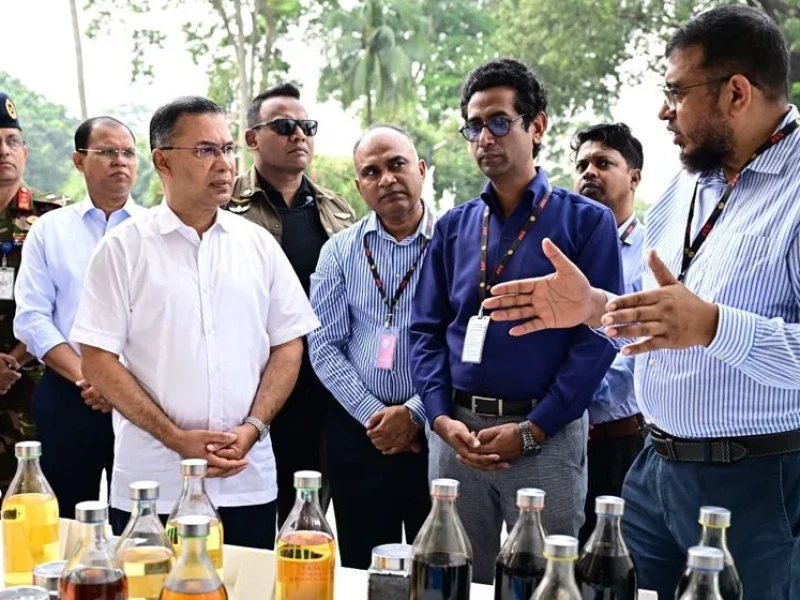
Prime Minister Tarique Rahman on Saturday watched a demonstration of an innovative project to produce fuel oil from human waste and agricultural residues, assuring the researchers of all necessary government support for its implementation.
The researchers presented their technology, research progress and the prospects for commercial-scale fuel oil production in Bangladesh to the Prime Minister at his office in Tejgaon in the capital in the morning.
During the presentation, KUET Professor Dr Md Khalequzzaman briefed the Prime Minister on the technology and various aspects of the research into producing fuel oil from human waste, sewage treatment plant sludge, kitchen waste and agricultural residues.
The Prime Minister observed the demonstration of the technology and was briefed on the project's operations and implementation plan. Considering its potential, he assured the researchers of all necessary government assistance to take the initiative forward.
After nearly a decade of research, the team at Khulna University of Engineering and Technology (KUET) has made significant progress in producing biocrude, a form of crude bio-oil, from waste using Hydrothermal Liquefaction (HTL) technology.
Laboratory tests have yielded biocrude at rates of 50 to 55 per cent. The researchers also informed the Prime Minister of their success in producing diesel-rich biocrude.
The next phase involves plans to establish a pilot plant capable of processing one to three tonnes of waste per day. The facility will be used to assess the technology's effectiveness, production costs and commercial viability.
The proposed pilot project is expected to require an investment of approximately Tk 100 crore to Tk 120 crore.
According to the researchers, successful commercial expansion of the technology could potentially replace around 10 to 15 per cent of Bangladesh's imported crude oil. This could generate annual foreign exchange savings equivalent to an estimated Tk 6,500 crore to Tk 13,000 crore.
However, they noted that the potential would need to be assessed through large-scale testing to establish the technology's effectiveness and economic viability.
The researchers expressed the hope that successful commercialisation of the technology, with government support, would help address the country's fuel supply challenges and waste management problems.
They also said the initiative could reduce dependence on imported fuel, save foreign exchange, curb environmental pollution and create new opportunities for the development of the domestic energy industry.
Power and Energy Minister Iqbal Mahmud Tuku, State Minister Anindya Islam Amit, University Grants Commission member for Public Management Professor Abdullah Al Mamun, KUET Vice-Chancellor Professor Mohammad Masud and Bangladesh Petroleum Corporation Chairman Dr Mohammad Rafiqul Islam were present at the event.