
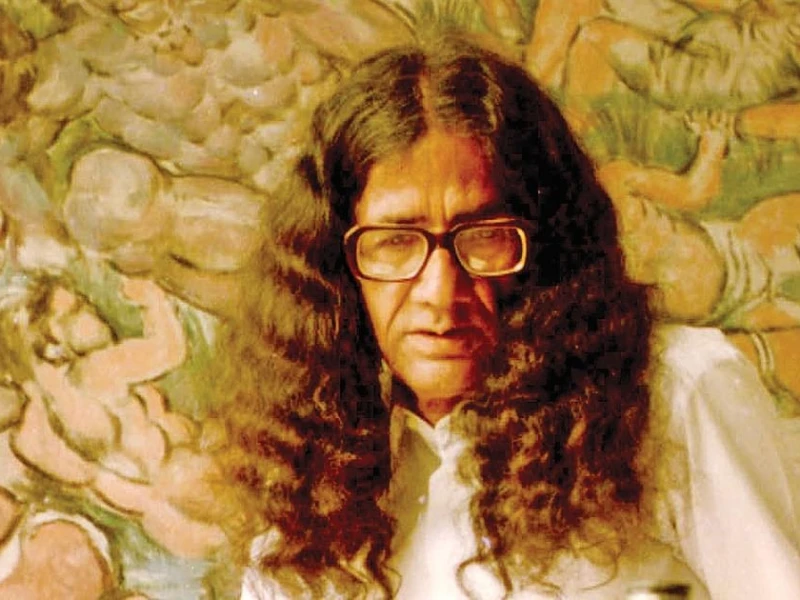
Bangladesh on Monday marked the 103rd birth anniversary of internationally acclaimed painter SM Sultan with a day-long celebration in his native Narail, honouring an artist who once shared exhibition space with Pablo Picasso and Salvador Dali yet spent his life painting barefoot farmers in a mud-walled village studio.
The programmes, organised by Bangladesh Shilpakala Academy in association with the SM Sultan Sangrahashala, District Shilpakala Academy Narail and the district administration, were held at the S M Sultan Memorial Museum and Shishu Sworgo (Children's Paradise) and the District Shilpakala Academy in Narail.
The day's events included an art camp featuring 20 local artists, a painting festival and exhibition involving more than 300 children from Shishu Sworgo, the newly launched "Sultan Sommanona Padak" (Sultan Honour Medal) presentation, a discussion on the artist's life and work, and a cultural programme.
Cultural Affairs Minister Nitai Roy Chowdhury, speaking at the event, said Sultan's stature extended far beyond Narail or the banks of the Padma.
"This world-famous painter belongs not just to us in Narail, but to the whole of Bangladesh and the world," he said, announcing that the Sultan honour medal, introduced this year, would place special focus on school-based initiatives to nurture young artists from rural Bangladesh.
"If children in small village schools are encouraged in art and given the opportunity, their intellect will awaken and flourish, and they will be able to stand tall," the minister said.
Bangladesh Shilpakala Academy Director General, poet Rezauddin Ahmed (Rezauddin Stalin), described Sultan as the most humane and life-affixed artist Bangladesh has produced.
"He is the greatest painter of agrarian civilisation, a pride of Narail, of greater Jashore, of Bangladesh and of the entire world," he said, expressing hope that children growing up at Shishu Sworgo would one day become artists in Sultan's own mould.
Born Sheikh Muhammad Sultan on August 10, 1923, the artist became known simply as SM Sultan, an icon whose canvases evoke rural Bengal much as poets Jibanananda Das or Jasimuddin might have painted it, had they traded pens for brushes. Unlike abstract or cubist art, which often demands interpretation even from its own creators, Sultan's work speaks for itself at first glance.
His most distinctive signature was the muscular, almost superhuman physique he gave to Bengal's peasants, a striking departure from the frail, emaciated figures typically associated with rural farmers.
In interviews with writer Shahaduzzaman and in the late filmmaker Tareque Masud's documentary "Adam Surat," Sultan explained the choice simply: he wanted to externalise the peasant's inner strength, endurance and perseverance. In his celebrated work "The First Tree Plantation," a heavily built farmer plants the earth's first tree, recasting the peasant as humanity's original ancestor and its most enduring hero.
Writer Ahmed Sofa, in his essay on Sultan in "Bangali Musalmaner Mon," argued that had Sultan been born in an Arab country he might have painted labourers; born in Scandinavia, perhaps fishermen. Because he was born in Bengal, the farmer became his lifelong subject.
Sultan himself contrasted his work with Western abstraction, telling Shahaduzzaman that Western artists often paint from a place of ideological doubt, whereas Bengali life, in his view, held far fewer such ruptures, and that a painting of a farmer should be recognisable to the farmer himself, or it fails as art.
Sultan credited Vincent van Gogh as his principal influence, and critics have long noted the resemblance between van Gogh's "The Potato Eaters" and Sultan's own depictions of domestic peasant life. His palette: browns, greens and hazy blues drawn from skin, soil, foliage and sky, grounded his work in the land itself.
Where established painters used costly pigments and canvas, Sultan mixed colours from village materials and treated cloth with the sap of the gab fruit to make his own canvas, turning humble materials into priceless work.
Sultan trained at Calcutta Art School under the patronage of local zamindar Shahed Suhrawardy, left before completing his studies to live and paint in Kashmir, spent time in West Pakistan after Partition, and later toured Europe on funding from the Pakistan government, before eventually returning to his roots in Narail.
Though he exhibited alongside Picasso and Dali as the first Asian artist to do so in the 1950s, recognition at home came only in 1976, when Sultan held his first exhibition in Bangladesh, 23 years after his final return.
He never married. He gave away paintings that could have fetched millions of dollars, choosing instead to live among Narail's farmers, where his canvases sometimes ended up as roof thatching or tablecloths.
Each morning, village children came to learn to draw from him, in exchange for breakfast, a practice Sultan said was rooted in the simple hunger of children who woke crying before dawn. Writer Borhanuddin Khan Jahangir once summed up his life: "Sultan's tragedy is that he tried to live in a way life cannot be lived."
Sultan died in poverty and illness, but never abandoned his vision of an aesthetic society in which art reached the marginalised, and in which farmers, the true heroes of civilisation, in his eyes, would carry no sense of inferiority. Monday's celebration at the Shishu Sworgo he founded suggested that vision continues to find new hands to carry it forward.