
Canada has expressed its intention to provide preferential market access for Bangladeshi products under its preferential trading regime until 2032 to support the country’s smooth and sustainable graduation from Least Developed Country (LDC) status.
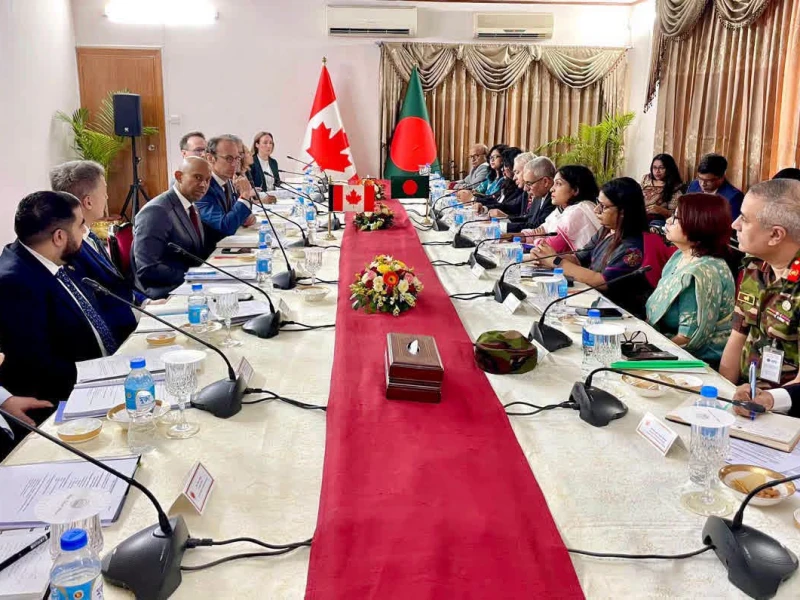
The commitment was reaffirmed as Bangladesh and Canada concluded the Sixth Bangladesh-Canada Bilateral Consultations in Dhaka on Tuesday (24 November), pledging to deepen a partnership spanning over five decades.
The consultations were co-chaired by Bangladesh Foreign Secretary Salahuddin Noman Chowdhury and Weldon Epp, Assistant Deputy Minister (Indo-Pacific) at Global Affairs Canada.
During the meeting, both sides welcomed the rapid growth in bilateral trade, which rose by nearly a quarter to exceed CAD 4 billion in 2025. They explored avenues to expand trade and investment across key sectors, including agriculture, energy, security and defence, as well as technical and vocational education and training (TVET).
Both delegations underscored the need to advance structural reforms ahead of Bangladesh’s LDC graduation and agreed to strengthen business-to-business engagement and people-to-people ties.
Highlighting their longstanding development partnership, Canada noted that it has provided over CAD 6.3 billion in development assistance to Bangladesh since 1972. This includes a recent commitment of CAD 45 million announced by Secretary of State (International Development) Randeep Sarai during his visit in October 2026 to support economic governance, institutional reforms, private sector growth, trade competitiveness, and agricultural innovation.
The two sides also discussed cooperation on skills development through TVET, knowledge transfer, and educational partnerships, alongside broader discussions on migration, security cooperation, climate resilience, and regional and global issues of mutual interest.
Canada commended Bangladesh’s generosity in hosting over 1.2 million forcibly displaced Rohingya, noting its own contribution of more than CAD 700 million towards the humanitarian response since 2017. Both countries reaffirmed the importance of sustained international support for the Rohingya and host communities, reiterating their commitment to facilitating the voluntary, safe, dignified, and sustainable return of the refugees to Myanmar.
They also welcomed the recent International Court of Justice (ICJ) ruling in The Gambia v. Myanmar case, noting its significance in addressing the Rohingya crisis.