
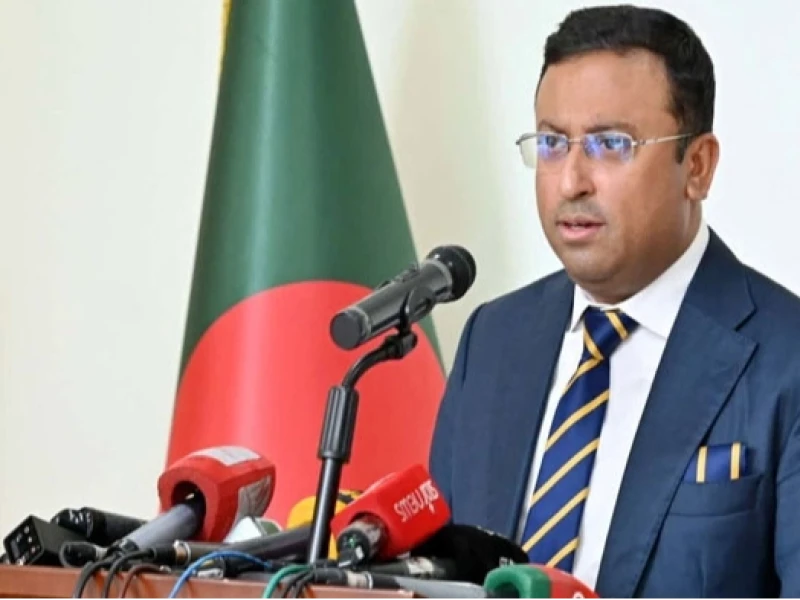
State Minister for Foreign Affairs Humaiun Kobir on Thursday called on the international community to move beyond expressions of solidarity and ensure shared responsibility and sustained political engagement to resolve the Rohingya crisis.
“Nine years of displacement should not make displacement acceptable. It should make finding a solution more urgent than ever on this crisis,” Kobir said while speaking at a programme at Foreign Service Academy.
Bangladesh has hosted Rohingya refugees for decades and, particularly since the massive influx in 2017, has provided refuge and protection to more than one million forcibly displaced Myanmar nationals.
“We have done so despite the considerable pressure this has placed on our economy, environment, public services, local communities and national security,” Kobir said.
He said Bangladesh has demonstrated “humanitarian responsibility and humanitarian leadership,” but such responsibility must not be mistaken for unlimited responsibility.
“Let me be clear: this is not a crisis that Bangladesh created, and it cannot be a crisis that Bangladesh resolves alone,” the state minister said.
Humanitarian financing, he said, must remain predictable and consistent, while host communities must receive meaningful support.
Regional cooperation must be structured, and every engagement with Myanmar must remain focused on addressing the conditions that produced this displacement in the very first place,Kobir said.
He also underscored the distinction between humanitarian assistance and a political solution.
“Humanitarian assistance manages the consequences of displacement. Only a political solution can end displacement,” he said.
Kobir said the objective remains clear: the safe, voluntary, dignified and sustainable return of the Rohingya to Myanmar.
“But return must not simply mean crossing a border. It must mean returning to a place where people can live with security, rights, dignity and confidence in their future,” he said.
That, he added, requires conditions and an environment that make the return of the Rohingya genuinely sustainable.
The state minister said the crisis also demands a broader regional approach, with ASEAN playing an important role alongside the United Nations and regional countries.
“We need a comprehensive approach that connects humanitarian action with diplomacy, accountability, development, resource mobilisation and political dialogue,” he said.
Kobir said Prime Minister Tarique Rahman has taken a decisive step towards addressing the matter by establishing the National Strategy Formulation Committee on the Rohingya issue.
“It will not be just another committee. It brings together, for the first time, diplomatic, humanitarian and security institutions under a comprehensive framework,” he said.
Addressing young diplomats and students present at the event, Kobir said diplomacy is not simply the art of managing difficult situations.
“At its best, diplomacy is the art of creating possibilities when none appear to exist,” he said.
“The Rohingya crisis will test precisely that capacity. Our responsibility is not merely to manage another year of displacement. Our responsibility is to create political conditions in which another decade of displacement becomes unnecessary. We will do our utmost,” he said.
Kobir said Bangladesh, as the country presiding over the 81st session of the United Nations General Assembly, would seek to keep the Rohingya crisis high on the agenda of the UN and other multilateral platforms.
“We will work with our bilateral partners to create an enabling environment, raise the profile of the Rohingya crisis and mobilise the international financial support that is required to resolve this crisis,” he said.
Bangladesh, under the leadership of Prime Minister Tarique Rahman, will work with important stakeholders, including China, and engage with the government of Myanmar and other relevant parties to find a peaceful and sustainable resolution to the crisis, he said.
“I hope today’s discussion will contribute not only to a better understanding of the crisis but also to evolving a coherent strategy, and most importantly, to resolving this crisis,” Kobir said.