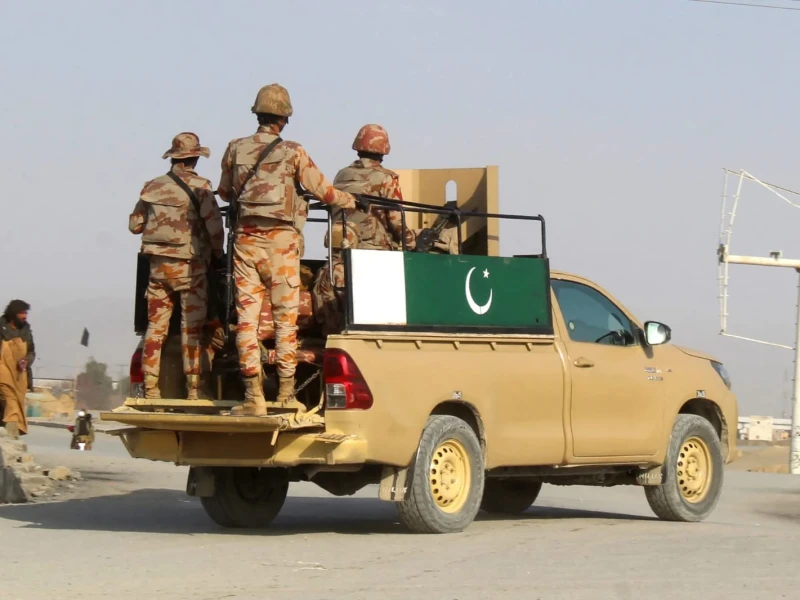
Pakistan and Afghanistan are fighting yet again. On Friday morning (February 27), Pakistan’s Defence Minister Khawaja Asif claimed that his country is in an ‘open war’ with its neighbour.
Pakistan has reportedly claimed that 133 Afghan Taliban fighters were killed and more than 200 others were wounded in its latest military offensive. Pakistan military spokesperson, Lt Gen Ahmed Sharif Chaudhry, also told reporters in a press conference that Pakistan’s armed forces had destroyed 73 posts and had captured 18.
But Kabul refutes these figures, claiming no loss of lives.
According to AFP reporters on the ground, new rounds of gunfire and shelling erupted near the strategic Torkham border crossing.
Amid rising tensions between the two neighbours, here’s a look at how Pakistan and Afghanistan’s militaries stack up against one another.
Overview
Backed by steady recruitment and retention, Pakistan’s military is reinforced by hardware from its primary defence partner, China. Islamabad is pressing ahead with investment in its nuclear capabilities and modernising its naval and air assets.
Meanwhile, the capability of the Afghan Taliban’s armed forces is declining, with a fall in their ability to use foreign equipment that the Islamist group seized when it returned to power in the landlocked country in 2021. A lack of international recognition for the Taliban administration has also hurt military modernisation.
As per Global Firepower’s rankings, Pakistan’s military is ranked high at 14, whereas Afghanistan is ranked 121 of 145 countries.
Personnel
Pakistan has a higher number of military personnel compared to its neighbour. Of Pakistan’s estimated 660,000 active service members, around 560,000 belong to the army, while the air force and navy account for about 70,000 and 30,000 personnel, respectively.
The strength of the Afghan Taliban’s military is thinner, with only 172,000 active personnel. The group has, however, announced plans to expand its armed forces to 200,000 personnel.
The Afghan forces also possess armoured fighting vehicles, including Soviet-era main battle tanks, armoured personnel carriers, and autonomous underwater vehicles, but their exact number is unknown.
The precise number of artillery pieces they possess, which is of at least three different types, is not known.
Aerial power
Pakistan has a fleet of 465 combat aircraft and more than 260 helicopters that include multi-role, attack and transport choppers. In fact, many of Pakistan’s fighter jets come from China or the US. For instance, one of the most deadliest aircraft in Pakistan’s arsenal is the F-16, which is manufactured by America’s Lockheed Martin. Also, Pakistan boasts of having the JF-17, which is developed by China.
Afghanistan has no fighter jets and no real air force to speak of. It is known to possess at least six aircraft - some of them dating back again to the Soviet era - and 23 helicopters, although it is not possible to assess how many are in flying condition.
Nuclear arsenal
While Pakistan is a nuclear-armed country and has 170 warheads, Afghanistan does not have a nuclear arsenal.
Asymmetrical tactics
While Pakistan seems to outgun and out power Afghanistan militarily, Kabul holds one advantage. The Taliban resorts to guerrilla tactics and deep knowledge of the rugged border terrain to challenge the Pakistani military. They often employ small, stealthy units for high-impact raids on border posts.
 Prev Post :