
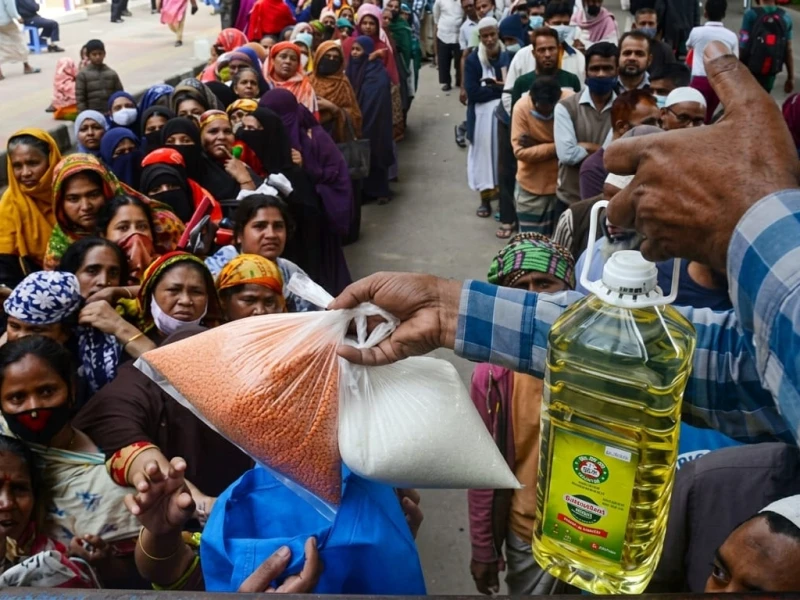
News reports frequently condemn the poor quality of subsidised food distributed to Bangladesh's low-income population, infested wheat from the Open Market Sale (OMS), substandard dates from the Trading Corporation of Bangladesh (TCB), calling it a mockery of welfare policy. But viewed through an economic lens, the argument flips entirely: not only is low quality acceptable in subsidised goods, it may be a prerequisite for the system to work at all.
Classical economics divides consumer goods into three categories— luxury goods, normal goods, and inferior goods. In Bangladesh, the wealthy buy luxuries, the middle class buys normal goods, and the poor consume inferior goods. When the government provides normal-quality goods through social safety net programmes, a predictable distortion occurs: those goods never reach the intended beneficiaries. The middle class intercepts them.
This is not theory. After the fall of the Awami League government, an audit of TCB's one crore family cards revealed that nearly 40 lakh, close to half, had gone to people with no need for subsidised goods, people perfectly capable of buying at market prices. Many among the middle and lower-middle classes had even paid bribes to local administrators and political representatives to secure those cards.
The reason is straightforward: TCB's distributed sugar, oil, onions, lentils, and Ramadan staples like chickpeas and dates were of reasonably good quality. Good enough, in fact, to qualify as normal goods rather than inferior ones. That single fact changed the entire consumer profile of the programme. The middle class found it worth their while, worth bribing for, and the poor lost their rightful share.
Had the oil been loose and dirty rather than bottled, had the onions been half-rotten, had the dates been visibly substandard, the middle class would have had no incentive to compete. The goods would have self-selected their recipients.
The same logic applies to the OMS programme. In 2025, allegations surfaced of organised syndicates manipulating OMS dealership lotteries in both Dhaka city corporations and extracting bribes from dealers. The motivation was clear: OMS rice and flour were of decent quality, making it profitable to hoard them and sell on the open market at a premium. That quality, perversely became the enemy of the poor. Dealers and local representatives diverted what was meant for struggling households. Wormy flour, as uncomfortable as it sounds, largely eliminates that temptation.
The economist Akbar Ali Khan, in his book ‘The Economics of Altruism’, recounts the story of Harsha, the ancient king of Kanauj, who distributed his entire wealth every four years at the Prayag fair. He was so extravagant in his giving that he would arrive home wrapped in borrowed cloth, having donated even the garments off his back. Court biographers celebrated this as magnanimity. Akbar Ali Khan offers a more clinical reading: Harsha did not voluntarily donate his last garment. The crowd, worked into a frenzy, simply stripped it from him. He leapt into the Ganges in desperation.
The parable has direct relevance to Bangladesh's newest welfare ambition. Following the Awami League's ouster, the BNP government came to power in 2026 with Tarique Rahman at the helm, carrying one of his most prominent electoral promises: a universal family card programme. The pilot has already been launched, and images of poor women receiving their cards with evident joy have made the rounds. The intent is genuinely public-spirited. The economics, however, present formidable challenges.
The first challenge is diversion. Even with digital disbursement, ensuring cash or benefits reach the right hands requires an honest, adequately staffed monitoring apparatus, a resource Bangladesh has historically struggled to maintain. The companion proposal of waiving interest on agricultural loans compounds this risk. Low-interest agricultural credit is already predominantly captured by moneylenders rather than actual farmers. A full interest waiver would hand local middlemen an even more lucrative tool to exploit vulnerable cultivators.
The second challenge is productivity. A domestic worker currently earning five thousand taka a month across five households may rationally choose to work less or demand higher wages if a family card delivers the same amount without labour. That is not a moral failing; it is rational economic behaviour. But the aggregate effect is reduced workforce participation and upward wage pressure on middle-class households already squeezed by the very taxes levied to fund the subsidies.
The third challenge is dependency. Britain under Queen Elizabeth I enacted poor laws that provided cash relief to the destitute. By 1834, Parliament was forced to repeal them. Cash, it turned out, was always attractive, rarely reaching the poorest, and when it did, it bred dependency rather than productivity. People substituted subsistence for work, and national output suffered.
There is also a psychological dimension that welfare economists rarely discuss openly. Large subsidy programmes make governments popular, briefly. Beneficiaries praise the leader's generosity; approval ratings climb. What gets obscured is that the underlying economy has not improved, and the subsidies often function less as welfare and more as loyalty mechanisms.
It is a playbook with a long history. Bismarck used it in 19th-century Germany; Churchill employed variations of it in Britain. Sheikh Hasina, Bangladesh's most recently deposed prime minister, deployed it with considerable skill, until it wasn't enough.
The lesson is not that governments should be indifferent to the poor. It is that welfare design matters as much as welfare intent. Throwing money at poverty the way Harsha threw his garments at the crowd ends the same way, in the Ganges, borrowing someone else's clothes.
If Bangladesh's new leadership genuinely wants its family card programme to reach those who need it most, the uncomfortable economic truth is this: the goods in the basket may need to be a little worse, the cash transfers a little harder to divert, and the glamour of generosity a little less intoxicating.
Sometimes, weevils are a feature, not a bug.
 Prev Post :