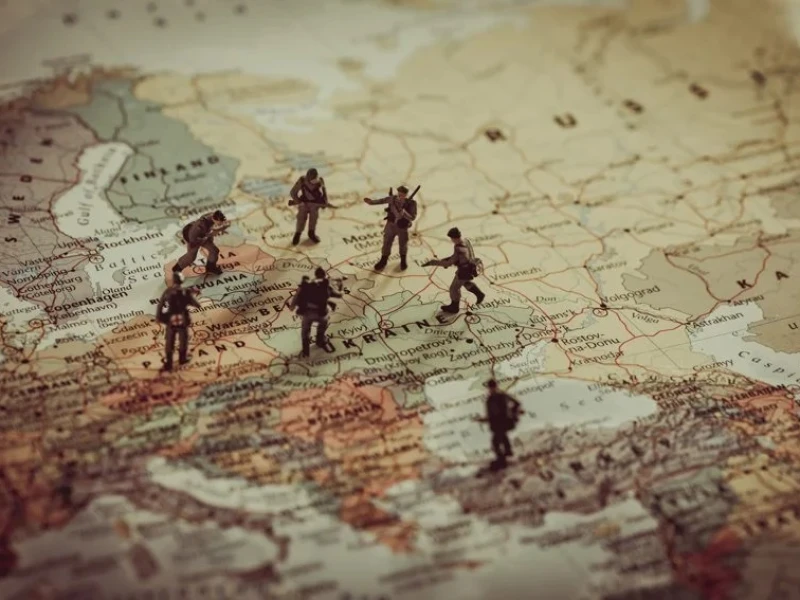
As global geopolitical tensions have intensified, fuelling widespread public anxiety that a third world war could be on the horizon, analysts and policymakers offer divergent views on how close the world actually is to such a conflict and most stop short of declaring that a global war is imminent.
Ukrainian President Calls Conflict ‘World War III’
Ukrainian President Volodymyr Zelensky has asserted that Russian President Vladimir Putin “has already started World War Three,” saying Russia seeks to reshape global norms and that preventing further territorial gains is crucial to global security (The Times, 2026).
His comments were made on the fourth anniversary of Russia’s full-scale invasion of Ukraine, and he urged deeper long-term commitments from Western allies.
Ukrainian officials have also raised alarms about involvement by foreign actors, including Chinese and North Korean personnel and Iran’s provision of armed drones, framing the ongoing war in Ukraine as part of a wider conflict dynamic (News.com.au, 2026).
Public Fears and Surveys Reflect Rising Anxiety
Polling data from Western countries suggests that many Europeans and Americans now believe another world war is likely in the next decade. Roughly 40–55% of respondents in major European states and about 45% of Americans said they think a global war could erupt within the next 5–10 years, with a large majority associating it with potential nuclear use (YouGov, 2026).
These results highlight rising public perceptions of risk, even if they diverge from formal military assessments.
Strategic Risk Assessments: Uneven but Not Cataclysmic
Major geopolitical analyses show that great power friction remains significant, but most do not treat a full-scale global war as the most likely outcome in 2026. The Eurasia Group’s risk forecast for 2026 places the year as one of deep geopolitical uncertainty, noting that direct conflict between major powers is not the top risk, although instability persists (Eurasia Group, 2026).
Similarly, the U.S. Council on Foreign Relations ranks potential flashpoints such as a Taiwan Strait crisis or clashes between Russia and NATO as scenarios with even chances, yet these remain contingencies rather than certainties (Council on Foreign Relations, 2026).
Security-focused surveys in Europe also highlight increasing risk of regional escalation, such as Russia’s hardened posture and hybrid attacks, but stress deterrence and diplomatic engagement to avoid wider conflict (European Union Institute for Security Studies, 2026).
Nuclear Risk Remains a Serious Concern
A symbolic barometer of nuclear threat, the Doomsday Clock, was moved closer to midnight in early 2026 than at any time since its inception, largely due to persistent conflicts, increased nuclear rhetoric, and the breakdown of arms control measures (Bulletin of the Atomic Scientists, 2026). While this does not equate to imminent nuclear war, it signals elevated levels of tension in global strategic dynamics.
Expert Caution: Not ‘World War III’ Yet
Strategic scholars stress that although the risk of major conflict is significant, full-blown global war involving major powers simultaneously remains unlikely at present. Historical analysis suggests that even severe regional wars — such as the Ukraine conflict — have not yet evolved into a systemic world war akin to those of the 20th century (Texas A&M University Experts, 2024).
Observers describe the current era as characterised by multipolar competition, regional proxy wars, hybrid threats, and strategic deterrence, where global mobilisation of great powers in a singular war remains an extreme scenario rather than an immediate forecast.
The international system in 2026 is undeniably strained, with wars in Ukraine and the Middle East, heightened U.S.–Iran tensions, and public fears contributing to a climate of uncertainty. However, global analysts and institutions largely indicate that while the world is at a heightened risk of conflict escalation, it is not on the verge of an outright World War III — yet. Continued diplomatic engagement, nuclear risk mitigation, and international cooperation are cited as essential to avoiding such an outcome.
 Prev Post :