
Eminent members of Bangladesh’s civil society on Friday called for building a future Bangladesh by upholding the ideals, democratic journey, political decency, tolerance toward opponents and overall restraint demonstrated by former Prime Minister and former BNP Chairperson Begum Khaleda Zia.
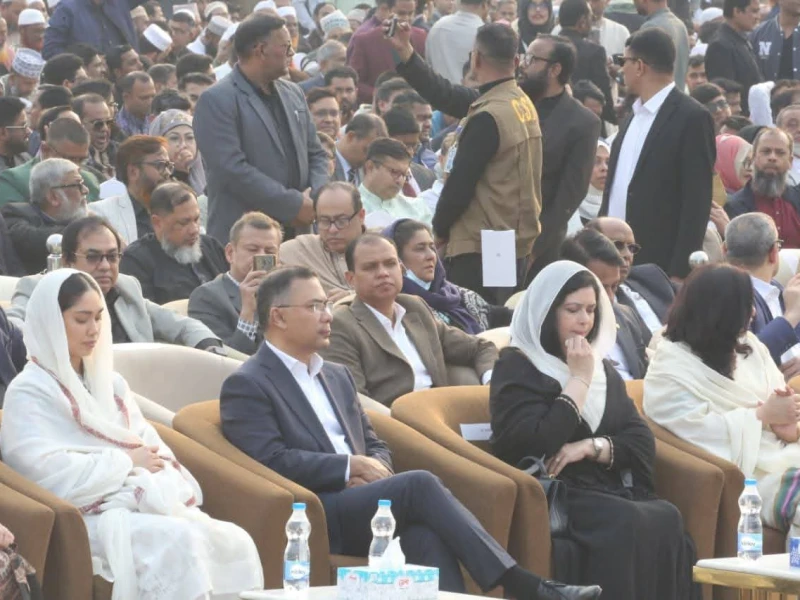
The call was made at a citizens’ condolence meeting organised in memory of the late Khaleda Zia at the South Plaza of the Jatiya Sangsad. Media personalities, leading business figures, former government officials, academics and prominent members of civil society arranged the programme to pay tribute to the departed leader.
BNP Chairperson Tarique Rahman attended the condolence meeting along with his wife Dr Zubaida Rahman, daughter Zaima Rahman and other family members.
At the outset, Saleh Uddin, coordinator of the programme and executive editor of The Daily Ittefaq, read out the condolence note. He said the event was not a political programme but a tribute from the country’s civil society to Khaleda Zia.
“Today, people across the country are remembering two-time Prime Minister Khaleda Zia not as a powerful political leader, but as a humane leader,” he said.
Condolence meeting preparation committee president Prof Mahbub Ullah recalled Khaleda Zia’s words, “We have friends abroad, not masters. We hold the flag of independence in our hands, while they hold the chains of subjugation. I have no address outside the country; this country is my final address.”
He said these three messages of Khaleda Zia should serve as guiding principles for statesmen in building the future of Bangladesh.
Law Adviser Asif Nazrul described the verdict against Khaleda Zia in the Zia Orphanage Trust corruption case as one of the most heinous trials in Bangladesh’s history. He advised internalising Khaleda Zia’s ideals to build the Bangladesh of the future.
Editors’ Council President Nurul Kabir, recalling Khaleda Zia, said her death proved how deeply loved she was by the people of the country. “The massive turnout of people at her janaza is clear testimony to that,” he said.
Offering advice to BNP, Nurul Kabir urged the party not to deviate from Khaleda Zia’s ideals, cautioning that BNP should not do anything that would make people say Khaleda Zia was spared from witnessing such actions only because she is no longer alive.
Writer Faham Abdus Salam said Khaleda Zia was the only political leader he had seen who transformed from a legal leader to a moral leader. “Many think the highest achievement of a politician is becoming prime minister, but Khaleda Zia rose far above that position in the hearts of the people.”
Bangladesh Puja Udjapan Parishad President Basudeb Dhar said Khaleda Zia always stood by oppressed people wherever she heard their voices. He said the history of democracy in Bangladesh remains incomplete without her, adding that completing the country’s democratic struggle would be the highest tribute to her.
Referring to Khaleda Zia’s final days, her medical team chief and medicine and chest disease specialist Dr FM Siddique said she had to endure immense suffering due to medical negligence. He said when treatment began at Evercare Hospital, they found she had been given certain harmful medications that led to liver cirrhosis. He also blamed wrong treatment for her arthritis and other complications.
“Despite her immense contributions to the country’s healthcare sector, she had to leave this world due to prolonged medical negligence. There should be a specific investigation into this matter,” he said.
Former caretaker government Chief Adviser’s Special Assistant Raja Devasish Roy said Khaleda Zia left two significant legacies in the Chattogram Hill Tracts. He noted that no government before her had given such importance and recognition to grassroots leaders like village heads and traditional leaders. “We expect to move towards a non-communal, pluralistic and inclusive Bangladesh by following Khaleda Zia’s path.”
Amar Desh Editor Mahmudur Rahman compared the massive turnout at Khaleda Zia’s funeral to that of late President Ziaur Rahman’s janaza. He said although Khaleda Zia was not in power at the time of her death, millions gathered because she lived in people’s hearts. “Her name will remain unforgettable in the democratic journey of the subcontinent.”
Mahbubur Rahman, President of the International Chamber of Commerce Bangladesh (ICCB), highlighted Khaleda Zia’s contribution to the country’s economic transformation. He said the private sector became stronger due to her timely and prudent decisions, which instilled confidence among businesspeople and transformed the economy.
Veteran economist and CPD Distinguished Fellow Debapriya Bhattacharya said Khaleda Zia demonstrated farsightedness by deciding against exporting natural gas in 2003. He noted that she paid serious attention to technical experts, describing it as one of her key strengths.
Founder Editor of Daily Jaijaidin Shafik Rehman said paying full tribute to Khaleda Zia meant restoring democracy through votes. “She fought for democracy until her last days. Under no circumstances should the February 12 national election be derailed.”
Writer and researcher Mohiuddin Ahmad said Khaleda Zia set a record in Bangladesh by becoming the first woman prime minister elected through a free and fair election and attaining the highest executive power after joining politics.
The Daily Star Editor Mahfuz Anam recalled starting his career as a young journalist during Khaleda Zia’s first tenure with aspirations for independent journalism. “I was fortunate to meet Prime Minister Khaleda Zia several times. Her respect for free journalism, tolerance and ability to accept dissent and criticism deeply impressed me and earned my lasting respect.”
Abdus Sattar Dulal, President of Disabled Peoples’ International, recalled the enactment of laws and policies for persons with disabilities and the introduction of disability allowances during Khaleda Zia’s tenure.
Former diplomat Anwar Hashim, who served as Bangladesh’s envoy to Pakistan and Geneva during her 1991 government, spoke on Khaleda Zia’s foreign policy.
Transcom Managing Director Simeen Rahman said Khaleda Zia, as a person, was uncompromising, firm and dignified. “Her contributions to Bangladesh’s business sector and economic development were far-reaching.”
Former Public Service Commission Chairman Prof SMA Faiz, who served during Khaleda Zia’s tenure, said she prioritised merit-based recruitment and never interfered in cadre appointments or exerted pressure for political recruitment.
Prof Rashed Titumir highlighted Khaleda Zia’s economic reforms, saying Bangladesh’s economy was largely restructured during her tenure, forming the foundation of today’s economy.
In his concluding remarks, former Chief Justice Syed JR Mudassir Husain described Khaleda Zia’s imprisonment as the captivity of democracy. He said the vision of a vengeanceless society that she articulated after her painful incarceration could serve as the blueprint for a civilised Bangladesh.
“The path of achievement through tolerance that she showed and the call for unity she made should be the guiding force for the Bangladesh of the future,” he said.
BNP standing committee members, political activists, diplomats from different countries, civil society members and representatives of various professional organisations from both public and private sectors were present at the meeting. The programme concluded with prayers seeking eternal peace for Khaleda Zia.
 Prev Post :