
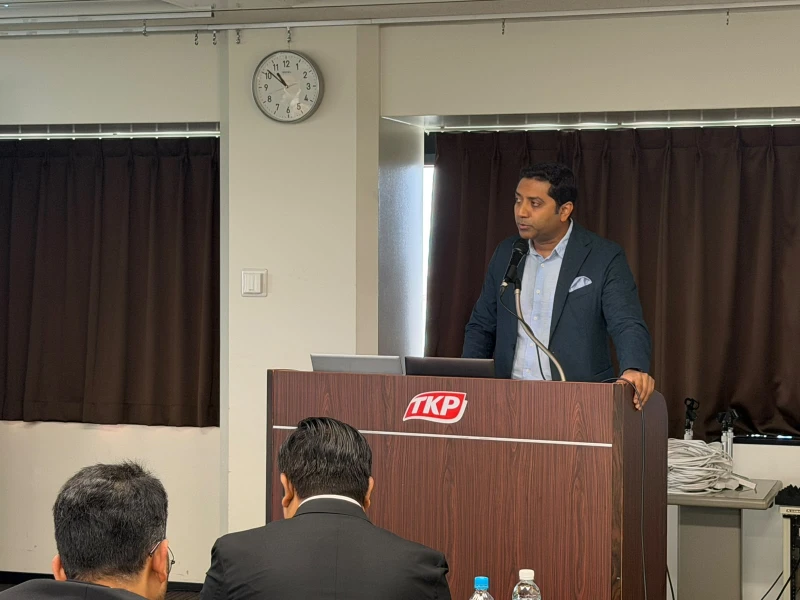
State Minister for Primary and Mass Education Bobby Hajjaj on Tuesday said Bangladesh's strategic geographic location at the junction of South Asia and ASEAN offers Japanese investors a unique opportunity, noting that investment in Bangladesh could give Japan access to a regional market of more than 3 billion consumers.
“Bangladesh is not just a promising investment destination but a strategic economic bridge between South Asia and ASEAN,” Bobby said while addressing the Bangladesh Investment Promotion Seminar in Osaka, jointly organised by the Japan External Trade Organization (JETRO), the Bangladesh Embassy in Japan, and the Osaka Chamber of Commerce and Industry.
The state minister said progress on the Economic Partnership Agreement (EPA) between Bangladesh and Japan, along with the establishment of a special economic zone for Japanese investors, would elevate bilateral economic ties to a new height.
He said these initiatives would play a groundbreaking role in expanding bilateral trade and investment and would ensure a more favourable environment for Japanese investors.
Referring to Japan's Meiji Restoration, Bobby described it as an exemplary case of national transformation through education, technology, industrialisation and visionary leadership, adding that Bangladesh wants to build its future economy by drawing on Japan's development experience through knowledge, technology, innovation, productivity and skilled human resource development.
He said Bangladesh's economy currently stands at more than $500 billion, having maintained growth above 6 percent for a long period and staying above 4.5 percent despite global economic challenges. “The government aims to elevate Bangladesh to a $1 trillion economy by 2034.”
The state minister said Bangladesh's biggest competitive strength lies in its workforce of more than 70 million young people.
He noted that with per capita income crossing $3,000, the domestic market is rapidly expanding and purchasing power is rising, creating new opportunities for foreign investors.
Bobby said bilateral trade between Bangladesh and Japan currently stands at around $3.5 billion, with both countries aiming to raise it to $10 billion in the coming years.
He identified machinery and light engineering, industrial components, automobile and electric vehicle (EV) parts, electronics, pharmaceuticals, API and medical equipment, diversified jute products, agro-processing, food security, cold-chain logistics, renewable energy, port and logistics infrastructure, industrial park development, robotics, education technology and skilled human resource development as promising sectors for Japanese investment.
He also pointed to the potential for partnership with organisations such as Artec in education technology and skills development.
Bobby said there is immense potential for cooperation between Bangladesh and Japan in education, skills development, healthcare and medical tourism. “Bangladesh's young, educated and skilled workforce can play a significant role in meeting Japan's growing labour shortage and the needs of its ageing population, creating scope for long-term partnership in skills development, technical training and employment between the two countries.”
The state minister thanked Japan, including JICA, for working for decades as one of Bangladesh's most trusted development partners in infrastructure, education, human resource development and economic progress through various bilateral initiatives.
Bangladesh and Japan are now entering a new era based on investment, trade, technology, innovation and shared prosperity, Bobby said, calling on Japanese businesses and investors to become long-term partners in Bangladesh's growth journey.
Investing in Bangladesh, he said, means not just entering one country's market but a strategic opportunity to access a vast regional market of more than 3 billion consumers.