
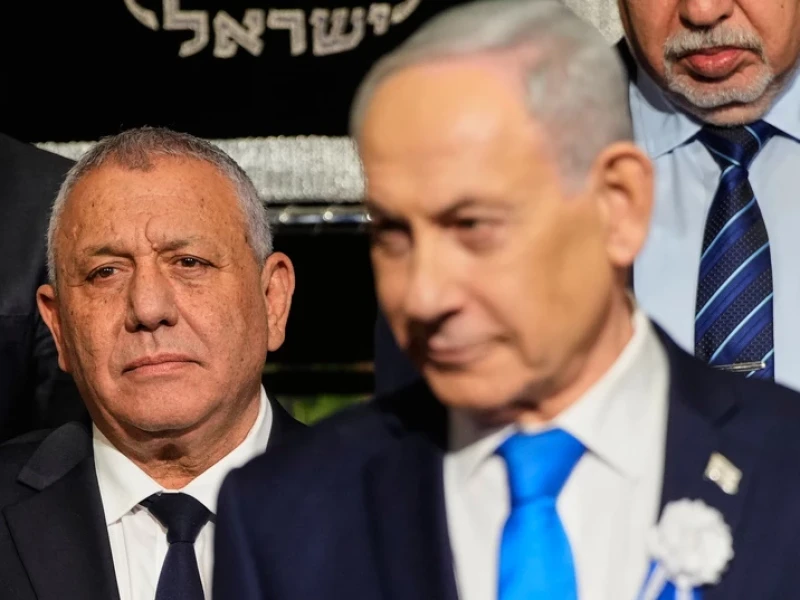
Gadi Eisenkot, the politician tasked with forming Israel's next government, has pledged to reverse several policies of Prime Minister Benjamin Netanyahu as the country's newly elected parliament was sworn in on Tuesday.
The pledge sets the stage for a crucial month of legislative initiatives and coalition negotiations. Eisenkot, a former military chief, has up to six weeks to form a government, potentially ending Netanyahu's tenure as Israel's longest-serving prime minister.
Although it remains uncertain whether Eisenkot can secure the support needed to form a coalition, Netanyahu's opponents now hold a clear majority in the new Knesset, allowing them to pursue legislation in the meantime.
At the opening of the parliamentary session, Eisenkot's bloc introduced several bills targeting Netanyahu and his policies. The proposed measures include establishing an official government inquiry into the Hamas-led October 7, 2023 attacks, introducing term limits for prime ministers and reversing changes made by Netanyahu's outgoing government to restrict the powers of the judiciary.
It was not immediately clear how quickly the proposals would advance or how far they would go in the coming weeks.
Competing calls for unity
Eisenkot, a former general who campaigned on a straightforward and pragmatic platform, reiterated on Tuesday that he wanted to form a government trusted by all Israelis rather than one representing only particular political groups.
"We will act for all citizens of Israel, those who voted for us and those who did not, out of deep commitment," he said ahead of the Knesset's swearing-in ceremony.
Netanyahu has sought to challenge the certified election results after his bloc failed to secure a parliamentary majority. He has repeatedly made unsubstantiated allegations that Arab-led parties "stole" the election.
Addressing parliament after the swearing-in ceremony, Netanyahu again questioned the reliability of Arab politicians, who represent about 20 percent of Israel's population. He also criticised Jewish opposition leaders who have indicated their willingness to work with Arab parties to form a government.
Eisenkot has not ruled out such an arrangement, provided the parties meet certain conditions, including recognising Israel as a Jewish state and declaring Hamas a terrorist organisation.
"I ask you: Are you prepared to be dependent on those whose goal is the destruction of the Jewish state?" Netanyahu said.
Eisenkot described Netanyahu's speech as "divisive" and "hate-filled", saying it had further strengthened his belief that Netanyahu was unfit to remain in office even for another minute.
He later announced that he had cancelled a meeting scheduled for Wednesday with Netanyahu's Likud party following the speech.
Opposition moves to advance legislative agenda
Eisenkot's bloc also initiated proceedings on Tuesday to replace the parliamentary speaker as it began pursuing its legislative priorities.
A majority of Knesset members submitted signatures seeking the removal of current speaker Amir Ohana, a Netanyahu ally, marking the first step towards a vote on his replacement. The process can move forward even before a new coalition government is formed.
The speaker holds considerable influence over parliamentary proceedings, including deciding which bills are taken up for consideration. An appointment from among Eisenkot's opposition allies could therefore help advance their legislative agenda.
The opposition has nominated Matan Kahana, a senior member of Eisenkot's Yashar party, for the position. A vote on his appointment could take place as early as this week.
Netanyahu remains caretaker prime minister
The swearing-in of the new Knesset has ushered in an unusual transitional phase in Israeli politics, with Netanyahu and his Cabinet continuing to govern while newly elected lawmakers begin introducing legislation.
Meanwhile, Eisenkot is expected to hold talks with political party leaders to assemble a coalition that could pave the way for him to become prime minister.
If he fails to form a government, Israeli President Isaac Herzog is expected to give Netanyahu another opportunity to secure the necessary support.
As caretaker prime minister, Netanyahu faces court-imposed restrictions on his authority. However, he can still make appointments and potentially seek to block new legislation. He retains full control over national security matters, including the military.
Netanyahu has called on Jewish-led parties to form a unity government, citing the threat of a possible Iranian attack. Renewing his appeal on Tuesday, he urged the parties to "set aside all other considerations" and said Israel should work to topple the Iranian government.
A new governing coalition without Netanyahu could leave him politically exposed as he faces an ongoing corruption trial and the possibility of investigations into security failures preceding the October 7 attacks.
 Prev Post :