
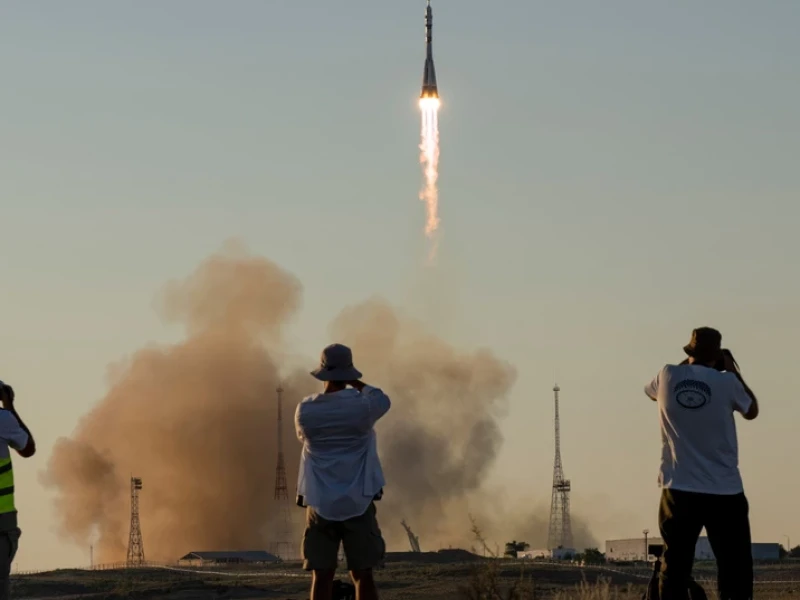
A joint U.S.-Russian crew arrived at the International Space Station (ISS) on Tuesday, hours after launching from the Russia-leased Baikonur Cosmodrome in Kazakhstan.
NASA astronaut Anil Menon and Russian cosmonauts Pyotr Dubrov and Anna Kikina lifted off as scheduled aboard the Roscosmos Soyuz MS-29 spacecraft at 7:47 pm local time (10:47 am EDT, 1447 GMT) for an eight-month mission aboard the orbiting laboratory.
The Soyuz spacecraft docked automatically with the ISS about three hours after launch.
NASA Administrator Jared Isaacman attended the launch, marking the first visit by a NASA chief to Baikonur in eight years. The visit underscored continued cooperation between Washington and Moscow in space despite tensions over Russia's military action in Ukraine.
Ahead of the launch, Isaacman met Roscosmos chief Dmitry Bakanov. During a meeting with the crew on Monday, he thanked the Russian space agency for its efforts in preparing the mission, saying the work carried out over the past several months reflected the professionalism and dedication of everyone involved.
Isaacman also met Russian Deputy Prime Minister Denis Manturov. According to Manturov's office, the two discussed future cooperation on the International Space Station and other space projects.
The mission marks Menon's first journey into space, while Dubrov and Kikina are each making their second spaceflight.
The three newcomers will join NASA astronauts Jessica Meir, Jack Hathaway and Chris Williams, European Space Agency astronaut Sophie Adenot, and Roscosmos cosmonauts Sergei Kud-Sverchkov, Sergei Mikaev and Andrei Fedyaev aboard the station.
Although the United States and Russia were fierce rivals during the Cold War space race, they have continued to cooperate on the ISS and other space projects. That partnership has come under strain since Russia launched its military operation in Ukraine in 2022, but both countries have maintained crew exchange missions using each other's spacecraft.
However, broader cooperation has stalled. Plans for possible Russian participation in NASA's Artemis lunar exploration programme have been shelved, while Roscosmos has expanded cooperation with China on a planned lunar mission as Russia has become increasingly dependent on Beijing for technology imports and energy exports amid Western sanctions.
 Prev Post :