
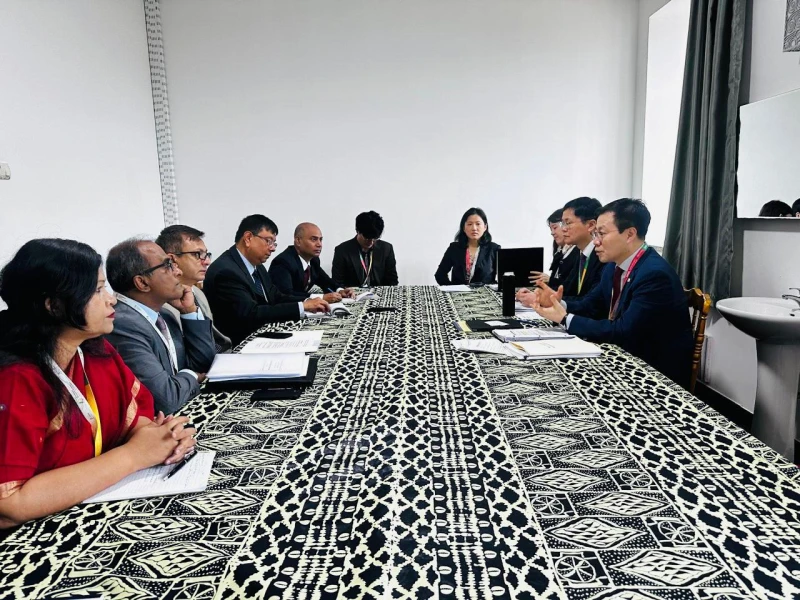
South Korea has expressed strong interest in continuing discussions on investment and a Free Trade Agreement (FTA) with Bangladesh, underscoring the potential for deeper economic engagement between the two countries.
The interest was conveyed by South Korean Trade Minister Yeo Han-koo during a bilateral meeting held on the sidelines of the 14th Ministerial Conference (MC14) of the World Trade Organization.
Bangladesh Commerce Minister Khandakar Abdul Muktadir led the Bangladesh delegation at the meeting, accompanied by Commerce Secretary Mahbubur Rahman and other senior officials. The South Korean delegation was headed by its Trade Minister.
During the meeting, the Bangladesh Commerce Minister highlighted that a new government was formed in February through a participatory and credible election, now led by Prime Minister Tarique Rahman, outlined the government’s forward-looking trade policy, including strategies for market diversification, exploration of new export destinations, and ongoing negotiations on FTAs and Economic Partnership Agreements (EPAs) with various countries in the context of Bangladesh’s graduation from the Least Developed Country (LDC) status.
The minister that Bangladesh has already concluded an EPA with Japan and is currently engaged in negotiations with countries including South Korea and Singapore on FTAs and Comprehensive Economic Partnership Agreements (CEPAs).
The minister also reiterated Bangladesh’s interest in joining the Regional Comprehensive Economic Partnership, citing the country’s strategic location and large consumer market as key advantages that could benefit both nations.
Referring to the success of South Korean investments in Bangladesh, particularly in the ready-made garment (RMG) sector, Muktadir encouraged Korean investors to expand their footprint further, assuring that Bangladesh continues to ensure a business-friendly environment for foreign investors.
Congratulating Bangladesh’s newly formed government, the South Korean Trade Minister recalled the long-standing bilateral relations and described Bangladesh as a promising and dynamic economy.
He emphasized the importance of enhancing trade cooperation and expressed his intention to visit Bangladesh soon.
He also voiced optimism about advancing ongoing FTA discussions and suggested that Bangladesh’s EPA with Japan could serve as an effective model for future agreements.
Noting that the current volume of bilateral trade remains below its potential, the Korean minister stressed that expanding cooperation in sectors such as shipbuilding, steel, manufacturing and investment could significantly boost trade flows, particularly highlighted interest in expanding investments in Bangladesh’s export-oriented industries.
Both sides agreed on maintaining regular engagement at ministerial and expert levels to ensure tangible progress in ongoing discussions.
The meeting concluded with both countries reaffirming their commitment to strengthening bilateral ties and working together towards a mutually beneficial trade and investment partnership.
 Prev Post :