
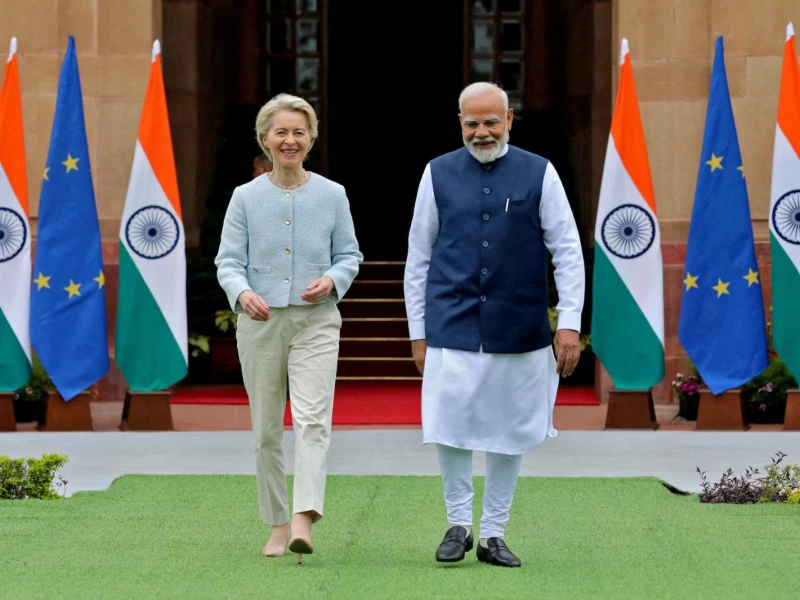
European Council President Antonio Luis Santos da Costa and European Commission President Ursula von der Leyen will be chief guests at India’s Republic Day celebrations next Monday, with advancing a free trade pact topping their agenda.
The high-profile visit comes as India seeks to diversify strategic and trade ties amid tensions with the United States over Washington’s 50% tariffs. Analysts say the EU-India deal, potentially announced as early as 27 January, underscores Delhi’s commitment to a multipolar foreign policy.
The agreement, described by von der Leyen and India’s Trade Minister Piyush Goyal as the “mother of all deals,” would be India’s ninth free trade pact in four years, following agreements with the UK, Oman, and New Zealand. For the EU, it follows deals with Mercosur, Japan, South Korea, and Vietnam.
“The deal aims to create reliable trade partnerships, helping India offset US tariff pressures while reducing EU dependence on China,” said Sumedha Dasgupta, senior analyst at the Economist Intelligence Unit.
Closer trade ties with India hold strategic significance for the EU, whose bloc stands to benefit from a free market of two billion people accounting for a quarter of global GDP. For India, the pact would restore lost market access under the Generalised System of Preferences (GSP), benefiting exports of garments, pharmaceuticals, steel, petroleum products, and machinery.
Sensitive sectors such as agriculture and dairy are expected to remain protected, while tariffs on cars, wine, and spirits could be phased down, mirroring India’s approach in previous deals, analysts noted.
Key issues remain, including intellectual property protection for Europe and India’s concerns over the EU’s Carbon Border Adjustment Mechanism (CBAM), which could impose additional costs on exporters, particularly MSMEs.
Experts say the deal could strengthen trade decoupling from the US and other “unreliable partners,” reducing vulnerabilities to tariffs, export controls, and supply chain disruptions. India’s reduction in Russian crude imports from November 2025 may also ease European approval of the agreement.
 Prev Post :