
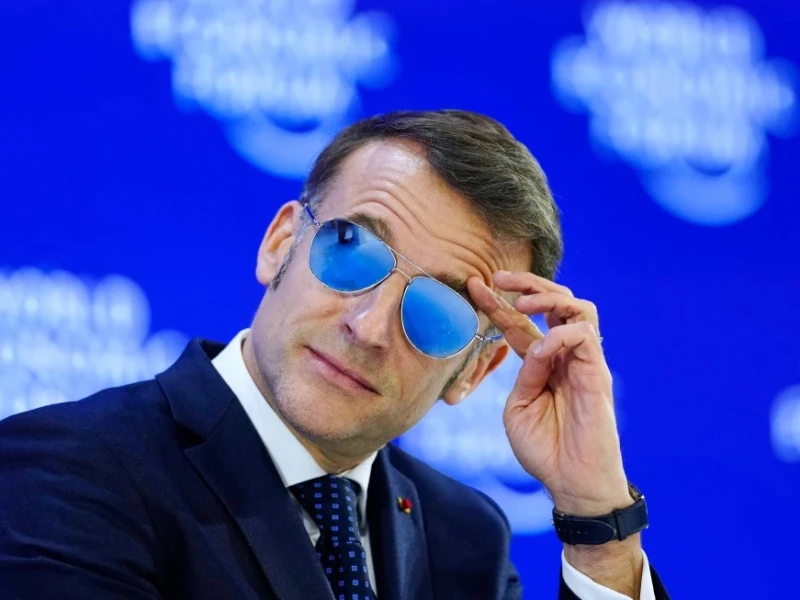
A pair of reflective sunglasses worn by French President Emmanuel Macron at the World Economic Forum in Davos has turned an otherwise routine appearance into a global talking point—blending politics, personal health and visual symbolism in the digital age.
Macron wore the aviator-style shades to conceal what his office described as a benign medical issue affecting his right eye. The choice, however, quickly transcended medical necessity, dominating news feeds, inspiring memes and even prompting a jibe from former US President Donald Trump.
“Those beautiful sunglasses,” Trump remarked during his Davos address. “What the hell happened?”
The eyewear was identified as the Pacific S 01 model by French luxury manufacturer Henry Jullien, retailing at 659 euros (about US$775). Macron purchased the glasses in 2024 after confirming they were French-made, according to the company’s Italian parent, iVision Tech SpA.
The exposure proved commercially significant. Henry Jullien reported an exceptional surge in website traffic following Macron’s appearance, while iVision Tech’s share price jumped sharply on the Milan stock exchange in the days after the Davos speech.
“It’s been a crazy week,” said iVision CEO Stefano Fulchir, calling the moment “an honor” for the brand. He said demand was so intense that the company struggled to respond to all enquiries.
Beyond commerce, the episode reignited debate over political image-making. Wearing sunglasses indoors is an uncommon—and risky—choice for elected leaders, who typically seek openness and relatability. Yet some analysts said Macron carried it off with confidence.
“He looked young, in control and visually striking,” said Cristina Archetti, a political communication scholar at the University of Oslo, noting how the blue-tinted lenses complemented the Davos backdrop. She added that such imagery resonates strongly in a media environment driven by visuals.
Others cautioned that sunglasses can signal detachment or concealment—traits politicians generally avoid. “They’re usually about connection,” said Marco Bohr of Nottingham Trent University. “Sunglasses suggest distance, which is why this stood out.”
Historically, shades have appeared in politics only sparingly—often justified by bright sunlight, health reasons or cultural context. Without such explanations, observers say, they risk raising suspicion or misinterpretation.
In a Davos meeting otherwise overshadowed by geopolitical tensions and transatlantic friction, Macron’s sunglasses have endured as a lasting symbol—of authority, control and the evolving theatre of political communication.
As Bohr observed, Macron had other options. “An eye patch would have signified something else entirely. Ray-Bans might suggest jazz and rebellion,” he said. “But aviators speak of pilots—of command, of being in control.”
In Davos, that message proved unmistakable.
 Prev Post :