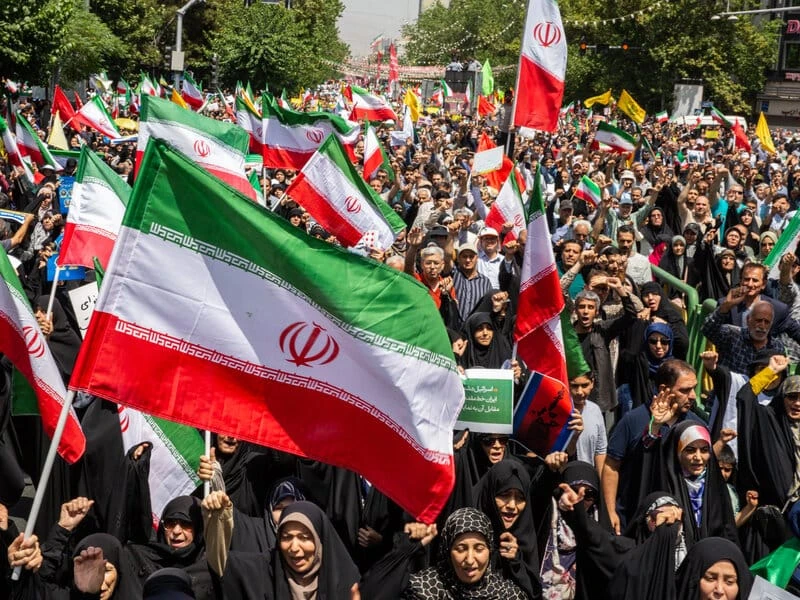
Large crowds of protesters marched through Iran’s capital Tehran and several other major cities on Thursday evening, marking what observers describe as the biggest show of force by opponents of the clerical establishment in years, according to verified videos and rights groups.
Footage verified by BBC Persian showed peaceful demonstrations in Tehran and the northeastern city of Mashhad, where protesters were not immediately dispersed by security forces. Later in the night, internet monitoring groups reported a nationwide internet blackout, further restricting the flow of information from the country.
In the videos, protesters were heard chanting slogans calling for the overthrow of Supreme Leader Ayatollah Ali Khamenei and the return of Reza Pahlavi, the exiled son of Iran’s last shah, who had urged supporters to take to the streets.
The demonstrations marked the 12th consecutive day of unrest, triggered by public anger over the collapse of the Iranian currency. According to human rights groups, protests have now spread to more than 100 cities and towns across all 31 provinces.
The US-based Human Rights Activist News Agency (HRANA) reported that at least 34 protesters, including five children, and eight members of the security forces have been killed so far, with more than 2,270 protesters arrested. Norway-based Iran Human Rights (IHR) put the death toll higher, saying at least 45 protesters, including eight children, were killed by security forces.
BBC Persian has independently confirmed the identities of 22 people killed, while Iranian authorities have acknowledged the deaths of six security personnel.
The unrest is widely seen as the most significant since the 2009 protests that followed a disputed presidential election, when millions took to the streets and dozens were killed in a violent crackdown.
Videos from Thursday evening showed a large crowd marching along a major road in Mashhad, chanting slogans such as “Long live the shah” and “This is the final battle! Pahlavi will return.” In one clip, several men were seen climbing an overpass and dismantling what appeared to be surveillance cameras.
Similar scenes were reported in eastern and northern Tehran, as well as in cities including Isfahan, Babol, Tabriz and Dezful. In Dezful, footage showed security forces apparently opening fire from a central square.
International media outlets, including the BBC, are barred from reporting inside Iran, making social media footage a key source of information, which is verified where possible.
The evening protests followed a renewed call by Reza Pahlavi, who lives in exile in Washington, DC, urging Iranians to “take to the streets and shout your demands as a united front.” In a post on X, he claimed “millions of Iranians demanded their freedom tonight” and called on European leaders to hold Iran’s leadership accountable.
Iranian state media downplayed the scale of the unrest, in some cases denying protests had taken place and broadcasting footage of empty streets.
Meanwhile, internet watchdog NetBlocks said its data indicated Iran was “in the midst of a nationwide internet blackout,” warning that escalating digital censorship was hindering public communication at a critical moment.
The unrest has also been accompanied by strikes in predominantly Kurdish regions, following calls by exiled opposition groups. Kurdish human rights organisation Hengaw reported that at least 17 protesters have been killed in the western provinces of Ilam, Kermanshah and Lorestan, many of them from ethnic minority communities.
Wednesday was described by IHR as the deadliest day so far, with at least 13 protesters killed nationwide amid violent clashes between demonstrators and security forces.
International reactions have intensified. US President Donald Trump reiterated a warning of possible military action if Iranian authorities killed protesters, while US Treasury Secretary Scott Bessent said Iran’s economy was “on the ropes.”
Iranian President Masoud Pezeshkian earlier urged security forces to exercise “utmost restraint” in dealing with peaceful protests, though Supreme Leader Khamenei has warned that “rioters should be put in their place.”
The protests began on December 28, when shopkeepers in Tehran demonstrated against a sharp fall in the value of the rial. The currency has hit record lows amid soaring inflation, estimated at around 40%, as sanctions over Iran’s nuclear programme combine with economic mismanagement and corruption.
The current wave of demonstrations is the most widespread since the 2022 uprising triggered by the death in custody of Mahsa Amini, during which more than 550 people were killed and some 20,000 detained, according to rights groups.
 Prev Post :