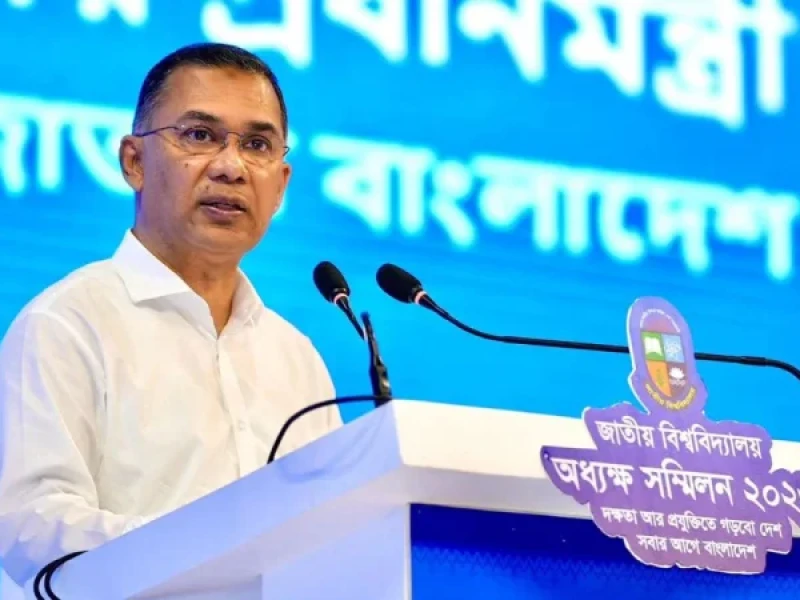
Prime Minister Tarique Rahman on Saturday called for transforming the country's higher education system into a modern, technology-driven, innovation-oriented and skills-based system to prepare students for the challenges of the Fourth Industrial Revolution.
He said conventional education methods must give way to an employment-oriented approach that combines academic knowledge with practical and technical skills, research, innovation and industry experience.
“Unless teachers and students can adapt themselves to modern and technology-driven education, the number of certificate-holding educated people will continue to rise every year, but unemployment will not decline,” he said.
The Prime Minister was addressing the National University Principals' Conference 2026 as the chief guest at the Shaheed Suhrawardy Indoor Stadium in Mirpur, Dhaka.
More than 2,300 principals of colleges affiliated with the National University attended the conference.
In his written speech, Tarique Rahman said a college principal was not merely the administrative head of an institution but also its leader, moral guide and centre of academic leadership. Principals played a vital role in shaping the future generation, while their competence, judgement, decisions and foresight significantly influenced students' prospects.
He paid tribute to the principals and teachers for their contributions to spreading the light of education across the country.
The Prime Minister recalled that former Prime Minister Begum Khaleda Zia had established the National University on October 21, 1992, to expand access to higher education for people in both urban and rural areas.
He said the number of affiliated colleges had now reached nearly 2,500, significantly expanding access to higher education and increasing student enrolment.
However, he questioned whether the quality of education had improved at the same pace as the growth in the number of institutions and students.
Referring to the damage caused to the country's education system during the period of fascism, he said it was now imperative for everyone to work together to rebuild and modernise the education sector in a fascism-free Bangladesh.
The government had undertaken initiatives to reform the education system and make it more relevant to contemporary needs, he said, adding that college principals would have to take the lead in implementing these reforms at the institutional level.
Emphasising teacher training, the Prime Minister said stronger links between teachers and modern, technology-based education were essential. He suggested introducing student-centred and research-based teaching methods in place of conventional teacher-centred approaches.
In this regard, he said, a 'Train the Trainer' programme could play an effective role.
He observed that a lack of practical and technical knowledge alongside academic qualifications was one of the major reasons behind the high rate of unemployment among educated people.
Noting that the world had already entered the era of the Fourth Industrial Revolution even though nearly half of the global population had yet to enjoy the benefits of the Third Industrial Revolution, he said higher education institutions had no alternative but to move beyond conventional teaching methods.
Artificial intelligence, robotics, big data, the Internet of Things, blockchain, automation, genetic engineering, biotechnology, cybersecurity and fifth-generation wireless technology were rapidly transforming the future world of work, he said.
While such technologies were making some traditional professions obsolete and contributing to unemployment, they were also creating new employment opportunities and professional fields, he added.
The Prime Minister said education provided people with strength, while clearly defined goals transformed that strength into success.
He stressed that the real value of education lay in converting acquired knowledge into practical skills relevant to the workplace.
For this reason, he described industry-academia collaboration as indispensable for translating the potential of education into professional competence.
He said educational institutions should provide the foundation of knowledge, industries should help transform that knowledge into practical skills, and students should emerge as future innovators, entrepreneurs and driving forces of economic development.
Classrooms should become centres of knowledge creation and innovation, laboratories should open up new possibilities through research, and industrial establishments should serve as practical training grounds for students, he said.
The Prime Minister urged college principals and university vice-chancellors to consider engaging skilled and experienced professionals from different industries as guest teachers to provide students with practical insights into their respective fields.
He also called on industrial entrepreneurs to offer students opportunities for internships, industrial attachments and hands-on workplace training.
Such opportunities would enable students to develop goal-oriented professional skills and gain practical experience while still studying, he said.
This, in turn, could help them become entrepreneurs and create employment opportunities for others rather than simply waiting for jobs after completing their education.
Tarique Rahman also emphasised the need to combine technological competence with humanistic education and ethical values.
He said the ultimate success of education should not be confined to preparing students for employment. Literature, philosophy, history, science, sociology and cultural activities were equally important for developing human values, creativity, reasoning and leadership qualities among students.
Highlighting the importance of foreign language proficiency, he urged colleges to create opportunities for students to learn English as a global means of communication, alongside other internationally sought-after languages, including Arabic, Mandarin, Japanese, Korean, French, German and Italian.
He also called for expanding career counselling, internships, skills development programmes, language clubs and entrepreneurship opportunities at every college affiliated with the National University.
The Prime Minister said the government was equally conscious of protecting the interests of educational institutions and teachers while modernising the education system.
He urged the Ministry of Education to take coordinated initiatives involving the Directorate of Secondary and Higher Education, the Non-Government Teachers' Registration and Certification Authority (NTRCA), the National University and other relevant authorities to assess teacher shortages at individual colleges, fill vacant posts, recruit and deploy necessary teachers, and strengthen teacher training and professional development.
He said protecting the interests of educational institutions and teachers was essential to achieving the desired goals in education.
Drawing attention to two other issues, the Prime Minister called on colleges with suitable rooftops to take initiatives to install solar power systems in line with the government's emphasis on rooftop solar energy.
He also urged teachers and students to maintain cleanliness not only on their campuses but also in their homes and surrounding neighbourhoods.
Calling for educational institutions to remain free from factionalism, group conflicts, personal interests and unnecessary disputes, he said differences in political opinions and beliefs were natural in a democratic society.
However, such differences must never disrupt the academic environment, teaching activities, administrative discipline or the safety of students, he said.
The Prime Minister also urged college authorities to remain particularly attentive to the interests of financially disadvantaged students, those from marginalised communities and students with special needs.
He said the government wanted to build a Bangladesh enriched by knowledge and excellence, self-reliant through hard work, firmly rooted in humanity and capable of standing tall on the global stage with dignity.
Tarique Rahman wished success to the National University's 'One Student One Tree' programme, undertaken as part of its tree plantation initiative, and once again expressed his sincere respect for the teachers.
 Prev Post :