
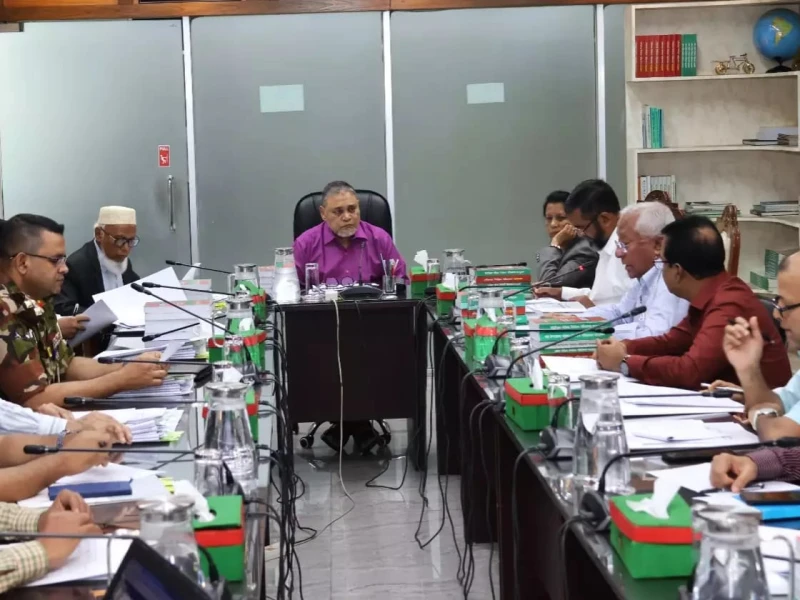
The Election Commission (EC) has finalised recommendations to amend relevant laws so that armed forces can be legally deployed in all local government elections, mirroring the provision that exists for national parliamentary polls.
The commission also finalised proposals to bar dual citizens and MPO-listed (Monthly Pay Order) teachers of educational institutions from contesting local government elections, EC Secretary Akhter Ahmed told reporters after a marathon meeting at the EC's Agargaon office on Tuesday.
The meeting, chaired by Chief Election Commissioner AMM Nasir Uddin, focused on amendments to laws and rules governing union parishad, municipality, upazila and city corporation elections. Election Commissioners Abdur Rahmanel Masud, Tahmida Ahmed, Anwarul Islam Sarkar and Abul Fazal Md Sanaullah also attended.
The EC will now send its recommendations to the ministry concerned, though it will be up to the government to decide whether to act on them. If accepted, the amendments would need cabinet approval before being passed as bills in parliament.
Akhter said the commission has recommended including the armed forces within the definition of law enforcement agencies across all local government laws. While the existing Union Parishad and Municipality Acts of 2009 already include the "defence department" under the definition of law enforcement agencies, the same is now being proposed for the Upazila Parishad and City Corporation Acts.
EC officials said having the armed forces defined within the law removes the need for separate orders to assign the three services election duties, and allows military personnel to perform duties at polling centres alongside police, including powers of arrest without warrant.
On the eligibility of MPO-listed teachers, Akhter said the commission believes such teachers should be barred from contesting local elections, since current law does not disqualify them. The EC has finalised a recommendation to add this as a disqualification criterion.
The commission will also propose declaring dual citizens ineligible to contest local government elections. While dual citizens are currently barred from parliamentary elections, no such bar exists for local polls. The EC favours barring dual citizens from contesting at all levels of local government institutions except union parishad member posts.
Akhter said the commission has agreed in principle to disqualify loan guarantors along with loan defaulters, and to treat unpaid utility bills, for electricity, land tax, or WASA services, whether personal or institutional, as grounds for disqualification. Candidates holding a profit-making post will also be barred from contesting.
According to meeting sources, the EC has decided that no one holding the post of administrator in a city corporation can contest elections without first resigning. The commission will also recommend disqualifying individuals charge-sheeted by the International Crimes Tribunal (ICT) from contesting elections.
Separately, the commission discussed amendments related to National Identity Card (NID) correction and renewal. Ahmed said applications for transferring voter areas will be allowed online, with a revised fee to be set for such transfers.
On NID renewal, currently required every 15 years under existing law, Akhter said the commission discussed introducing a dedicated renewal form that would include a "family tree," requiring applicants to provide family information to help the EC maintain consistency, along with a minimum fee.
The EC secretary added that the EC currently collects data and issues NIDs to those aged 16, and will further review at what educational stage: SSC, eighth grade, or primary school admission, this data collection age could be lowered.
 Prev Post :