
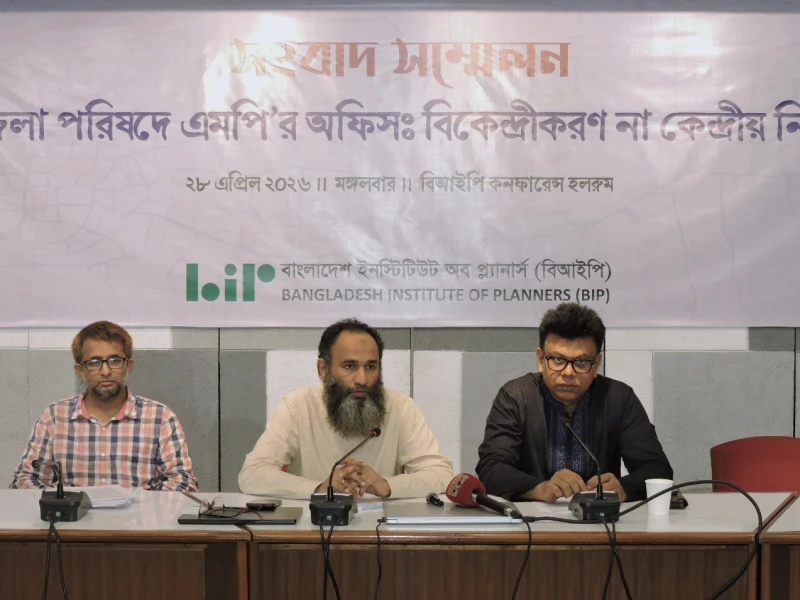
The Bangladesh Institute of Planners (BIP) on Tuesday cautioned that establishing parliamentary members' offices within upazila parishads would further erode local governance structures, calling instead for a clear constitutional demarcation between legislative and executive functions at the grassroots level.
The warning came at a press conference held at BIP Conference Hall in Planners Tower, titled "MP Offices in Upazila Parishad: Decentralisation or Central Control?", convened in response to a government proposal currently before parliament to set up 'inspection rooms' for Members of Parliament within upazila parishad premises.
Presenting the keynote paper, BIP Vice-President-1 Planner Shaikh Muhammad Mehedi Ahsan said the institute's position was non-partisan and addressed a fundamental policy question concerning state structure, local governance and democratic standards. "Our position is clear, we are neither for nor against any individual or political party. We are raising a question of national importance about the architecture of the state."
Mehedi argued that development planning is inherently tied to local realities, and centralising decision-making authority invariably renders plans ineffective, reducing them in many instances to paper exercises.
Drawing on past experience, he noted that the direct involvement of MPs in development activities has historically blurred the boundary between the legislature and the executive, weakening accountability, compromising administrative neutrality and eroding the institutional capacity of local government bodies.
He further warned that the presence of politically opposed actors such as a ruling-party upazila chairman alongside an opposition MP, or vice versa could create a condition of "dual leadership" at the local level, breeding coordination failures, delays and conflict, with ordinary citizens bearing the cost.
"An MP's core function is legislation. Local government's function is to plan and implement development activities. A clear boundary between the two is indispensable," Mehedi said, adding that deploying professional planners at the upazila level would structurally strengthen the parishad, since the absence of integrated, scientific planning remained the foremost barrier to effective local development.
In his closing remarks, BIP Secretary General Planner Prof. Md. Musleh Uddin Hasan, underscored the need for a well-defined understanding of the roles and jurisdictions of upazila, district and municipal councils.
He noted that the resolution of persistent urban challenges: footpath encroachment, inadequate public transport, waterlogging and unplanned development depended squarely on the functional capacity of local government.
Musleh proposed the formation of "Local Parliaments" at the divisional level, where MPs and relevant representatives could jointly deliberate on problems and solutions, and reiterated the urgency of appointing a professional planner at every upazila.
He also cautioned that the existing power friction between the Upazila Nirbahi Officer (UNO) and the upazila parishad chairman would be further aggravated by the introduction of an MP's office within the same institutional space.
BIP Recommendations
On the proposed MP office arrangement, BIP recommended that while MPs may maintain offices, these must not be housed within local government institutions.
Separate constituency offices at the upazila or district level, or initially through virtual platforms should be established instead. MPs' roles must be confined to policymaking and oversight, and the institutionalisation of central or political influence over local government must be firmly avoided.
On strengthening upazila governance and planned development, the institute called for, among other measures: immediate conduct of local council elections to restore elected leadership; conferring full decision-making authority upon upazila parishads as genuine local governance bodies; mandatory integrated spatial planning at the upazila level.
Linking upazila plans to district and national frameworks under BIP's proposed three-tier planning management system; ensuring independent budgets and fiscal autonomy for upazila parishads; curtailing central administrative control and restricting UNOs to a coordinatory role; and forming an all-party parliamentary committee to reassess the Local Government Commission 2025 report incorporating professional planners and subject-matter experts with a view to implementing meaningful modernisation of the local government system.
 Prev Post :