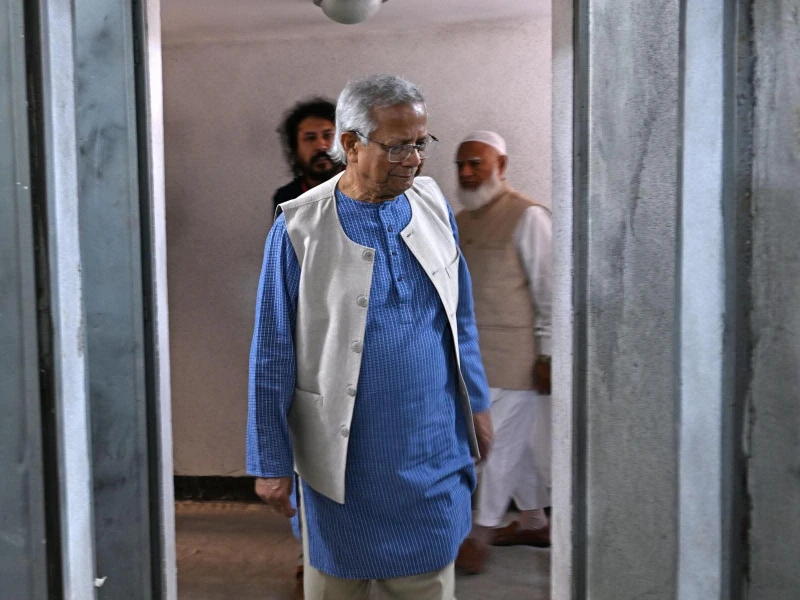
Chief Adviser Professor Muhammad Yunus on Tuesday afternoon visited the July Mass Uprising Memorial Museum at Ganabhaban to review the progress of its final-stage works.
The Chief Adviser arrived at the museum around 3:00pm and toured various sections showcasing the background of the July mass uprising and visual documentation of what he described as the 16 years of authoritarian rule under Sheikh Hasina.
Among those present during the visit were BNP Standing Committee member Salahuddin Ahmed, Bangladesh Jamaat-e-Islami Ameer Dr Shafiqur Rahman, and National Citizen Party (NCP) Convener Nahid Islam.
Advisers accompanying the Chief Adviser included Cultural Affairs Adviser Mostofa Sarwar Farooki, Law Adviser Dr Asif Nazrul, Housing and Public Works Adviser Adilur Rahman Khan, Home Affairs Adviser Jahangir Alam, Health Adviser Nurjahan Begum, National Security Adviser Dr Khalilur Rahman, Chief Adviser’s SDG Coordinator Lamia Morshed, and Housing and Public Works Ministry Secretary Md Nazrul Islam.
Also present were Sanjida Tuli, coordinator of Mayer Daak, an organisation representing families of enforced disappearance victims, Barrister Mir Ahmad Bin Qasem Arman, who returned after being forcibly disappeared, and student leaders Asif Mahmud Sajib Bhuiyan and Hasnat Abdullah, who played frontline roles during the July uprising.
Under the guidance of Cultural Affairs Adviser Mostofa Sarwar Farooki, museum curator Tanjim Wahab, architect Marina Tabassum Khan, researchers and other officials guided the visitors through the entire museum.
The July Memorial Museum houses photographs of the uprising, various memorabilia, clothing worn by martyrs, letters, important documents, newspaper clippings from the period, and audio-visual materials. It also preserves footage depicting former Prime Minister Sheikh Hasina’s departure from the country.
During the visit, Professor Yunus watched a 15-minute documentary produced by the Ministry of Cultural Affairs, highlighting enforced disappearances, state-sponsored repression, attacks on political opponents, and the mass killings that took place during the July 2024 uprising.
Describing the museum as unprecedented, the Chief Adviser said, “This museum was established while the blood of the July martyrs is still fresh. This is a rare example for the entire world.”
“We do not want a future where such museums need to be built again anywhere. If the nation ever loses its way, this museum will help it rediscover direction,” he said.
Professor Yunus urged citizens, particularly students, to visit the museum in groups and spend time there to understand the brutality the nation endured.
He also referred to the reconstructed detention cells, commonly known as Aynaghar, saying visitors should be allowed to stay there for hours or even a full day to truly grasp the inhuman conditions faced by detainees.
“Sitting inside these cells, people will realise the cruelty the prisoners went through. From this experience, we must unite around one resolve—that our nation must never return to such dark days,” he said.
Highlighting the role of young people, the Chief Adviser said the uprising demonstrated how unarmed students and ordinary citizens courageously stood up to armed repression. “That is our greatest lesson,” he added.
He thanked Cultural Affairs Adviser Mostofa Sarwar Farooki and all those involved in the museum’s development for their efforts.
Speaking on the occasion, Farooki said completing the museum to this stage in such a short time was a record. “Many young people worked tirelessly, some without any remuneration for eight months. I am deeply grateful to them all,” he said.
He noted that work on several additional sections would be completed soon and the museum would be opened to the public before the next election.
“The July Memorial Museum will stand as a historical marker—an anchor of Bangladesh’s past, present and future politics. It will play a vital role in future political discourse, education, research, and cultural and literary practices,” Farooki added.
 Prev Post :