
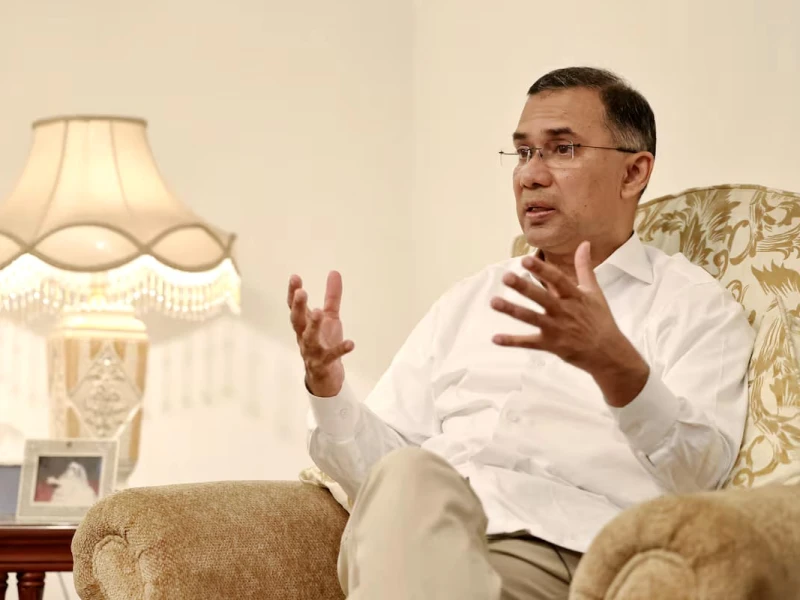
Bangladesh Nationalist Party (BNP) acting chairman Tarique Rahman on Friday rejected a proposal for forming a post-election unity government, saying his party is confident of securing enough seats to form a government on its own after next week’s national election.
Speaking in an interview at the BNP’s central office, Rahman said governing with political rivals would undermine the role of the opposition in parliament.
“How can I form a government with my political opponents, and then who would be in the opposition?” he said. “I don't know what will be their seat number, but if they are in the opposition, I hope to have them as a good opposition.”
Rahman, 60, returned to Bangladesh in December after nearly two decades in exile in London, following a youth-led uprising that toppled former prime minister Sheikh Hasina in 2024. Hasina, a long-time political rival and daughter of Bangladesh’s founding leader, fled to India in August last year and remains there.
The BNP’s main rival in the February 12 election is Jamaat-e-Islami, which was previously banned but has re-emerged as a major political force. The two parties governed together between 2001 and 2006.
Jamaat leaders have said they are open to renewing cooperation through a unity government to help stabilise the country, particularly after prolonged political unrest disrupted Bangladesh’s garment industry in 2024.
Bangladesh has been governed by an interim administration since Hasina’s departure.
Rahman declined to specify how many seats the BNP expects to win but said the party was confident of securing a clear majority.
“We are confident that we’ll have enough to form a government,” he said.
BNP aides said the party expects to win more than two-thirds of the 300 parliamentary seats. The BNP is contesting 292 seats, with allied parties competing for the remainder.
Opinion polls have consistently forecast a BNP victory, although they also indicate strong competition from a Jamaat-led alliance that includes a Gen-Z-backed party formed during the anti-Hasina protests.
Foreign Policy and Regional Relations
Relations between Bangladesh and India have remained strained since New Delhi granted refuge to Hasina, who was sentenced to death by a Dhaka court last year over her role in the crackdown on protests. The situation has also opened space for China to expand its political and economic engagement with Bangladesh.
Asked whether a BNP government would shift away from India towards China, Rahman said his priority would be economic growth and job creation.
“If we are in the government, we need to provide jobs for young people,” he said. “We need to bring businesses into the country so that people can have a better life.”
“So whoever, while protecting the interests and sovereignty of Bangladesh, offers what is suitable for my people and my country, we will have friendship with them—not with any particular country,” he added.
On whether members of Hasina’s family could return and re-enter politics, Rahman said political participation should be decided by public acceptance.
“If someone is accepted by the people, if people welcome them, then anyone has the right to do politics,” he said.
Hasina’s Awami League is barred from contesting the election, with many of its senior leaders currently abroad.
Rohingya Issue
Bangladesh currently hosts nearly 1.2 million Rohingya refugees who fled persecution in neighbouring Myanmar. The interim government has said it lacks the resources to support additional refugees and has urged the international community to facilitate repatriation.
Rahman said the BNP also supports the return of Rohingyas, but only when it is safe.
“We will try to work on the issue so that these people can go back to their own land,” he said. “The situation has to be safe for them to go back there. As long as it is not safe, they are very welcome to stay here.”
 Prev Post :