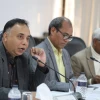
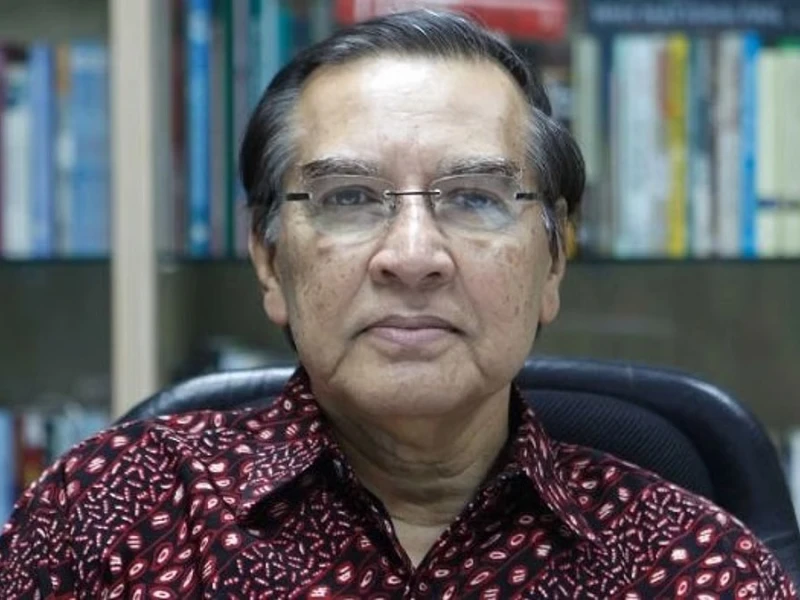
The importance of personal self-filtering and strong institutional editorial control to ensure objective journalism and responsible freedom of expression in Bangladesh was emphasised on Sunday by The Daily Star Editor Mahfuz Anam.
Speaking at the Prof Sitara Parveen Award Ceremony–2026 at Dhaka University, Mahjfuz argued that while the expansion of expression platforms—particularly social media—has democratised speech, it has also introduced new perils. Without individual "self-filtering" and professional editorial control, he warned, this freedom can become dangerous.
“For much of civilisation, attempts were made to curb free expression. Over the past 50 years the space has widened, and in recent decades social media has made it even easier,” Mahfuz said. “Where expression is effortless, the absence of self-filtering by individuals and editorial control by news organisations can be perilous.”
Emphasising self-filtering in individual expression, Mahfuz noted that social media allows anyone to instantly reach large audiences—unlike earlier times when letters to editors were selectively published. “Before you speak, you must consider whether your words stem from personal hatred or an intent to harm. If opinions are not well thought out or evidence-based, they distort facts. Content driven by anger and spread online is not free expression—it is hate speech, which harms society.”
On institutional journalism, Mahfuz said the editor bears the primary responsibility for preventing bias in news reports. “An editor must not compromise ethics. If an editor feels unable to uphold principles, resignation is the better option.”
He stressed that editors should not publish reports unquestioningly. “Especially in reports involving individuals or institutions, editors must demand multiple pieces of evidence and remain alert to a reporter’s potential bias. Only through necessary corrections and verification can a report be truly objective.”
Addressing media philosophy, Mahfuz said a news organisation may hold a political philosophy, but it must disclose it transparently, allowing audiences to decide whether to trust its content. “Neutrality, however, is the highest ideal,” he said, adding that neutral outlets are best positioned to practise independent journalism. Citing Fox News, he said audiences are aware of its political stance, whereas a neutral outlet’s core mission should be public service and delivering accurate information.
Describing journalists as “social doctors,” Mahfuz said their role is not to highlight only positive developments but to diagnose and expose societal problems. “People go to doctors not to be told they look fine, but to know what is wrong. Journalists must reveal society’s ailments to the public and the government.”
He identified the judiciary, parliament and the media as the three pillars that hold governments accountable, noting that in Bangladesh, the media has played the most effective role. “Those in power—party colleagues, bureaucrats, intelligence—do not tell governments the truth. Journalists do.”
Mahfuz also stressed the need for financial sustainability for independent journalism. “If a media house depends on shareholders to pay salaries, those shareholders will seek to advance their interests through the outlet,” he said, adding that financial self-reliance is essential to safeguard editorial independence.
Highlighting journalists’ responsibilities beyond democracy and human rights, Mahfuz urged stronger coverage of environmental issues. He said many private companies contributing significantly to country exports may simultaneously pollute rivers, and such contradictions must be reported.
He also warned of groundwater depletion in parts of Bangladesh, where water tables have fallen as deep as 600 metres, calling on journalists to bring such risks to public attention.
Concluding his remarks, Mahfuz congratulated students of Dhaka University’s Department of Mass Communication and Journalism for choosing the profession and advised them to respect teachers and mentors, learn from scholars, and build principled lives.
 Prev Post :