The rise of mob justice is completely undermining the core concept of justice in Bangladesh, speakers said Sunday, warning that the rampant misuse of religious sentiments to target minorities is eroding the country's democratic fabric ahead of the 2026 national elections.
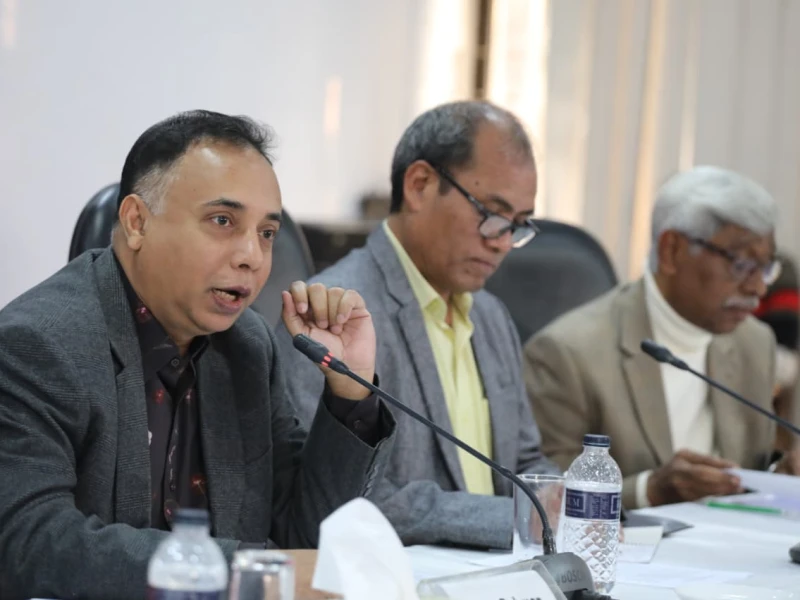
The observations emerged from a policy dialogue titled “Democracy For All: Minority Rights, Representation And The National Election 2026,” organized by the Centre for Governance Studies (CGS) at the CIRDAP auditorium in the city.
Addressing the roundtable, Chandra Mohan Ravidas, Dhaka Division Head of the Dalit Parishad, termed the killing of Adivasi, Dalit, and minority community members through mob violence a "deep shame" for the nation.
"Mob justice completely undermines the core concept of justice. It is alarming that these citizens are deprived of their basic security when they go to vote," Ravidas said. "Every citizen should be able to vote freely and without fear, but such violence is consuming our system."
The dialogue brought together civil society members, human rights activists, and minority representatives who expressed grave concern that while minorities constitute approximately 8% of the country’s population, their security and rights remain largely unaddressed by the state and political machinery.
Representation 'Only on Paper'
CGS President Zillur Rahman, who moderated the session, emphasized that democracy is being reconsidered as the nation looks toward the 2026 elections. He questioned whether the upcoming polls would truly be inclusive.
"Democracy means a state where the voices of minorities are heard, even though they are fewer in number," Zillur said. "Currently, minorities make up about 8% of the population, yet political parties give them representation only on paper for political gain. If they have rights on paper, they must be implemented in practice."
Zillur noted that while attention is being paid to women's participation, political parties fail to give similar importance to minorities, often creating an environment where many feel it is safer not to visit voting centers at all.
A Crisis of Identity and Security
Speakers highlighted that the marginalization of minorities is systemic. Khushi Kabir, Coordinator of "Nijera Kori," argued that the term "minority" itself is often used to deliberately marginalize groups.
"Rights should not be determined based on an individual’s identity," added Dr. Sukomal Barua, Advisor to the BNP Chairperson. He questioned the necessity of separate forums for Dalits or Buddhists if rights were truly universal, calling for a collective effort to build a society where all citizens are empowered equally.
However, the reality on the ground remains grim. Jayanta Kumar Dev, President of the Dhaka Metropolitan Public Puja Committee, described the current situation as "mobocracy."
"Is this the Bangladesh we wanted? We cannot vote outside of fear. No matter which party wins, both parties have been torturing minorities," Jayanta said.
Bijan Kanti Sarkar, Chairman of the Bangladesh Hindu-Buddhist-Christian Welfare Front, echoed this sentiment, stating, "I believe we are not equal; we are second-class citizens. Those who live in the hills are oppressed minorities, and I believe their problems will never be solved."
Political Manifestos: Promises vs. Reality
A recurring theme was the disconnect between election manifestos and post-election reality. Sanjeeb Drong, General Secretary of the Bangladesh Adivasi Forum, noted that while parties promise opportunities for Adivasis, Hindus, and Christians, these remain unrealized.
"Rights are a fundamental right, not a characteristic," Sanjeeb said.
Basudeb Dhar, President of the Puja Celebration Committee, pointed out that since 2014, political parties have included minority rights in manifestos solely to gain power. He also criticized the 2008 change in terminology that reclassified 'Adivasis' as 'small ethnic communities,' a move he termed a transfer for "national interests."
"When the constitution was formed in 1972, there was no discussion of the rights of indigenous people... We have not seen the practical impact of secularism anywhere," Basudeb observed.
Demands for the 2026 Election
With the national election approaching, speakers laid out specific demands. Nirmol Rozario, Senior Vice President of the Bangladesh Hindu-Buddhist-Christian Unity Council, stated that minority security must be ensured by law and through adequate parliamentary representation. "Voter politics is contrary to humanity. Until our mindset changes, it will be very difficult to secure democracy."
Other speakers, including Munni Merrina Chiran, Faculty Member (Part-Time) of ULAB and Mir Abu Reyad, President of Brave Dimension Global called for targeted government support in education, skill development, and housing, and highlighted the discrimination faced by the Hijra community in the health sector.
"If the state's mentality does not change, minority rights will never be ensured," warned Human Rights Activist Ilira Dewan.
The speakers unanimously urged political parties to clearly address minority rights, security, and representation in their electoral commitments for 2026, warning that without the rule of law, democracy cannot function.
 Prev Post :