
Corruption in Bangladesh remains pervasive, with political and administrative spaces still vulnerable to abuse, according to Transparency International Bangladesh (TIB) Executive Director Iftikharuzzaman.
“There is no comparative data available yet. TIB is working on this. However, we can say that corruption persists. Various quarters are engaged in partisanship, land grabbing, and extortion by misusing political and governmental power. There have also been instances of corruption within the government, which is a matter of concern,” he said responding to a question on whether corruption has increased or decreased, Iftikharuzzaman.
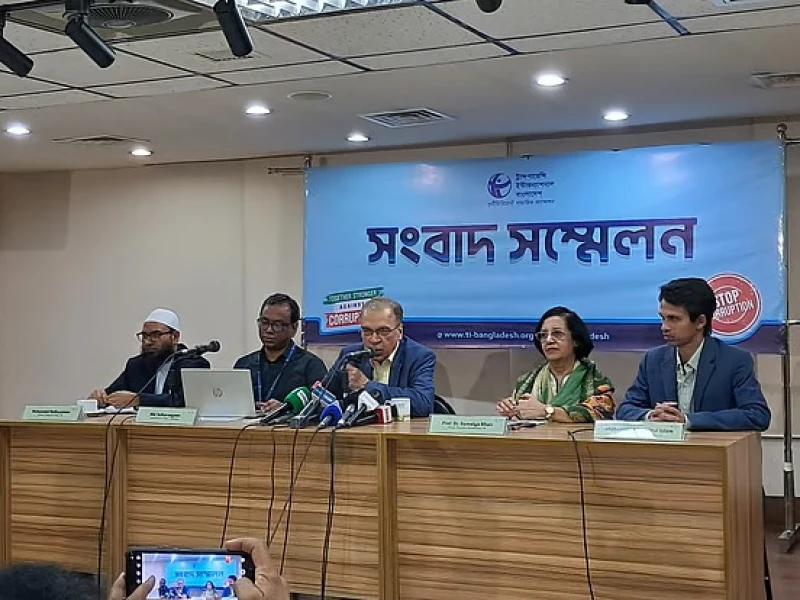
Speaking at a press briefing at TIB’s Dhaka office on Sunday afternoon, Iftikharuzzaman, who also served as the former head of the Anti-Corruption Commission during the caretaker government, added, “This government had the opportunity to take a firmer stance against corruption, but it has failed, and that cannot be denied.”
He also revealed that TIB is preparing a comprehensive analysis covering the government’s full tenure.
The briefing, titled “Commitment to a well-governed, equitable, and corruption-free Bangladesh: TIB recommendations for political party manifestos in the 13th national election”, was attended by journalists who raised several questions.
On the long-term challenge of building a transparent society, Iftikharuzzaman said, “We are in a situation where overcoming 54 years—especially the last 15 years—of entrenched problems cannot be achieved overnight. Establishing a well-governed, democratic, corruption-free, and inclusive society is a long-term process. Nevertheless, an opportunity has emerged. How political parties utilise this opportunity is crucial, as is the extent to which money, muscle power, and religion influence them before and after the election.”
On reforming the business sector, he noted, “It is similar to political party reform; it must come from within. Ensuring open competition, transparency, and accountability benefits the business community at large. Otherwise, a select group profits while others suffer, a pattern seen over the past 15 years, leading to capture of the state machinery. Certain business segments have acted as pillars for authoritarianism, and preventing a repeat of this scenario is essential.”
Addressing a question about the current chilly relations with India, he said, “From India’s perspective, this is one of the most diplomatically and politically embarrassing moments in their history, which they have failed to acknowledge so far. That said, it does not preclude the possibility of improving bilateral relations. There are opportunities for high-level partnership and cooperation, which depend on both sides. Greater objectivity and a move away from authoritarian positions by India would make this process easier for Bangladesh.”
During the briefing, TIB presented 52 recommendations for political party manifestos ahead of the next election.
Iftikharuzzaman read the first seven proposals, which included commitments to implement recommendations from the July Charter and other reform commissions, ensure continuity of measures and ordinances introduced based on those commissions, and continue proper investigation and prosecution of killings, crimes, and human rights violations committed during the July uprising and the authoritarian government period.
The remaining proposals, presented by TIB Senior Research Fellow Md Zulkarnain and Research and Policy Director Mohammad Badiuzzaman, focused on preventing irregularities and corruption, promoting internal party democracy, good governance, and integrity, ensuring social justice and equity, and reforms in sectors including social safety, education, health, agriculture, banking and finance, energy, environment and climate, as well as private sector governance.
TIB Executive Management Advisor Professor Sumaiya Khair and Outreach and Communications Director Mohammad Tauhidul Islam were also present at the briefing.
 Prev Post :