
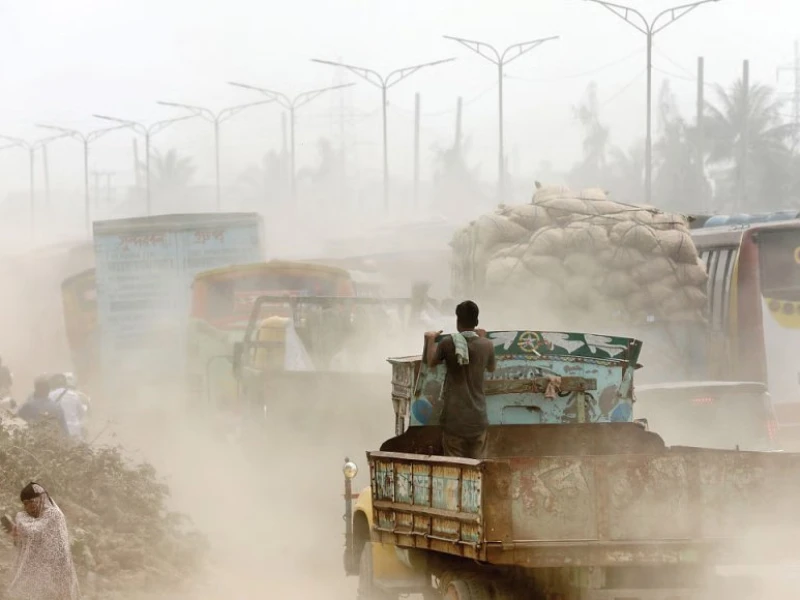
As the seasonal cycle moves from autumn into winter, Dhaka continues to struggle with polluted air, a problem that resurfaces almost every year during the dry months.
With rainfall absent and the atmosphere increasingly arid, the capital has once again found itself among the world’s most polluted cities.
On Thursday, Dhaka’s air quality was categorised as ‘unhealthy’, although pollution levels were marginally lower than on several recent days. At around 8:30 am, the city recorded an Air Quality Index (AQI) score of 182, placing it eighth on the global list of polluted cities, according to data from international air quality monitoring organisation IQAir.
The winter season typically exacerbates Dhaka’s air pollution, as dust particles, vehicle emissions and industrial pollutants remain suspended in the air for longer periods due to the absence of rain and reduced wind flow. This seasonal pattern has made the capital a regular presence on global pollution rankings.
On the same morning, New Delhi topped the list with a severe AQI score of 285, while Wuhan in China ranked second with 251. India’s Kolkata followed in third place with a score of 227. Chinese cities Hangzhou and Beijing occupied the fourth and fifth positions, recording AQI scores of 205 and 201 respectively.
The AQI is measured on a scale from zero to 500, with higher numbers indicating greater health risks. An AQI score between 0 and 50 is considered good, while 51 to 100 is deemed moderate. Scores ranging from 101 to 150 are classified as unhealthy for sensitive groups, including children, the elderly and those with respiratory conditions.
Air quality is labelled ‘unhealthy’ when the AQI falls between 151 and 200, as is currently the case in Dhaka. Scores between 201 and 300 are considered ‘very unhealthy’, prompting health advisories that recommend limiting outdoor activities, particularly for vulnerable populations. AQI readings above 300 are classified as ‘hazardous’, posing serious health risks to all residents.
Public health experts warn that prolonged exposure to polluted air can lead to respiratory illnesses, cardiovascular problems and other long-term health complications. As winter deepens, concerns remain that Dhaka’s air quality may deteriorate further unless effective measures are taken to curb emissions and manage urban pollution.
For now, residents are advised to remain cautious, reduce unnecessary outdoor exposure and take protective measures as the city navigates yet another polluted winter.
 Prev Post :
-1767186963.webp)