
Bangladesh is navigating a period of overlapping macroeconomic, financial, sectoral and social pressures as FY2025-26 draws to a close, with revenue mobilisation far off target, inflation persistently above wage growth, and structural fragilities deepening across the banking and energy sectors.
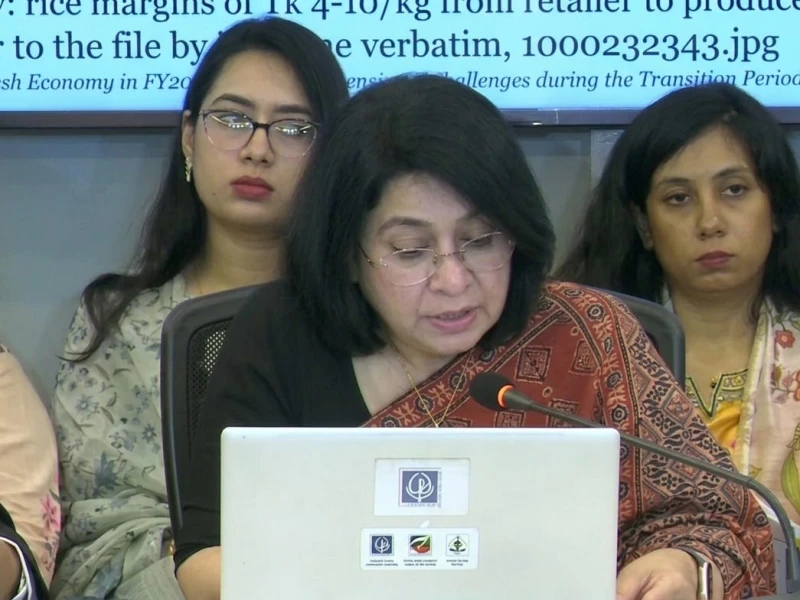
The Centre for Policy Dialogue (CPD) presented these findings on Thursday at its Dhanmondi office in Dhaka, releasing the third reading of its Independent Review of Bangladesh's Development (IRBD) for FY2025-26, titled “State of the Bangladesh Economy in FY2025-26: Multidimensional Challenges during the Transition Period.”
CPD Executive Director Dr Fahmida Khatun led the presentation, said recent economic developments indicate a mixed picture of resilience and fragility.
Revenue and Public Finance
Bangladesh's revenue mobilisation grew by only 6.9 per cent during July-March of FY26, against a target growth rate of 29.3 per cent. CPD said meeting the annual target would now require an improbable 84.6 per cent growth in the final quarter, calling the revenue mobilisation target “operationally unrealistic.”
NBR tax collection fell short of the target by BDT 104,533 crore during July-April FY26, with growth of 10.6 per cent against a target of 34.5 per cent. Closing the gap by June would require 128.6 per cent growth in May-June, a figure the think tank described as near-impossible.
ADP implementation stood at just 35.4 per cent during July-April FY26, significantly below the FY17-FY24 average of 49.8 per cent. Among the top-10 allocatee ministries and divisions, six underperformed, with the Health Services Division recording a dismal 9.3 per cent and the Ministry of Railways only 21.0 per cent.
To finance the widening deficit, the government leaned heavily on bank borrowing, which reached BDT 102,442 crore or 98.5 per cent of the full-year target by March FY26, up 20 per cent from the same period of FY25. CPD warned this could crowd out private sector credit and dampen investment.
Inflation and Living Costs
Headline inflation rose to 9.04 per cent in April 2026, up from 8.71 per cent in March, with non-food inflation reaching 9.57 per cent. Both rural and urban inflation trended upward, while the national wage growth rate of 8.16 per cent in April 2026 failed to keep pace, eroding real purchasing power, particularly for low-income households.
The Strait of Hormuz blockade triggered sharp fuel price increases between December 2025 and May 2026: diesel rose 15 per cent to BDT 115 per litre, while octane and petrol each surged over 20 per cent. The price of a 12 kg LPG cylinder jumped 40.57 per cent, from BDT 1,341 in March 2026 to BDT 1,885 in June 2026.
CPD's event-study analysis of external shocks found that the Middle East conflict drove chicken prices 5.4 per cent above expected levels within 10 days, while egg prices shot up 7.3 per cent, the sharpest immediate commodity shock recorded in the study period.
A CPD market survey of around 1,000 agents across 10 commodities identified green chilies, onions, pulses and brinjals as carrying the highest markups in the supply chain, driven largely by the dominant role of urban aratdars.
Banking Sector
The banking sector's capital adequacy ratio fell to a historic low of negative 2.93 per cent. Specialised banks collapsed to a CRAR of negative 87.9 per cent in September 2025. While the gross NPL ratio declined from 35.73 per cent in September 2025 to 32.26 per cent in March 2026, CPD said the improvement reflects rescheduling and restructuring rather than any real asset quality recovery.
Private sector credit growth fell to a record low of 4.72 per cent in March 2026, constraining investment and job creation. Excess liquidity as a share of total liquid assets rose from 43 per cent in May 2025 to 55 per cent in March 2026, a sign of cautious lending and weak economic activity, CPD said.
On regulatory measures, CPD flagged concern over a proposed amendment that would allow former owners of distressed banks to regain control, calling it an accountability risk that could weaken resolution credibility. It also raised concern over a Bangladesh Bank circular raising the single-borrower exposure limit from 15 per cent to 25 per cent of capital until June 2028, warning it could amplify systemic risk.
External Sector
Bangladesh's overall balance of payments shifted from a deficit of USD 1.1 billion in FY25 to a surplus of USD 3.6 billion in FY26 during July-March, an improvement of USD 4.8 billion. Remittances rose 19.8 per cent during July-April FY26, continuing to serve as a critical external stabiliser. Forex reserves stood at USD 34.57 billion on 23 May 2026.
However, CPD cautioned that the BoP improvement was driven largely by debt-creating financial account inflows of USD 3.2 billion, not a genuine improvement in the current account. Exports fell 2.02 per cent during July-April FY26, far below the 14 per cent target. RMG exports declined 2.8 per cent, with knitwear falling 3.7 per cent. Bangladesh lost ground in both the US and EU markets, while Vietnam gained.
External debt stood at USD 113.2 billion as of June FY25. Debt servicing costs have more than doubled in five years, from USD 3.2 billion in FY20 to USD 7.2 billion in FY25. The IMF in January 2026 moved Bangladesh to moderate risk from low risk, while Fitch revised its outlook to negative in May 2026.
Labour Market
CPD said factory closures since August 2024 left between 100,000 and 300,000 workers unemployed. Real wages declined throughout January 2025 to April 2026, with industrial workers bearing real wage contractions of up to 2.1 per cent.
Wage-related labour unrest incidents rose from 59 in 2023 to 204 in 2025. Workplace deaths stood at 1,190 in 2025, with at least 186 recorded in the first quarter of 2026 alone. Overall unemployment is expected to remain at 3.8 per cent in 2026, while youth unemployment is projected to rise from 9.1 per cent to 9.7 per cent.
Energy Crisis and Haor Floods
The Strait of Hormuz blockade exposed Bangladesh's deep vulnerability to imported fuel dependency. CPD estimated that the government will need BDT 31,122 crore in additional subsidies for the energy sector by the end of FY26. The total yearly subsidy requirement for the power and energy sector now stands at BDT 77,122 crore.
Using a Structural VAR model, CPD found that the Q2 FY26 fuel price shock generated a CPI inflation increase of 0.581 percentage points on impact, while real GDP is projected to fall to a trough of negative 0.353 per cent by October-December 2026, implying foregone output on the order of USD 1.4 billion annually.
The Haor floods of April 2026 damaged an estimated 49,000 hectares of boro cultivation, affecting 236,811 farm households. CPD's own estimate placed rice losses at 339,449 metric tonnes, significantly higher than the official DAE revised figure of 214,000 MT.
The government's compensation of BDT 7,500 per farmer, CPD said, covers only 14-18 per cent of per-household production loss.
Measles Outbreak
CPD characterised the 2026 measles outbreak as a case study in health sector governance failure. Between 15 March and 2 June 2026, the outbreak produced 74,572 suspected cases, 9,191 lab-confirmed cases and 601 deaths. About 72 per cent of cases were among zero-dose children.
CPD attributed the outbreak to vaccine stockouts in 2024-2025, the absence of a nationwide MR campaign since 2020, and procurement failures.
Recommendations
CPD called for a package of structural reforms across all sectors. On public finance, it recommended exploring new tax avenues including digital economy and wealth taxation, curbing illicit financial flows, and tightening ADP project management.
On banking, it urged strict loan classification, an end to political interference in credit allocation, and full disclosure of rescheduled and restructured loans.
On energy, it called for urgent gas exploration, rooftop solar expansion and immediate digitalisation of the petroleum supply chain.
On agriculture, it recommended satellite-based loss assessment, higher farmer compensation, a 12-month loan moratorium, and immediate G2G rice import arrangements.
“Bangladesh's recovery requires credible governance reform, beyond macroeconomic stabilisation,” Fahmida said in her concluding remarks. “The government needs strong institutions and accountability mechanisms to achieve the development goals outlined in its election manifesto.”
 Prev Post :