
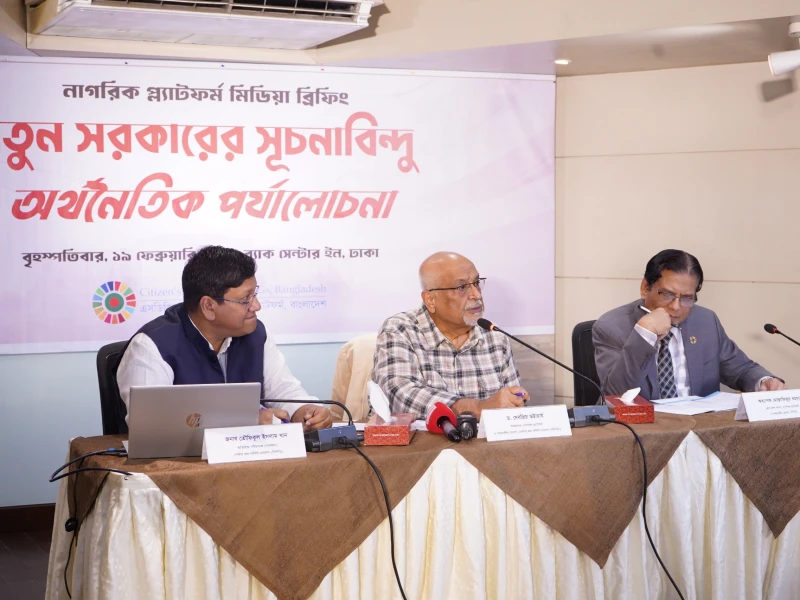
Citizen’s platform on Thursday urged the new government to immediately prepare a realistic revised budget for the current fiscal year and enforce a hard budget constraint to stabilise the economy amid mounting macroeconomic pressures.
The recommendations came at a briefing held at BRAC Centre in Mohakhali, where Citizen’s Platform presented its “Macroeconomic Benchmark for the New Government”. The presentation was made by Towfiqul Islam Khan, Additional Director (Research) at CPD.
Highlighting what it termed three binding constraints—fragile macroeconomic stability, weakened private investment and employment, and diminishing fiscal space—the platform stressed that there should be “no compromise” in formulating a realistic revised budget for FY2025, including updated projections on debt stress.
According to the analysis, Bangladesh is now in a position where recurrent operating expenditures cannot be met through domestic revenue mobilisation. In FY2025, revenue shortfall exceeded Tk 1 lakh crore, while foreign debt repayment rose sharply. The revenue deficit after accounting for non-ADP expenditures and foreign debt repayment widened significantly, squeezing fiscal space further.
The platform team warned that public debt increased by Tk 2.6 lakh crore between end-June and end-September 2024, driven largely by domestic and external borrowing, alongside currency depreciation. Although the budget deficit has remained below 5 percent of GDP, repayment capacity—both in fiscal and foreign exchange terms—should now be the key concern rather than the debt-to-GDP ratio alone, it noted.
Against this backdrop, the platform recommended adopting a “miser approach” for the remainder of FY2025, prioritising public expenditure, cutting unnecessary operating costs, and refraining from allocating additional public funds to troubled banks during the current fiscal year. New public investment projects should be deprioritised, while ongoing and foreign loan-financed projects should receive priority.
On monetary policy, Citizen’s Platform suggested that a small cut in the policy rate could be considered to support private investment, though it cautioned that non-food inflation remains sticky. It also advised against aggressively building up foreign exchange reserves over the next four months, noting that this could add to money supply pressures.
While foreign exchange reserves have improved—reaching $28.9 billion in January 2026 under BPM6 methodology—and the exchange rate has shown some stability, inflation remains elevated at 8.7 percent in January, with non-food inflation hovering above 9 percent.
Private investment fell to 22.5 percent of GDP in FY2025—the lowest in recent years—while GDP growth slowed to 4 percent. In the first half of FY2025, about 21 lakh jobs were lost nationwide, and poverty is believed to have increased, the report said.
Assessing selected election pledges, the platform described goals such as raising the tax-GDP ratio to 15 percent by 2035, allocating 5 percent of GDP to health and education, and increasing foreign investment to 2.5 percent of GDP as “highly ambitious” and requiring strong political commitment and reform momentum.
It recommended a staggered approach to delivering manifesto pledges, suggesting that resource-intensive commitments be initiated from FY2027 and beyond, while some targets may need recalibration to ensure overall macroeconomic stability.
As part of a realistic pathway forward, the platform proposed implementing an economic stabilisation plan with a hard budget constraint for the rest of the fiscal year, preparing a credible fiscal framework for the next budget, convening a multi-stakeholder development forum, and rolling out a time-bound reform agenda, including an LDC transition strategy.
“Setting the course early on is crucial for success,” the presentation noted, underscoring that prudent macroeconomic management will significantly influence the government’s ability to deliver on its electoral commitments.
 Prev Post :