
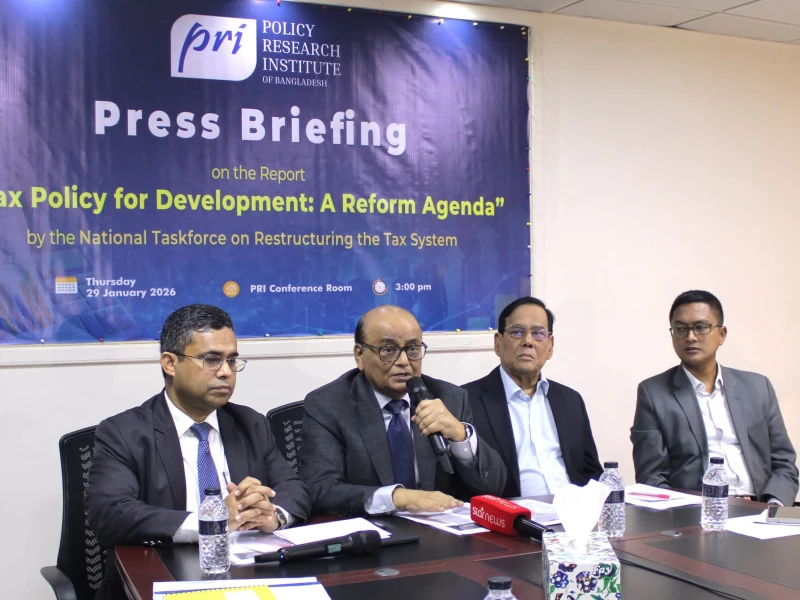
Bangladesh’s tax system requires comprehensive and structural reforms rather than incremental or purely administrative measures to support long-term economic growth and meet the country’s rising development needs, according to a report of the National Taskforce on Restructuring the Tax System.
The report, titled “Tax Policy for Development: A Reform Agenda for Restructuring the Tax System,” was prepared for the Revenue Policy Division (RPD) of the Ministry of Finance, presented at a press briefing organised by the Policy Research Institute of Bangladesh (PRI) on Thursday in Banani.
The study finds that the existing tax system is unnecessarily complex and inefficient, marked by a narrow tax base, excessive reliance on manual administration and a heavy dependence on indirect taxes. It cautions that durable and credible revenue mobilisation cannot be achieved through administrative action alone unless it is grounded in a coherent and well-designed tax policy framework.
“Tinkering at the margins will not suffice,” the report observes, warning that weak policy design forces tax administrators to rely on discretion rather than rules, leading to ad hoc practices such as aggressive audits, arbitrary valuation and excessive dependence on withholding taxes—ultimately eroding taxpayer trust and voluntary compliance.
The report identifies 55 priority policy issues across major tax segments, including 32 in direct taxes, 10 in value-added tax (VAT) and 13 in trade taxes. It sets an ambitious but achievable target of raising the tax-to-GDP ratio to 10–12 percent by 2030 and further to 15–20 percent by 2035.
A central reform objective outlined in the report is to rebalance the tax structure by shifting from indirect to direct taxation. It proposes reducing the indirect-to-direct tax ratio from the current 70:30 to 50:50 over time. Direct taxes are projected to increase from about 2.5 percent of GDP at present to 9–10 percent by 2035, driven by growth in personal and corporate income taxes.
At the same time, the share of trade taxes in total revenue is expected to decline from around 28 percent currently to 15 percent by 2030 and about 7.5 percent by 2035, reflecting a move toward a more modern and growth-friendly tax system.
Trade Tax Reforms
On trade taxes, the report stresses the need to gradually reduce reliance on tariffs and para-tariffs and shift toward domestic taxes such as VAT, personal income tax, corporate income tax and property taxes. It notes that Bangladesh’s tariff structure is overly complex, creates strong anti-export bias and sustains a dualistic trade regime that discourages export diversification.
The report recommends rationalising tariff structures, eliminating the use of supplementary duty and VAT for protection purposes and ensuring that tariffs do not make domestic sales more profitable than exports. It also highlights persistent customs valuation problems, noting that high tariffs create strong incentives for under-invoicing and tax evasion.
Although Bangladesh has invested in the UNCTAD-supported ASYCUDA World customs automation system, the report finds it grossly under-utilised. It recommends enforcing valuation through post-clearance audits using ASYCUDA’s built-in risk analysis and valuation intelligence instead of discretionary practices at ports.
VAT Reforms
On VAT, the report calls for transforming the existing patchwork system into a broad-based consumption tax. Key recommendations include moving toward a single standard VAT rate over time, minimising exemptions to widen the tax base and ensuring the effective functioning of the input tax credit mechanism.
It notes that in FY2023–24, VAT revenue stood at about 2.8 percent of GDP, while revenue foregone due to exemptions was estimated at 3.6 percent of GDP. Bringing informal sector activities into the VAT net through digital integration, e-invoicing and simplified compliance regimes is seen as critical to improving VAT buoyancy.
Direct Tax Reforms
In direct taxation, the report emphasises strengthening progressivity in personal income tax by broadening the tax base rather than increasing marginal rates. It recommends reducing the top marginal personal income tax rate to 25 percent to promote compliance and expand the tax net.
For corporate income tax, the report proposes a uniform 15 percent rate for firms with equity exceeding 35 percent of total capital, regardless of foreign ownership. This, it argues, would reduce excessive reliance on bank financing and help revitalise the capital market.
The report also calls for major reforms in withholding taxes, recommending that tax deducted at source be limited to salaries, interest, dividends and capital gains on listed shares. It suggests repealing the minimum tax on gross receipts, describing it as regressive and inconsistent with the principle of taxing actual income.
In addition, the report proposes introducing a modest tax on property transfers through gifts or bequests, while reducing other property transfer taxes and mandating regular updates of assessed property values. This would help broaden the tax base and introduce an inheritance-related tax element that has been absent in Bangladesh for more than five decades.
The report concludes that only a coherent, policy-led and technology-enabled tax system—rather than an enforcement-driven approach—can deliver the sustainable revenue mobilisation required to support Bangladesh’s transition to an upper-middle-income economy.
 Prev Post :