
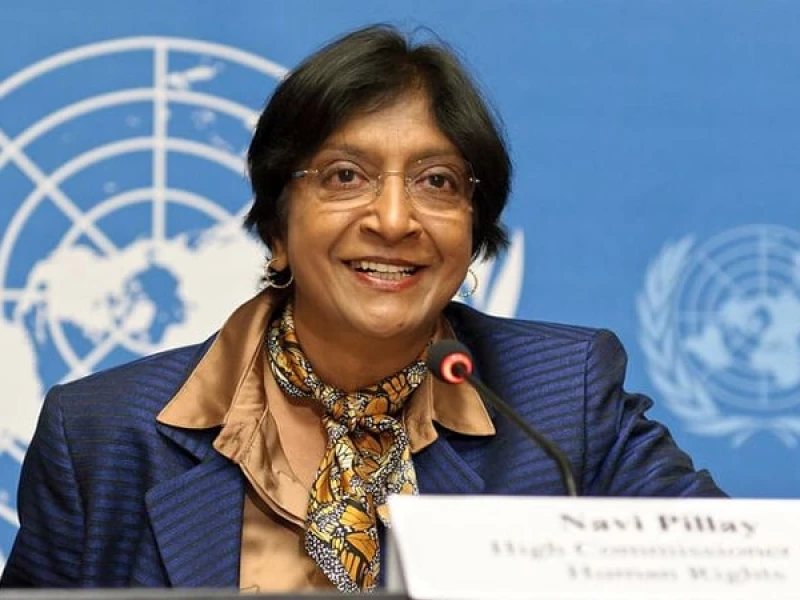
The news of renowned South African jurist and international court judge Navi Pillay winning the 2026 Nobel Peace Prize has triggered an unprecedented political and diplomatic uproar in the international arena. In response to receiving the award, she took a sarcastic swipe at the US leadership, drawing intense resentment and criticism from Washington and Tel Aviv.
Standing in the historic Courtroom 600 in Nuremberg, Germany, after receiving the news of the prize, the 85-year-old judge made a subtle, witty remark hinting at US President Donald Trump's long-standing desire to win the Nobel Prize. "If you clap a little bit more, I may share this prize with Trump," Pillay said with a smile. Her clever sarcasm has sparked widespread debate across the globe.
However, Washington and Tel Aviv are refusing to accept Pillay's Nobel victory. Last year, the UN Independent International Commission of Inquiry led by Navi Pillay submitted a report to the international court explicitly terming Israel's military operations in Gaza as 'genocide'. In reaction, Israel's Ministry of Foreign Affairs strongly condemned the award, labeling it a "grotesque weaponisation of an award to legitimise anti-Israel hatred and prejudice"
On the other hand, US President Donald Trump fiercely attacked Navi Pillay on his social media platform 'Truth Social', branding her "anti-America and anti-Israel". Just hours after the Nobel announcement, the US administration announced fresh, stringent sanctions against the International Criminal Court (ICC)-an institution deeply tied to Pillay's legacy-escalating global diplomatic tensions to a peak.
Childhood under apartheid
Navi Pillay (full name: Navanethem Pillay) was born on September 23, 1941, into a poor Tamil immigrant family in the Clairwood slum of Durban, South Africa. Her ancestors had migrated from Tamil Nadu in undivided India during the late 19th century to work as indentured laborers in the sugarcane fields of South Africa.
Pillay's father was a humble bus driver. The family endured extreme poverty and hardships, raising eight children. She grew up in the dense darkness of apartheid in a household that possessed neither a book nor a newspaper.
Despite qualifying for the University of Natal, the expenses were impossible for Pillay's impoverished father to bear. Her local community in the Clairwood slum then pooled money, alongside a small church scholarship, to fund her higher education. Overcoming all social and economic barriers, she remained steadfast in her pursuit of education and went on to establish her own law firm, becoming the first non-white woman lawyer in the Natal province.
After opening her law firm, white judges would frequently mock her in the courtroom, asking, "Who are you? The accused in the dock or a cleaner?" She never backed down in the face of such humiliation. Later, she became the first South African to earn a doctoral degree from the prestigious Harvard Law School in the United States.
Fighting for Nelson Mandela's rights
As a lawyer, Navi Pillay's core battle began against the white-minority apartheid government. She defended hundreds of revolutionaries in court, including the undisputed leader of the anti-apartheid movement, Nelson Mandela, who was then imprisoned on the notorious Robben Island. Pillay fought courageously in court to secure the historic legal right of lawyer access for the prisoners in that jail in 1973.
During this period, she founded a movement in South Africa named 'Women towards Peace', which provided legal protection to young Black men who were tortured and forcibly disappeared by the apartheid police. Following the end of apartheid in South Africa, Nelson Mandela was elected president and appointed Navi Pillay as the country's first non-white woman High Court judge in 1995.
The verdict that changed world history
Upon Mandela's recommendation, Navi Pillay joined the United Nations International Criminal Tribunal for Rwanda (ICTR) as a judge and later became its president. During the trials of the 1990s Rwanda genocide, she established a groundbreaking precedent. Her historic ruling formally recognized 'rape and sexual violence' as crimes against humanity and instruments of genocide for the first time in global legal history.
When the Rome Statute was being signed in 1998 to map out the creation of the International Criminal Court (ICC) in The Hague, Pillay played a resolute role there in defending gender equality, and she later served as one of the apex court's premier judges.
UN human rights chief and international judge
From 2008 to 2014, she served with immense courage as the United Nations High Commissioner for Human Rights. Whether it was the civil wars in Syria, Libya, or Sri Lanka-she maintained a vocal stance wherever global superpowers violated human rights.
Unflinching present at the age of 85
Even at the age of 85, Navi Pillay continues her legal work as a judge ad hoc at the UN's highest court, the International Court of Justice (ICJ), in the ongoing case brought by The Gambia against Myanmar over alleged violations of the Genocide Convention against the Rohingya people.
Concurrently, the UN Independent Commission of Inquiry under her leadership submitted a report to the international court last year, characterizing Israel's military campaign in Gaza as 'genocide'.
Reflecting on her relentless crusade in the twilight of her life, Navi Pillay stated, "Justice is not a favor; it is a fundamental human right. And there is no age limit to the fight for one's rights." It is in recognition of this monumental international legal legacy and decades of struggle that she has been honored with the 2026 Nobel Peace Prize.
 Prev Post :