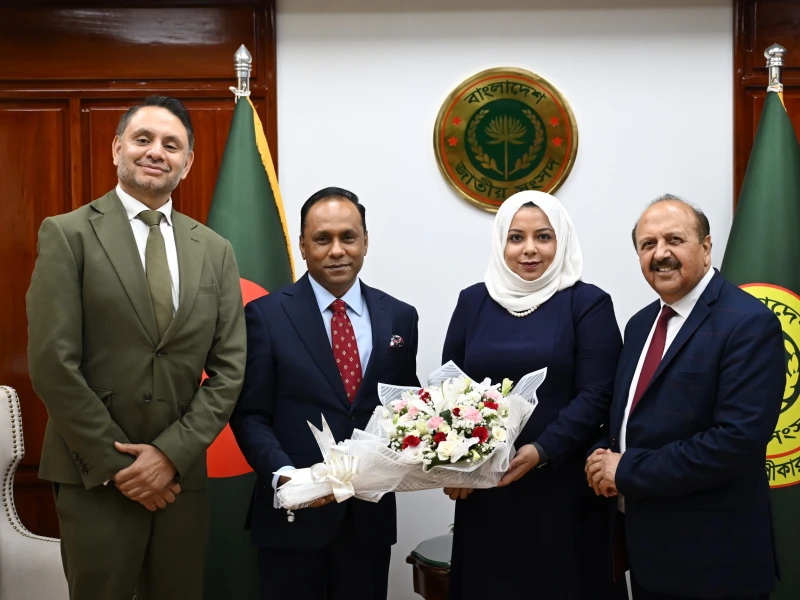
A delegation of the British Parliament's All-Party Parliamentary Group (APPG) Tuesday expressed interest in opening branches of British educational institutions in Bangladesh, as it met Deputy Speaker Barrister Kayser Kamal to discuss strengthening parliamentary cooperation between the two countries.
The Deputy Speaker welcomed the proposal, saying British teachers and other official staff should be appointed at such institutions to help maintain educational standards.
The delegation, which met him at his office, comprised British MPs Apsana Begum and Shockat Adam, and Lord Qurban Hussain.
At the outset, the delegation congratulated Bangladesh on holding what it described as a free and fair national election in 2026. The Deputy Speaker said the 2026 parliamentary election was accepted as free and fair both at home and abroad.
Kamal described Bangladesh-UK relations as deep and traditionally friendly, saying the ties had developed through bilateral and diplomatic channels. He also highlighted the contribution of Bangladeshis living in the UK to strengthening the relationship.
He said Prime Minister Tarique Rahman had introduced Family Cards, Health Cards and Farmer Cards to improve living standards and strengthen the social safety net.
Referring to institutional reforms, Kamal said the prime minister was working to strengthen Bangladesh's institutions along the lines of those in Britain, and considered the British Parliament a model for Bangladesh's Parliament.
Asked by the delegation about the situation of minorities, the Deputy Speaker said minorities were treated equally in every sphere of national life, noting that a number of lawmakers and ministers currently belonged to minority communities.
He said democracy had not been properly maintained in Bangladesh over the past one and a half decades, but the parliamentary democratic process was now functioning.
Parliamentary standing committees had become more active and stronger, while the opposition was playing an important role in Parliament, which he described as a significant change, Kamal said.
He said that, in line with the prime minister's initiative, students from schools, colleges and universities were now being given opportunities to observe parliamentary proceedings and visit the Parliament complex.
Political identity was not being considered in recruitment to government jobs, he said, adding that the bureaucratic system was being made more people-oriented to strengthen the country's democratic process.
Both sides stressed the importance of exchanging parliamentary experiences between Bangladesh and the UK.
At the end of the meeting, Kamal invited the delegation to visit the Parliament complex and the July Memorial Museum. The delegation responded positively to the invitation.
Senior officials of the Parliament Secretariat were present at the meeting.
 Prev Post :