
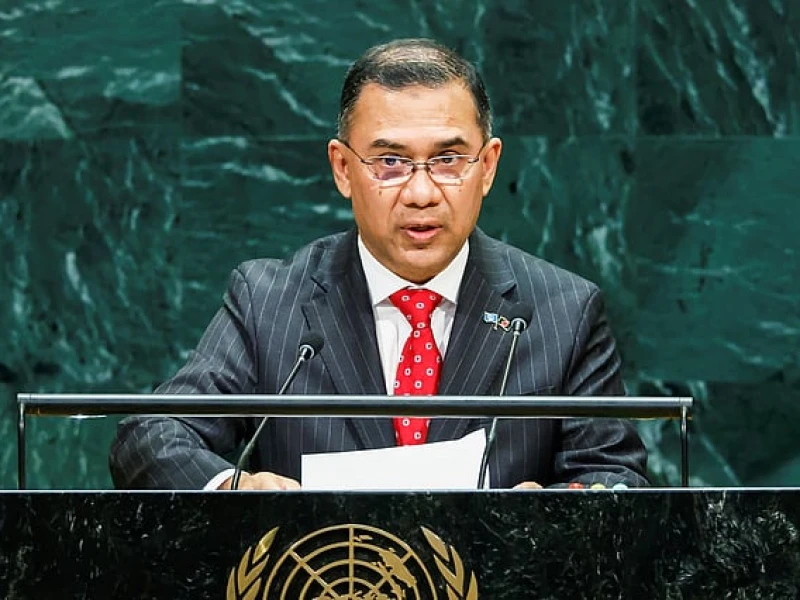
Prime Minister Tarique Rahman’s five-day visit to the United States for the 81st session of the United Nations General Assembly brought a packed schedule of diplomatic, economic and international engagements, with several developments emerging during his stay in New York.
It was Tarique Rahman’s first UNGA visit since forming the government, and his maiden address to the General Debate placed Bangladesh’s priorities and perspectives on global issues before the international community.
By the time he left New York, two notable developments had taken place in Bangladesh-US relations: Biman Bangladesh Airlines signed an agreement with Boeing to purchase 11 more aircraft, while Bangladesh and the United States signed a memorandum of understanding on strategic civil nuclear cooperation.
The Prime Minister did not personally attend either signing ceremony.
Boeing order and nuclear cooperation
Biman’s agreement with Boeing covers five 787-10 Dreamliners and six 737-8 aircraft. Boeing said the latest order takes Biman’s total Boeing order book to 25 aircraft this year, following an earlier order for 14 aircraft.
The civil nuclear cooperation MoU was signed in New York on September 25 by Prime Minister’s Adviser for Science and Technology Rehan Asad and US Under Secretary of State for Economic Growth, Energy and the Environment Jacob Helberg. The agreement provides a framework for cooperation on the peaceful use of nuclear energy, with both sides stressing nuclear safety, security, safeguards and non-proliferation.
The two developments came against the backdrop of broader efforts to deepen economic, energy and strategic engagement between Dhaka and Washington.
Some observers have argued that Washington had been putting pressure on Bangladesh over the Boeing purchase and civil nuclear cooperation even before the government led by Tarique Rahman came to power. The government, however, has consistently rejected claims that it was under such pressure.
The Sheikh Hasina question
Another significant development came during Tarique Rahman’s stay in New York, when a US State Department official said Washington hoped Bangladesh and India would resolve the issue surrounding former prime minister Sheikh Hasina through discussions.
At an on-background briefing at the New York Foreign Press Centre, the official said the United States had not taken a formal position on what should happen to Hasina, but described the issue as a major source of tension between India and Bangladesh and expressed hope that the two countries would reach a solution through dialogue.
The comments added another diplomatic dimension to the Prime Minister’s visit, as Bangladesh seeks to manage its relations with both India and the United States amid a changing regional environment.
A packed diplomatic schedule
According to Prime Minister’s Adviser and PMO spokesperson Mahdi Amin, Tarique Rahman held 30 official engagements during the visit, including bilateral meetings with 11 countries.
He said Bangladesh’s national interests, trade and investment, manpower exports, energy security, regional cooperation, the Rohingya crisis, healthcare, climate change and international peace featured prominently in the meetings and programmes.
The Prime Minister took part in eight programmes directly linked to the General Assembly, four high-level side events and 11 bilateral meetings, in addition to meetings with international organisations and other prominent figures.
Among those he met were UN Secretary-General António Guterres, World Bank President Ajay Banga, UN High Commissioner for Human Rights Volker Türk, UN High Commissioner for Refugees Barham Salih and the UN Secretary-General’s Special Envoy on Myanmar, Julie Bishop.
He also met leaders and senior officials from several Middle Eastern countries, including the Crown Prince of Kuwait, the Saudi foreign minister and the Deputy Prime Minister and Foreign Minister of the United Arab Emirates. Discussions focused on issues including the interests of Bangladeshi workers, manpower exports, energy security, mineral-sector cooperation, trade and investment.
Bangladesh’s priorities at the UN
Tarique Rahman’s UNGA programme also included high-level discussions on some of Bangladesh’s longstanding priorities.
Bangladesh co-hosted a high-level side event on the Rohingya crisis and another on midwifery, maternal and newborn healthcare. The Prime Minister also addressed high-level events on climate action and a just transition and on sea-level rise.
His General Assembly address covered Bangladesh’s national priorities as well as wider issues including global peace, humanity, democracy, human rights and international cooperation, according to Mahdi Amin.
Economic outreach
Economic diplomacy was another prominent feature of the visit.
On the final day, Tarique Rahman attended a breakfast meeting hosted by JPMorgan Chase with leading Wall Street investors, where discussions focused on investment opportunities in Bangladesh, particularly in the financial sector.
The Boeing agreement also gave the visit a significant commercial dimension, with the US aircraft manufacturer describing the order as part of Biman’s fleet renewal and international expansion plans.
How the government views the visit
Briefing Bangladeshi journalists in New York, Mahdi Amin said the government had sought to make maximum use of the Prime Minister’s limited time, with Bangladesh’s interests given priority in every engagement.
“During the Prime Minister’s visit, the maximum use of time was ensured and Bangladesh’s interests were given the highest priority in every programme,” he said.
Mahdi said the Prime Minister and members of his delegation together represented Bangladesh at around 80 programmes during the visit. He also highlighted the participation of Tarique Rahman’s wife, Dr Zubaida Rahman, who attended eight high-level programmes and delivered remarks at four of them.
For a government making its first appearance at the UNGA under Tarique Rahman’s leadership, the visit therefore combined a broad diplomatic agenda with economic outreach and a series of developments touching on aviation, energy and Bangladesh’s relations with major international partners.
The significance of the visit will ultimately depend on how these engagements translate into concrete cooperation and follow-up after the Prime Minister’s return, particularly in trade and investment, energy security, international partnerships and Bangladesh’s key diplomatic priorities.
 Prev Post :