
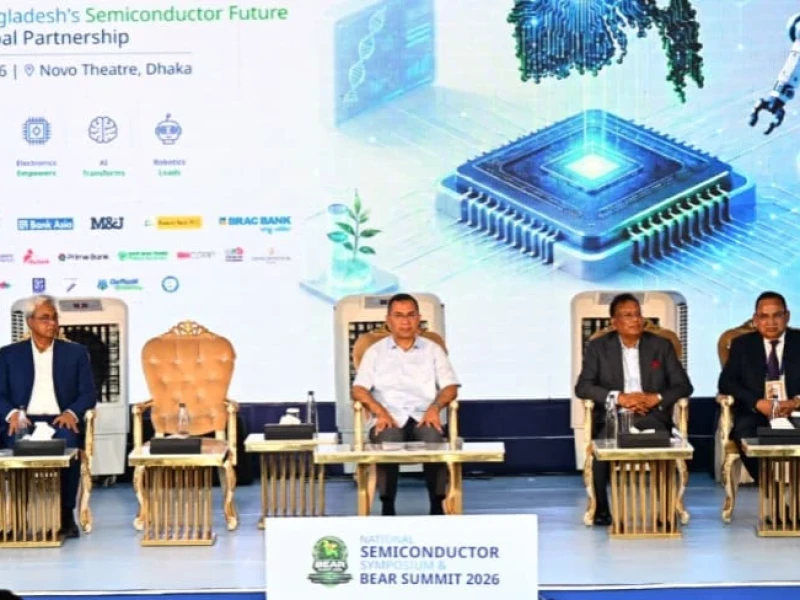
Prime Minister Tarique Rahman on Saturday described the semiconductor industry as Bangladesh's next major economic growth engine after the ready-made garment sector, saying his government is laying the foundation for the country to become a competitive player in the global high-tech value chain.
"I firmly believe that powered by innovation, skills and dynamism of our talented young workforce, the semiconductor industry has the potential to become Bangladesh's next economic growth driver after the ready-made garment sector,” he said while inaugurating the 2-day National Semiconductor Symposium and Biotechnology, Electronics, Artificial Intelligence and Robotics (BEAR) Conference 2026 at the Novo Theatre in Tejgaon.
He called upon the relevant ministries, government agencies, universities, industry stakeholders, Bangladeshi professionals living abroad and development partners to work in a coordinated manner to help build Bangladesh's semiconductor industry and achieve its long-term development goals.
Tarique Rahman said the government has already begun implementing a comprehensive plan to create a semiconductor-friendly ecosystem through investment incentives, tax reforms, infrastructure development and startup support.
He announced that all taxes and duties on raw materials required for semiconductor manufacturing have been withdrawn in the current national budget, while initiatives have been taken to introduce cash incentives for export earnings from semiconductor design services.
The government has also allocated Tk 500 crore for startup grants in the current budget to encourage innovation and technology entrepreneurship, the Prime Minister said, adding that the process has already begun and grants have started reaching deserving entrepreneurs.
The Prime Minister said the government is also planning to establish a biotechnology park alongside modernising existing high-tech parks to strengthen the country's deep-tech ecosystem.
Addressing policymakers, technology experts, global semiconductor executives, investors, researchers, entrepreneurs and members of the Bangladeshi diaspora, the Prime Minister said Bangladesh wants to build a self-reliant, prosperous and technology-driven nation through a knowledge-based economy.
"This conference is not merely another event. I see it as a gathering of those who will help build tomorrow's Bangladesh," he said.
The Prime Minister noted that the world is currently passing through a technological transition where artificial intelligence, robotics and automation are laying the foundation for the fourth and fifth industrial revolutions.
He described semiconductors as no longer just another industry but "the foundation of modern civilisation," saying they are indispensable in everything from mobile phones and computers to medical equipment, agricultural technology, defence systems, artificial intelligence, robotics, data centres, renewable energy, advanced manufacturing and satellite technology.
Referring to global industry forecasts, Tarique Rahman said the worldwide semiconductor market is expected to approach US$1 trillion by 2030, while some experts believe it may reach that milestone even earlier. "That presents enormous opportunities for Bangladesh to enter this market."
The Prime Minister expressed confidence that Bangladesh would achieve its semiconductor export target by 2030 through coordinated efforts by the government, private sector and technology professionals.
Highlighting Bangladesh's growing strengths, he said more than 3,000 Bangladeshi semiconductor professionals are currently working at leading technology companies, research institutions and universities in the United States, Malaysia, South Korea, Japan, Singapore and Europe as engineers, architects, researchers, managers and entrepreneurs.
Tarique Rahman stressed the need to engage these globally recognised Bangladeshi professionals more deeply in the country's technological transformation.
"The government alone cannot build this industry. Universities, research institutions, industries, entrepreneurs and our diaspora all have important roles to play," he said.
The Prime Minister said Bangladesh has already started working in semiconductor design, embedded systems, power electronics and advanced packaging, with several domestic companies entering international markets.
He said the government has identified semiconductors as a national priority sector because of its strategic importance for future economic development.
Tarique Rahman said his administration is working continuously to ensure an investor-friendly environment by providing policy support, tax incentives, bonded warehouse facilities and specialised infrastructure for semiconductor companies.
He also praised industry stakeholders for organising international roadshows in Malaysia, South Korea and the United States to showcase Bangladesh's semiconductor potential to global investors.
The Prime Minister said Bangladesh has overcome many challenges in agriculture, the garment industry, remittance and digital services through the talent and innovation of its young people.
He said the country possesses the same potential to emerge as a competitive player in the global semiconductor industry despite challenges such as skill shortages, limited laboratory facilities, investment constraints and intense international competition.
"I want to assure you that the government will stand beside you with all its strength and resources to help transform your aspirations into reality," the Prime Minister said.
He expressed hope that the symposium would generate new partnerships, research initiatives, investment opportunities and innovative ideas that would further accelerate Bangladesh's technological advancement.
The symposium and BEAR Conference 2026 has been jointly organised by the Ministry of Science and Technology, the Bangladesh Semiconductor Industry Association and Silicon River Bangladesh under the theme "Building Bangladesh's Semiconductor Future through Global Partnership."
The event features 11 technical sessions and seven strategic dialogue sessions focusing on semiconductor industry development, global technology leadership, entrepreneurship, advanced manufacturing, research commercialisation, workforce development and deep-tech innovation.
Senior executives and representatives from Texas Instruments, Purdue University, GlobalFoundries, NXP, Applied Materials, SanDisk, Credo and the Vietnam Semiconductor Alliance and Partnership are participating in the conference.
Science and Technology Minister Faqir Mahbub Anam, Prime Minister's ICT Adviser Rehan Asif Asad, Professor Mohammad Mustafa Hossain of Purdue University, Science and Technology Secretary Md Anwar Hossain and Bangladesh Semiconductor Industry Association President M A Jabbar also addressed the inaugural session.
The Prime Minister later visited the BEAR Innovation Expo 2026, where students, researchers and startups are showcasing innovations in semiconductors, artificial intelligence, robotics, health technology and other deep-tech sectors through 35 exhibition stalls.
 Prev Post :