
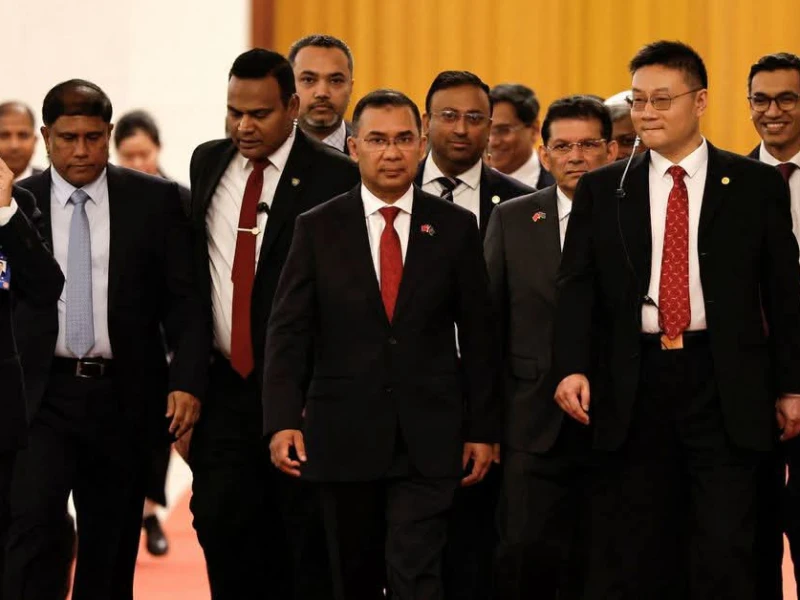
Prime Minister Tarique Rahman’s first overseas tour since assuming office has yielded a series of diplomatic, economic and strategic gains for Bangladesh, with his back-to-back visits to Malaysia and China focusing on investment, trade, labour migration and long-term infrastructure cooperation.
The first foreign tour underscored the government's foreign policy priority of attracting investment, expanding export markets and creating overseas employment while maintaining balanced relations with key Asian partners.
The Malaysia leg of the visit centred on the interests of Bangladeshi migrant workers, one of the country's largest sources of remittance.
Prime Minister Tarique urged Malaysian Prime Minister Anwar Ibrahim to reopen Malaysia's labour market for Bangladeshi workers after recruitment restrictions imposed in 2024.
The two leaders also discussed regularisation of undocumented Bangladeshi workers, repatriation of detainees and ensuring transparent and ethical recruitment practices.
Both countries signed agreements covering investment promotion, culture and counterterrorism cooperation, while also agreeing to continue negotiations on a proposed Bangladesh-Malaysia Free Trade Agreement that could significantly expand bilateral trade.
The visit also reinforced Malaysia's commitment to increasing investments in Bangladesh and strengthening cooperation in manufacturing, education and skills development.
The China visit produced the largest package of outcomes, reflecting Beijing's growing economic engagement with Bangladesh.
Bangladesh and China signed multiple memorandums of understanding spanning trade, investment, artificial intelligence, green technology, healthcare, education, water resources and infrastructure cooperation. Reports indicate between 13 and 17 agreements were concluded during the visit.
One of Bangladesh's major achievements was securing China's commitment to work toward reducing the large bilateral trade imbalance by increasing imports of Bangladeshi products, including leather goods, pharmaceuticals, aquatic products and agricultural commodities.
Dhaka also sought faster implementation of ongoing Chinese-funded infrastructure projects while inviting additional Chinese investment in industrial parks, manufacturing and export-oriented industries.
The long-discussed Teesta River project received fresh momentum during the visit.
Bangladesh and China agreed to deepen cooperation on Teesta River management and broader water-resource development, with both sides expressing willingness to advance technical collaboration on river management and environmental sustainability.
The two countries agreed to expand cooperation in economic zones, port development and industrial infrastructure.
Chinese companies were encouraged to increase investment in Bangladesh's manufacturing sector, while both sides reaffirmed cooperation under the Belt and Road Initiative and discussed development of the China-Myanmar-Bangladesh Economic Corridor.
Analysts view the twin visits as signalling Bangladesh's multidimensional foreign policy, with Dhaka seeking to diversify economic partnerships while strengthening ties with both Southeast Asia and China.
The government has presented the tour as part of a broader strategy to secure foreign direct investment, generate employment, expand exports and accelerate infrastructure development at a time when Bangladesh is pursuing higher economic growth.
While many agreements signed during the visits are framework arrangements whose success will depend on implementation, the tour has already produced tangible diplomatic gains by advancing discussions on labour migration, trade expansion, investment, water cooperation and major infrastructure projects.
Officials say the next challenge will be translating these commitments into concrete investments, employment opportunities and export growth that deliver measurable economic benefits for Bangladesh.
 Prev Post :