
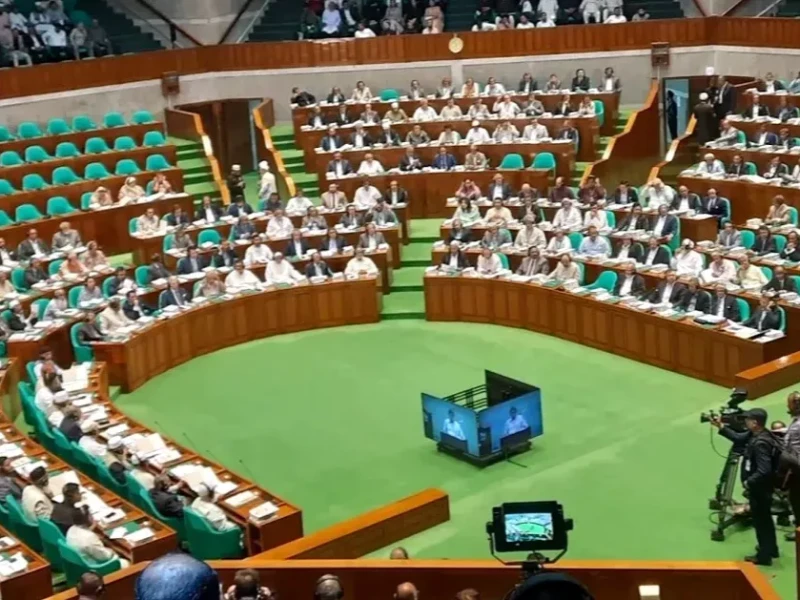
The Public Procurement (Amendment) Bill, 2026 was passed in Parliament on Thursday as the government moves to modernise the nation's public purchasing framework.
Finance Minister Amir Khosru Mahmud Chowdhury placed and moved the bill in the House, which was passed by voice vote.
The proposed legislation aims to overhaul the nearly two-decade-old law to align Bangladesh with international best practices, focusing on sustainability, transparency, and "Value for Money."
The bill seeks to formalise the Public Procurement (Amendment) Ordinance, 2025, which was previously promulgated by the President during the Prof Muhammad Yunus-led interim government.
One of the most significant changes lies in the fundamental objective of the law. The amendment replaces the singular focus on "transparency and accountability" with a comprehensive mandate.
The new preamble will emphasise best value for money, efficiency, ethics, quality, and sustainable procurement.
For the first time, the law introduces the concept of Sustainable Public Procurement (SPP).
This mandates that the government must consider environmental protection, social progress, and economic development when purchasing goods or services.
Under the new Section 16, the government is prohibited from including any terms in tender documents that negatively impact the environment or violate workers' rights, including wages, social benefits, and the prohibition of child labour.
The bill also introduces technological advancements such as reverse auctioning, a real-time electronic bidding process where suppliers compete by gradually lowering their prices to win a contract.
This is expected to drive down costs for standardised goods. Furthermore, the bill makes the Electronic Government Procurement (e-GP) portal mandatory for all public procurement processing.
Any exception to this rule will now require prior approval from the Bangladesh Public Procurement Authority (BPPA).
Key structural reforms include the formal recognition of the BPPA as the primary regulatory body and the categorisation of "physical services" as a distinct type of procurement.
The law also expands the use of Framework Agreements, allowing multiple government agencies to purchase commonly used goods from pre-selected suppliers over a set period.
Addressing practical challenges for international operations, the bill allows Bangladeshi embassies and missions abroad to follow the local procurement laws of their host countries or international standards, provided they receive prior approval from the Cabinet Committee on Economic Affairs.
To protect the domestic industry, the bill stipulates that for IT services funded by the government's own resources, international tenders must include a local consultancy firm as a joint venture partner.
About the object of the bill, Khosru said to ensure the legal framework for ensuring fairness, accountability, timeliness and free competition in government procurement management, the government formulated the Public Procurement Act, 2006 (PPA 2006) on 6 July 2006.
With the aim of making the government's speedy process more efficient and easier through necessary amendments and additions. The said act has been amended a total of five times till 2016.
As the issue of ensuring efficiency, ethics and quality in government procurement and the best value for money (Value for Money) has been considered relevant and necessary in recent times, the need for inclusion of government procurement in the legal framework was felt.
In addition, the minister said the need to formulate an alternative provision to the said provision arose due to the imposition of price capping in internal procurement in the fifth amendment made to the act in 2006, which significantly reduced the level of competition in government procurement.
Therefore, in order to ensure consistency with international best practices, it is necessary to amend the Public Procurement Act, 2006 (PPA 2006) by including the following topics: formulation of procurement strategies, introduction of the concept of 'Sustainable Public Procurement' in government procurement, provision for asset disposal, inclusion of reverse auction, consideration of 'infrastructural service’ as a separate type of procurement, etc.
Later, on May 4, 2025, the Public Procurement (Amendment) Ordinance, 2025 was issued by the President, which was implemented by the government through a gazette notification from September 28, 2025.
 Prev Post :