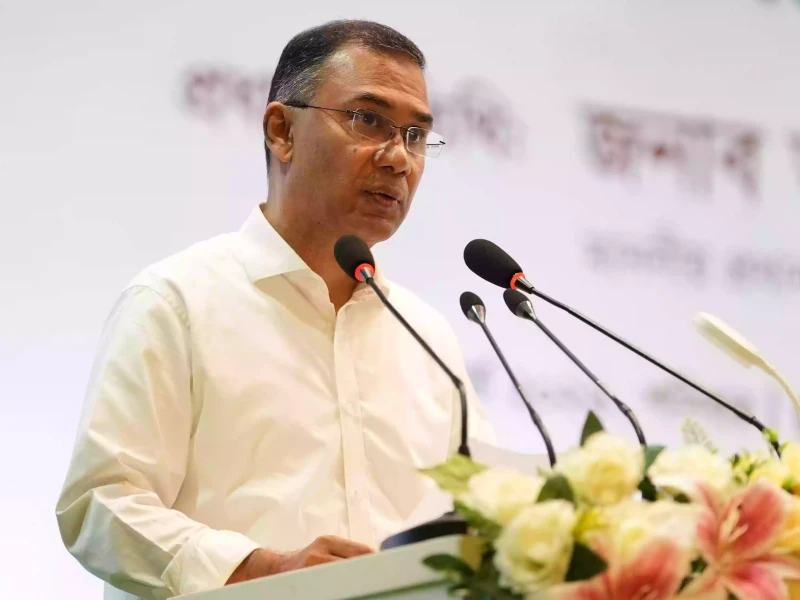
Prime Minister Tarique Rahman on Saturday expressed his determination to build a peaceful and secure Bangladesh through united efforts of people of all religions and warned against any attempt to create division among them.
“Today people of all religions are sitting together in one row here. This has been a long-standing tradition of Bangladesh. No one should be allowed to create division among us. Muslims, Hindus, Buddhists and Christians—we will all work together, Inshallah, to build a peaceful Bangladesh,” he said.
The Prime Minister made the remarks while inaugurating a pilot programme under the Ministry of Religious Affairs at the Osmani Memorial Auditorium to provide monthly honourariums to imams, muazzins, khatibs and other religious leaders, including priests and Buddhist monastery principals.
Tarique Rahman, also the Chairman of BNP, mentioned that the people of all religions in Bangladesh have always lived together in peace.
“We want to build a safe state and a secure society for everyone—something that people from all classes and professions desire. Once again, through today’s programme, we take an oath to build our beloved Bangladesh into a country where people of every religion and every profession can live in peace. Together, we will build this country. Let this be our oath and our expectation,” he said.
Tarique said he believes every religion carries positive messages for building a morally enriched human society and stressed that people with religious knowledge have a crucial role in promoting religious, social and moral values in society.
He said economic prosperity may bring comfort, but virtues such as patience, honesty, gratitude, respect, loyalty, solidarity, tolerance, generosity, friendship, humility, responsibility and compassion can only be cultivated through moral and social values.
“Religious leaders have a vital role in fostering this moral and social consciousness.”
The Prime Minister said the government’s programme to provide honorariums to khatibs, imams and muazzins has reached its first phase under a pilot scheme.
A total of 4,908 mosques, 990 temples, and 144 Buddhist monarchies are covered, benefiting 16,992 religious leaders with monthly honorariums.
He promised that everyone will be gradually included under this programme.
Tarique said the main goal of such economic initiatives for people of all professions is to help people become financially self-reliant.
At the same time, he made a humble appeal to religious leaders, saying that if they wish to participate in other economic or social activities alongside their duties at mosques or places of worship, the government is ready to support those initiatives as well.
The Prime Minister said his government will make its best efforts, within the capacity of the state to ensure financial and social security for every citizen regardless of religion or background.
He, however, said citizens also have responsibilities towards the state and society. “If each of us performs our duties properly from our respective positions, I hope that within the next 10 years we will see a politically and economically self-reliant Bangladesh, Inshallah.”
The Prime Minister said the government wants mosques and other religious institutions to become centres of religious, social and moral education.
He said during the tenure of the BNP founder and ex-president Ziaur Rahman, the first imam training academy was launched, and in 1993, under Begum Khaleda Zia’s government, mosque-based child and adult education programmes were introduced.
Tarique Rahman said the current government has not only introduced honorariums for imams, muazzins and other religious leaders, but is also planning ways to enhance their leadership skills and utilise their talents for national development.
He said the Home Ministry has decided to include one imam, one khatib, or religious leaders from any other faith as a member of the law-and-order committees in every district and upazila.
The Prime Minister said the government wants to reduce financial inequality and ensure peaceful coexistence by providing allowances or financial support and creating employment opportunities for economically disadvantaged group.
“We made these promises to people before the national elections, and after forming the government, we began implementing them even before the ink on the ballots had dried, Alhamdulillah,” he said.
Tarique said the government has already introduced the Family Card for economically disadvantaged women and gradually, it would reach the female heads of four crore families across Bangladesh.
He added a pilot project for the Farmers Card will be launched on April 14, and the canal-digging programme will begin in Dinajpur on March 16.
“By ensuring the political and economic empowerment of every citizen, we aim to build Bangladesh on a strong foundation, so that no fascist or anti-democratic force can deprive people of their freedom or right to speak. Religious leaders should be able to speak freely, and citizens should be politically and economically empowered to strengthen the nation,” the Prime Minister observed.
During the programme, , the Prime Minister distributed cheques for the monthly among imams, muazzins, khatibs, priests and monastery principals and vice-principals from across the country.
The payments were also sent directly to the recipients’ mobile accounts immediately after the Prime Minister pressed the iPass baton.
Local Government Minister Mirza Fakhrul Islam Alamgir, Prime Minister’s Public Administration Adviser Ismail Zobihullah, senior religious leaders from various faiths, and officials including the Religious Secretary Munshi Alauddin Al Azad, among others, spoke at the programme with Religious Affairs Minister Kazi Shah Mofazzal Houssain (Kaikobad) in the chair.
 Prev Post :