
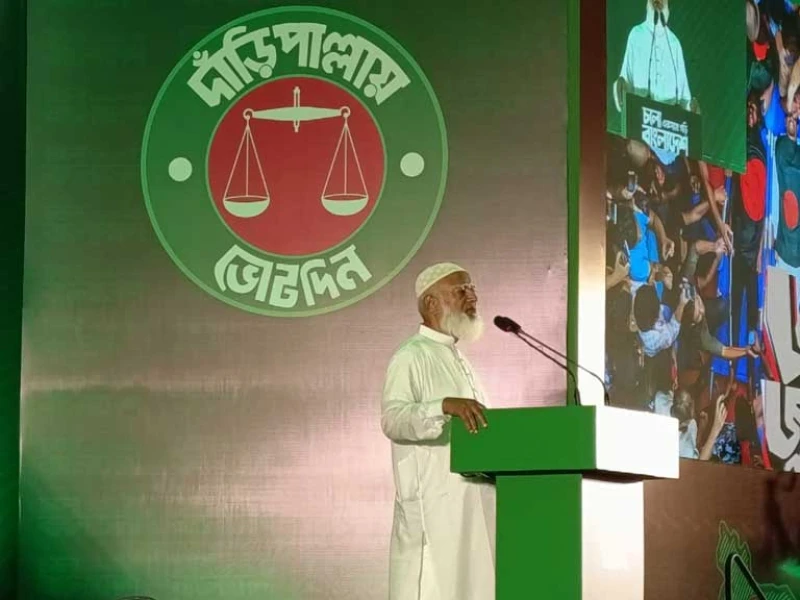
Bangladesh Jamaat-e-Islami has announced a 26-point list of priority areas it says it will focus on if it comes to power, ahead of the upcoming 13th Jatiya Sangsad (national parliament) election.
The party formally unveiled its election manifesto on Wednesday evening at a programme held at a hotel in the capital’s Banani area. Jamaat Ameer Dr Shafiqur Rahman presented the manifesto on behalf of the party.
According to Jamaat-e-Islami, the manifesto places particular emphasis on youth participation in state governance, ensuring women’s safety, building a technology-driven society, implementing the so-called July Charter, and dismantling what it describes as a “fascist system” of governance.
Alongside the 26 priority commitments, the party said its manifesto also outlines broader discussions under 41 separate vision statements covering political, economic and social reforms.
Key priorities outlined in the manifesto
Among the headline commitments, Jamaat pledged to build a state that is “uncompromising on national interest”, safeguarding independence, sovereignty and national dignity. The party also promised to establish a discrimination-free, just and humane society based on fairness and accountability.
Youth empowerment features prominently, with Jamaat saying young people would be given priority in state administration and decision-making. It also committed to creating a safe, dignified and participatory environment for women across all sectors.
On law and order, the manifesto promises stronger enforcement to create a crime-free society, with a specific focus on eliminating extortion and terrorism. The party also vowed to establish honest leadership at all levels and undertake institutional reforms to curb corruption.
Economic pledges include the creation of large-scale employment across technology, manufacturing, agriculture and industry. Jamaat said government job applications would be free of charge, recruitment would be merit-based, and all forms of discrimination would be eliminated.
The party also proposed reforms in the banking and financial sectors to restore public confidence, promote investment and ensure a transparent, sustainable and business-friendly economy.
Electoral, justice and rights reforms
Jamaat-e-Islami reiterated its support for elections under a proportional representation (PR) system and pledged to strengthen the caretaker government mechanism to ensure free and fair polls. It also promised to investigate and bring to justice past incidents of killings, enforced disappearances and extrajudicial actions, while ensuring fundamental human rights.
The manifesto includes commitments to preserve the history of the July movement, rehabilitate families of those killed or injured, and implement the July Charter.
Social development and welfare goals
In agriculture, Jamaat pledged to promote technological use and increase support for farmers to trigger what it described as an “agricultural revolution”. It also set a target of achieving fully adulteration-free food security by 2030, alongside a “three-zero vision” aimed at eliminating environmental degradation, waste and flood risks to build a green and clean Bangladesh.
Other pledges include industrial expansion through small and medium enterprises as well as heavy industry, improved wages and working conditions for labourers—particularly ensuring safe workplaces for women—and securing voting rights and broader participation for expatriate Bangladeshis.
The party also emphasised equal citizenship rights for all, rejecting the majority–minority divide, and promised special support for marginalised communities.
In the social sectors, Jamaat pledged to introduce universal healthcare, with free advanced treatment for the poor in phases, reform the education system in line with global demands and gradually ensure free education, and stabilise commodity prices to keep essentials within people’s purchasing power.
Infrastructure promises include overhauling transport systems, reducing travel time between Dhaka and divisional cities to two or three hours, improving regional connectivity and reforming urban transport in the capital. The manifesto also commits to low-cost housing for lower- and middle-income families.
Governance and social security
Finally, Jamaat said it would continue judicial and reform processes aimed at preventing the return of authoritarian rule, introduce a universal social security system to ensure workplace safety and international-standard protection for citizens, and ensure good governance through transparency and accountability.
The party says these measures together are aimed at establishing what it describes as a happy, prosperous and welfare-oriented state.
 Prev Post :