
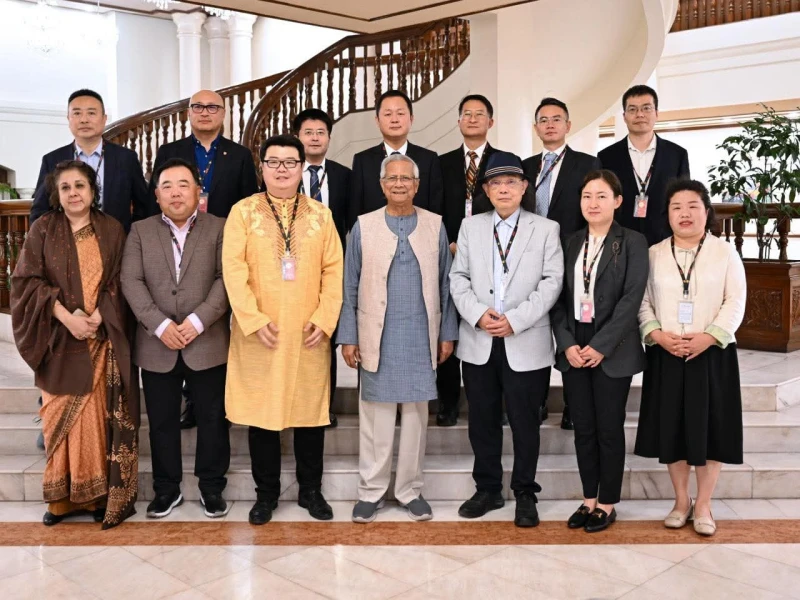
Chief Adviser Professor Muhammad Yunus on Wednesday underscored the need for uninterrupted cooperation between Bangladesh and China, even as a new government prepares to take office, while outlining an ambitious vision for healthcare collaboration, including a proposed “health city” in northern Bangladesh.
He made the remarks during a meeting with a delegation of the China-Bangladesh Partnership Forum at the State Guest House Jamuna.
The delegation comprised senior Chinese academics, investors and industry leaders from the biomedical, infrastructure, digital, construction and legal sectors, who expressed keen interest in expanding cooperation with Bangladesh, particularly in health, technology and capacity-building.
“Although I will be leaving this office in a few weeks and a new government will form, the work between our two countries must go on,” Professor Yunus said, emphasising the importance of continuity in bilateral relations.
Highlighting healthcare as the interim government’s top priority, the Chief Adviser stressed the need to integrate digital technologies into the health system to improve patient access, preserve medical histories and streamline appointments.
“Our highest priority is healthcare—how to connect doctors and patients through digital technology so services become accessible, efficient and people-centred,” he said.
Professor Yunus also called for the promotion of social business models in the pharmaceutical sector, criticising the high cost of medicines despite low production expenses.
“Medicines cost pennies to produce but are sold for dollars. We want social business pharmaceutical companies that exist to help people, not just to maximise profit,” he said.
Recalling Bangladesh’s stance during the COVID-19 pandemic, Professor Yunus reiterated the country’s advocacy for patent-free vaccines, lamenting global inequities in access.
“People were dying while others were making money. We said we don’t need gifts—we need fairness. That was a shameful moment for the world,” he said.
Sharing a major development vision, the Chief Adviser said he had proposed establishing a 1,000-bed international hospital and a comprehensive “health city” in northern Bangladesh during his recent visit to China.
The proposed health city would house hospitals, medical colleges, research centres, vaccine production facilities, pharmaceutical industries and medical equipment hubs, serving not only Bangladesh but also neighbouring India, Nepal and Bhutan.
“It is a poor region, but strategically located. People from across the region could benefit from quality healthcare there,” he added.
During the meeting, Professor Yunus reflected on his long-standing relationship with China, which began through the microcredit movement. He recalled visiting remote Chinese villages and witnessing how similar principles were later adopted by the Chinese government.
He also shared his experience of meeting Chinese President Xi Jinping during a visit in March.
“He told me he had read my book and followed its principles. That was a very happy moment for me,” Professor Yunus said.
Members of the delegation praised Bangladesh’s young talent, noting their recent interactions with university students on artificial intelligence and digitalisation.
Xin-yuan Fu, Director of the West China School of Medicine at Sichuan University, said he looked forward to collaborating with Bangladeshi academics to improve lives through biomedical innovation.
Representatives of Walvax Biotechnology, which exports vaccines to at least 22 countries, shared their experience in localisation of vaccine production, citing ongoing initiatives in Indonesia and interest in similar collaboration with Bangladesh.
The delegation also included representatives from China State Construction Engineering Corporation, PowerChina Overseas Investment Group, China Hunan Construction Investment Group, legal and asset management firms, and leading academic institutions.
They thanked Professor Yunus for the constructive discussion and reaffirmed their interest in long-term collaboration in health, infrastructure and digital development.
SDG Coordinator and Senior Secretary Lamiya Morshed was also present at the meeting.
 Prev Post :