
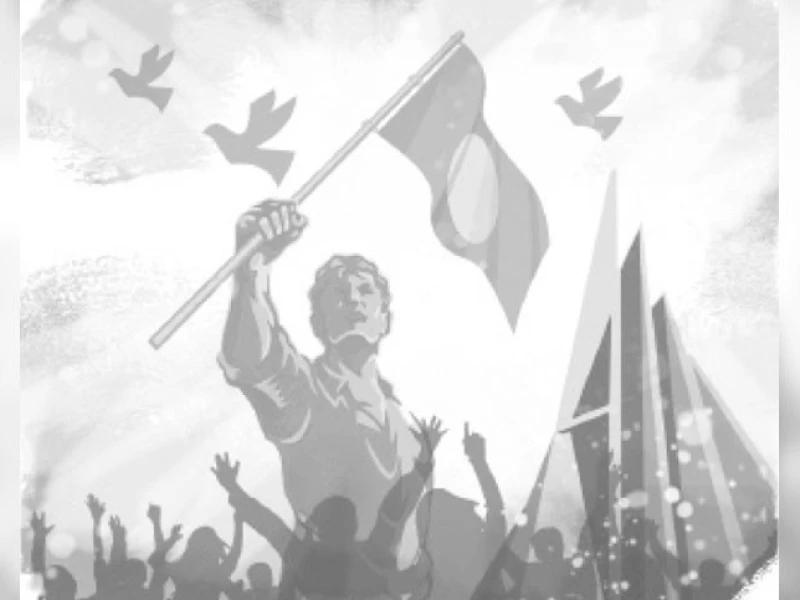
Bangladesh is observing the 54th anniversary of Victory Day today, commemorating the historic triumph achieved through immense sacrifice during the nine-month Liberation War of 1971. On this day, Pakistani occupation forces surrendered, paving the way for the emergence of Bangladesh as an independent nation on the world map.
On December 16, 1971, the red-and-green national flag was raised as the people of Bengal secured freedom through the blood of three million martyrs and the suffering of countless others. Tuesday’s observance of Victory Day is marked with extensive programmes across the country to honour that sacrifice.
The national flag is flying atop government and private buildings, while the National Martyrs’ Memorial in Savar and memorials nationwide are adorned with floral tributes. Victory processions, cultural events and commemorative programmes have brought streets and public spaces to life.
As a special feature this year, the Army, Navy and Air Force are jointly organising a skydiving display in which 54 paratroopers will descend carrying the national flag. According to the Chief Adviser’s Press Office, the event may be recorded as the world’s largest flag-carrying parachute display in the Guinness World Records.
Following the creation of Pakistan in 1947 under the two-nation theory, the Bengali-speaking region became East Pakistan. Deep-rooted linguistic, cultural and economic discrimination soon exposed the fragility of the state structure. The attempt to impose Urdu as the sole state language ignited resistance, which gradually evolved from a movement for autonomy into a full-scale struggle for independence.
The Liberation War began on the night of March 25, 1971, with the Pakistani military’s brutal crackdown. Responding to the call of Bangabandhu Sheikh Mujibur Rahman, ordinary people joined the resistance. After nine months of bloody war, Pakistani forces formally surrendered on December 16 at the then Racecourse Maidan in Dhaka, sealing Bangladesh’s independence.
This year’s Victory Day arrives at a time of significant political transition. The mass uprising of 2024 has altered the country’s trajectory, and the upcoming 13th national parliamentary election, scheduled for February, is expected to shape Bangladesh’s next course. Alongside celebration, the day carries both hope and anxiety over democratic transition.
Concerns over security have intensified following a shooting incident targeting Sharif Osman Bin Hadi, convener of the Inqilab Mancha, shortly after the election schedule was announced. Hadi, who had declared his candidacy from a Dhaka constituency, was injured in the attack, prompting heightened security measures for Victory Day events.
Liberation War Museum trustee and veteran freedom fighter Dr Sarwar Ali said there is no scope to distort or erase the history of the Liberation War. “There may be differences in interpretation, but history cannot be changed or deleted,” he said, stressing that the war was fundamentally a people’s war driven by ordinary citizens.
Another trustee, Mofidul Hoque, said the core spirit of the Liberation War lay in building a society based on secularism and equality. While those values are often questioned in contemporary times, he noted that history ultimately stands on Bangladesh’s side. According to him, the 1971 uprising showed a path of harmony among religion, ethnicity and communal coexistence.
In separate messages marking Victory Day, President Mohammed Shahabuddin said the Liberation War aimed not only at political independence but also economic emancipation and social justice. Chief Adviser Muhammad Yunus described the day as an occasion to renew commitment to national unity and democratic transition.
The day’s programmes began at dawn with a 31-gun salute in Dhaka. At sunrise, the President and the Chief Adviser placed wreaths at the National Martyrs’ Memorial in Savar. Throughout the day, discussions, cultural programmes, parades, victory fairs and special events are being held nationwide to honour the spirit of the Great Victory Day.
 Prev Post :