
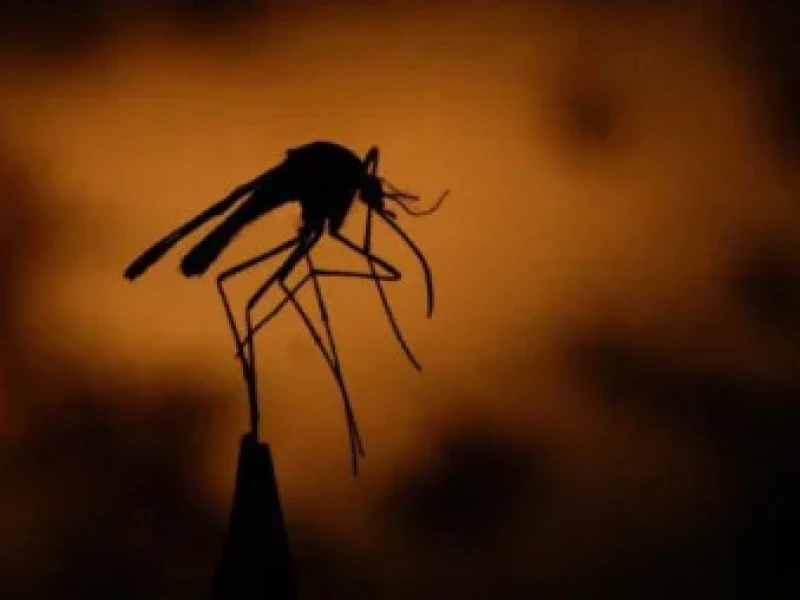
Despite years of heavy spending on mosquito control, Culex infestation continues to plague Dhaka, with residents reporting a sharp rise in mosquito density in recent week.
From Kalyanpur and Gabtoli to Khilgaon, Uttara and Old Dhaka, complaints of worsening conditions are widespread.
On Tuesday afternoon, at a grocery shop in Kalyanpur New Market, Russell Jony was selling goods while burning mosquito coils at three separate spots inside his shop. Even then, he kept brushing mosquitoes off different parts of his body.
Over the past few days, the infestation has increased so much that even burning coils during the day does not help. From evening onwards, customers cannot even stand inside the shop because of the mosquitoes. Many times I close the shop early. There is no relief at home either, so I have covered the windows with nets," he told The Business Standard.
The problem is not limited to Russell. Complaints are rising from Mirpur, Khilkhet, Mohammadpur and Farmgate to Karwan Bazar, Jatrabari, Kamrangirchar, Lalbagh, Shonir Akhra and Shyampur.
Experts link surge to short winter, poor maintenance
Experts say the shorter duration of winter this year created favourable conditions for Culex breeding. Research by entomologists shows that about 92% of mosquitoes currently in Dhaka are Culex, 0.5% are Aedes and around 7% belong to other species.
An investigation by The Business Standard found that, along with the early end of winter, lack of coordination in control efforts, irregular cleaning of city corporation drains and canals, and stalled development works have contributed to the higher prevalence this year.
The prolonged absence of elected representatives in ward offices has slowed both control efforts and waste management. However, officials of both Dhaka city corporations claim their operations are continuing at a normal pace.
Professor Kabirul Bashar of the Zoology Department at Jahangirnagar University told TBS that Culex infestation in Dhaka is increasing daily and may continue until mid-March. "It will not decrease easily without a major storm or heavy rainfall."
He added that mosquito density is not uniform across the capital.
Peripheral areas such as Mugda, Manda, Khilgaon, Kamrangirchar, Lalbagh, Shonir Akhra, Shyampur, Rayerbazar, Uttara and adjoining Savar have higher larval and adult mosquito density. Central areas like Shahbagh, Farmgate and Paribagh have comparatively lower density," he said.
"Compared to January, mosquito numbers in February have increased by about 50%, and the rise is continuing. Currently, 92% of mosquitoes in Dhaka are Culex and around 0.5% are Aedes."
He cited a mild and short winter, pollution in drains, canals, lakes and water bodies, and weak programmes due to the absence of elected representatives as key reasons for the increase.
He warned that without effective measures, Aedes mosquitoes may increase rapidly once the rainy season begins.
"As temperatures rise and rainwater accumulates, breeding conditions for Aedes will improve. There is no alternative to strengthening control activities," he said.
Field-level challenges persist
In Ward 39 under Zone 9 of Dhaka North City Corporation, road and drain renovation works in Nurerchala and Khilbarir Tek have remained incomplete for months. The areas remain unclean, and stagnant water and waste have created breeding grounds.
Hafizul, a resident of West Khilbarir Tek, told TBS that from evening they cannot keep doors or windows open due to the infestation.
"Even after using aerosol sprays and coils, there is no relief," he said.
He said city corporation workers visit once a week, but do not spray everywhere.
"Over the past two weeks, the infestation has increased sharply. Without a ward councillor, complaints bring no result," he added.
Mosquito control supervisor Md Sakil Hossain of Dhaka North City Corporation said ongoing road and drain works have left water and waste stagnant in the ward.
Even after applying chemicals, it is not very effective in those conditions," he said.
He added that in some buildings, workers are obstructed from entering, and accumulated waste becomes breeding grounds.
"Without elected representatives, it is difficult to enforce proper measures. When infestation increases, residents often argue with workers," he said.
Workers alleged that without ward councillors they cannot pressure building owners to clean surrounding waste or allow spraying.
Since the beginning of Ramadan, they have also been unable to conduct adequate fogging in busy areas in the afternoon due to iftar stalls and public gatherings.
Mosquito control supervisor Anwar Shadat, responsible for Ward 26 areas including Tejkunipara, Farmgate and Tejgaon, said irregular canal cleaning and accumulated waste around buildings are major breeding sources.
"In many places, chemicals cannot reduce mosquito density. Without local representatives and proper waste removal, control is difficult, as treatment often fails to reach stagnant water inside drains," he said.
In Khilgaon under Dhaka South City Corporation, resident Hossain Tarek said he has to keep his six-month-old baby covered with socks despite the heat.
"Even inside a mosquito net, mosquitoes bite. Using creams does not help. There is severe infestation across Dhaka, yet control activity is hardly visible," he said.
Limited impact despite Tk1,012 crore spending
Over the past 10 years, Dhaka North and South city corporations have spent Tk1,012 crore on control programmes and procurement, yet infestation remains widespread.
From FY2016-17 to FY2025-26, Dhaka North spent Tk688.39 crore, while Dhaka South spent Tk323.63 crore. The largest share of the budget went toward purchasing insecticides.
In FY2025-26, Dhaka North allocated Tk187.75 crore for control operations, including Tk80 crore for chemicals and Tk45 crore for outsourced activities. Dhaka South allocated Tk53.50 crore, of which Tk45 crore is for procurement.
Officials said procurement for the current fiscal year has been completed, and spending may exceed the allocated budget.
Experts say no other city corporation or municipality in the country spends as much on mosquito control as Dhaka, yet residents are not receiving proportionate benefits.
Administrators promise action
The newly appointed administrators of both Dhaka city corporations yesterday inspected control operations and insecticide storage facilities, a day after submitting their joining papers at the ministry.
Dhaka South City Corporation Administrator Md Abdus Salam said, "When I take office, I will formulate plans for mosquito control."
"Dhaka must remain clean. Mosquito infestation is likely to increase in the coming days. We must plan now on how to control it. We will also consider how to generate electricity and fertiliser from waste to keep the city clean," he said.
He added that mosquito control is not the sole responsibility of city corporations and called for greater public awareness.
Dhaka North City Corporation Administrator Shafiqul Islam Khan said unfinished development works would be prioritised and mismanagement reviewed. He pledged to perform his duties with honesty and integrity.
Health and Family Welfare Minister Sardar Md Sakhawat Hossain yesterday said Culex mosquito numbers have increased significantly.
"Within seven days of taking oath, the ministry has taken steps. Control activities will be carried out through both water and land routes. Spray boats will be used in canals," he said.
"Without public cooperation, dengue prevention is not possible," he added.
He said several insecticide samples have been collected from city corporation storage facilities and will be tested. If found ineffective, alternative measures will be taken.
 Prev Post :