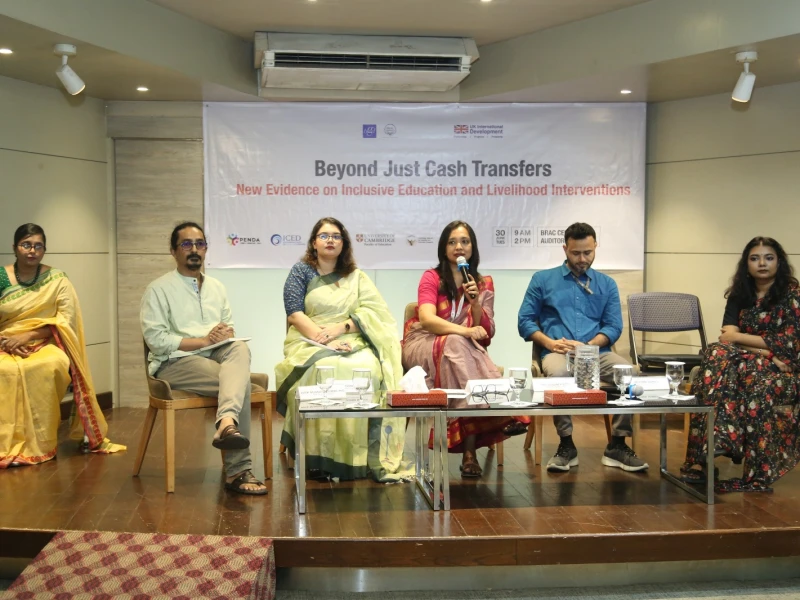
Disability-inclusive interventions that go beyond cash transfers are significantly improving livelihoods and educational access for persons with disabilities in Bangladesh, according to new research presented at a joint event of the BRAC Institute of Governance and Development (BIGD) and the London School of Hygiene & Tropical Medicine (LSHTM) on Tuesday.
The event, held at the BRAC Centre Auditorium in Mohakhali, brought together academics, practitioners, persons with disabilities and their representative organisations, policymakers and development partners to share evidence on advancing economic and educational inclusion for persons with disabilities.
Speakers said lasting change requires moving beyond cash transfers towards holistic interventions that build livelihoods, widen access to quality education, and connect research with policy and practice.
Globally, 1.3 billion people with disabilities face disproportionately high poverty and social exclusion, while around 240 million children with disabilities continue to face barriers to quality education that limit their future economic prospects, the event heard.
In Bangladesh, inadequate inclusive infrastructure, limited teacher capacity and financial constraints continue to hinder educational participation for children with disabilities.
"There is a two-way relationship between disability and poverty. For households with persons with disabilities, lifting themselves out of poverty is considerably more difficult. We need to address poverty and disability together," said Imran Matin, Executive Director of BIGD, in his opening remarks, adding that while cash transfers remain a citizen's right for persons with disabilities, efforts must go further.
Tahera Jabeen, Social Development Adviser at the British High Commission in Dhaka, said the UK remains committed to advancing disability-inclusive development by strengthening the link between evidence and practical action, citing programmes such as the Programme for Evidence to Inform Disability Action (PENDA) that support inclusive policymaking in Bangladesh.
Mark Carew of LSHTM's International Centre for Evidence in Disability, who worked on the research, said the new evidence shows BRAC's Disability Inclusive Ultra-Poor Graduation (DIUPG) Programme is helping persons with disabilities move out of poverty, while Sightsavers' Shikhbo Shobai programme is making education more inclusive for children with disabilities.
Findings presented during the first session showed the DIUPG programme significantly improved economic well-being among participating households, raising per capita monthly income and household expenditure. Among persons with disabilities specifically, the programme led to a 21 percent rise in employment, a 27 percent increase in working hours, and a 30 percent jump in earnings.
The second session examined the Shikhbo Shobai programme, presenting evaluation findings on a holistic educational intervention for children with disabilities.
During the closing panel, Salma Mahbub, Founder General Secretary of B-Scan, said children with disabilities continue to fall behind in schools due to a shortage of trained teachers, and called for disability education to be brought under the Ministry of Education, noting that special schools often reinforce segregation rather than closing the gap.
Responding, Mohammad Nazmul Ahsan, Joint Secretary (Planning and Development) at the Ministry of Social Welfare, said the government follows a life-cycle framework under which special education is integrated with broader social protection initiatives rather than treated as an isolated requirement.
SM Zulfiqar Ali, Research Director at the Bangladesh Institute of Development Studies, who moderated the session, said the government must remain in the driving seat while bringing together NGOs, civil society and the private sector to make inclusive development a reality.
Morgon Banks, Associate Professor of disability research at LSHTM's International Centre for Evidence in Disability, closed the event by calling for translating the day's lessons into sustainable change so that inclusion becomes standard practice in Bangladesh and beyond.
 Prev Post :