
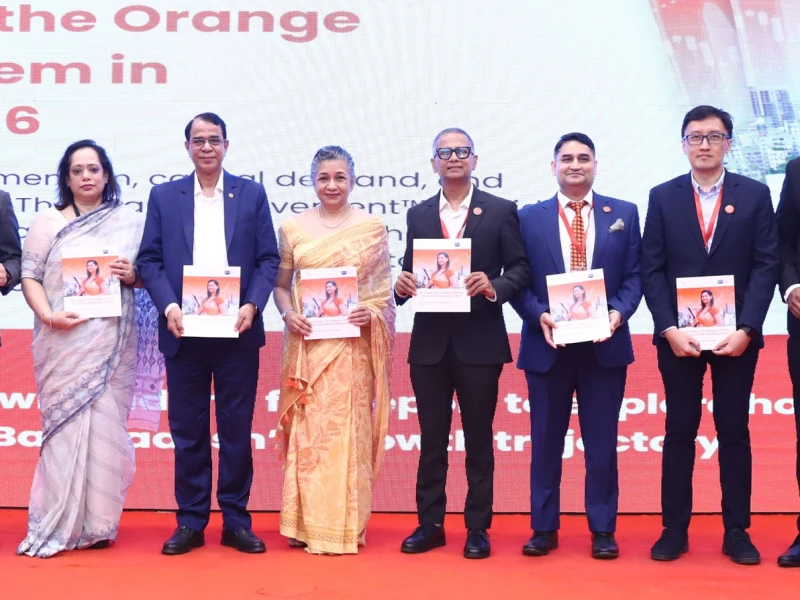
Bangladesh Bank Deputy Governor Habibur Rahman on Tuesday called for building a sustainable and diversified financial market as the country navigates its transition from least developed country (LDC) status, stressing that innovative financial instruments like Orange Bonds can play a transformative role in advancing climate resilience, women's empowerment and inclusive growth.
“The Orange Bond is a historic milestone for our capital market,” Habib said, highlighting the country's first Orange Zero Coupon Bond issued through Sajida Foundation.
He reaffirmed Bangladesh Bank's full backing to attract $100 million in Orange investment by 2030, underscoring the importance of positioning Bangladesh as an attractive investment destination through inclusive and sustainable financing.
The deputy governor was speaking as chief guest at the 'Orange Economy Summit 2026: Dhaka', jointly organised by Dhaka Stock Exchange (DSE), Impact Investment Exchange (IIX) and Policy Research Institute of Bangladesh (PRI) at the DSE premises.
The summit centred on the potential of a $100 million investment under IIX's Orange Climate Fund for Bangladesh, development of the country's Orange Capital ecosystem, and the role of capital markets in achieving long-term, inclusive and sustainable economic growth.
In her welcome address, DSE Managing Director Nuzhat Anwar expressed satisfaction at hosting the summit, saying economic growth must go hand in hand with social inclusion and climate resilience to ensure sustainable development.
She noted DSE's commitment to sustainable finance, corporate governance and implementation of international standards, adding that such initiatives would help raise awareness of Orange economy instruments and strengthen the regulatory framework for capital market development.
IIX Founder and CEO Professor Durreen Shahnaz, delivering the opening remarks, said building a robust and inclusive financial market is indispensable for Bangladesh's long-term sustainable growth amid its LDC graduation.
She identified vast investment potential in the readymade garments, agriculture, energy transition and financial services sectors, saying deepening the capital market is essential to unlock that potential.
Describing the 'Orange Movement' as a global initiative to build inclusive capital markets, Shahnaz said IIX is working to mobilise $10 billion by 2030. She disclosed that IIX has invested over $18 million in Bangladesh over the past decade and announced that $100 million has been earmarked for Bangladesh under IIX's $1 billion Orange Climate Fund.
She expressed confidence that Bangladesh can emerge as a leading Orange economy in South Asia by building a robust Orange Capital ecosystem.
PRI Chief Economist Ashikur Rahman presented the keynote paper titled 'Building an Orange Capital Ecosystem in Bangladesh', noting that the country must overcome challenges including job creation, climate risk management and increased investment in productive sectors to achieve LDC graduation and a trillion-dollar economy.
He argued that Orange Capital can serve as an innovative financing framework to address existing structural pressures and limitations in banking, capital markets, bonds and venture capital.
Ashik said the groundwork has already been laid through Green Bonds, Social Bonds and the country's first Orange Bond, and what is now needed is policy support, market-driven innovation and attraction of international capital to build a strong Orange Capital market.
The summit concluded with a session on 'Experience Sharing from Emerging Markets', moderated by IIX Senior Director (Research and Government Relations) Priyank Tiwari.
IIX Indonesia's Antya Widita and IIX Director of Impact Partners (Investment Banking) Jonathan Abeywickrema shared experiences on inclusive financing, sustainable investment and the role of Orange Capital in capital market development across emerging economies, while also exploring how international best practices can be applied in the Bangladesh context.
 Prev Post :