
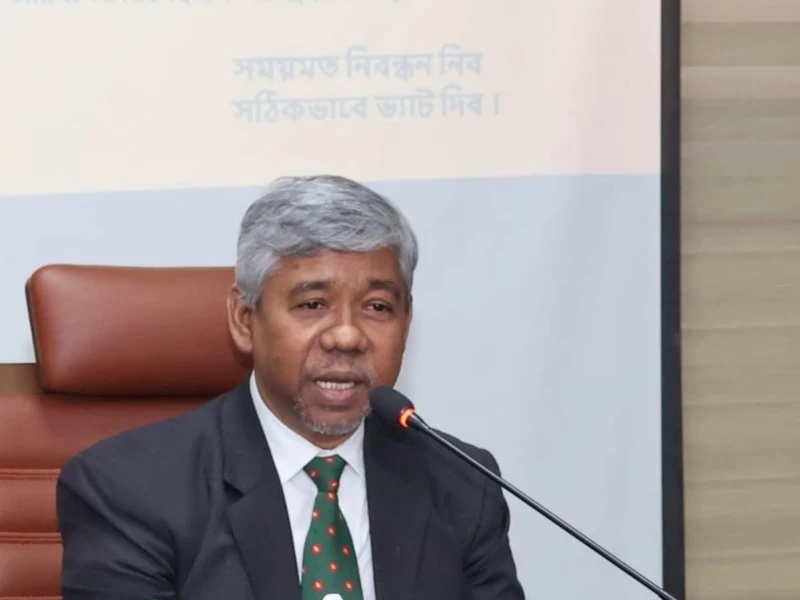
The desired collection of value-added tax (VAT) is not being achieved due to the complexity of VAT laws and multiple rates, said National Board of Revenue (NBR) Chairman Md. Abdur Rahman Khan.
Speaking at a press conference on Tuesday marking the observance of ‘VAT Day and VAT Week 2025,’ the NBR chairman said that as the country’s revenue system has long relied on imports, pressure falls on the general public. To ease this, the NBR is focusing on increasing emphasis on income tax and VAT.
He said the NBR has set a target of registering 100,000 new VAT payers this year.
Md. Abdur Rahman noted that the VAT law of 1991 was complex, prompting the enactment of a new law in 2012. However, over time, new complexities have emerged. “This time, efforts will be made to simplify the VAT system by introducing a single rate instead of multiple rates. Simplifying VAT will also make automation easier, as overly complex processes are difficult to manage digitally,” he said.
“Businesspeople need to understand that they do not pay VAT; consumers do. Once the process is fully automated, revenue collection will increase significantly,” he added.
The chairman said work is ongoing to bring a larger portion of GDP into the tax net, noting that sustainable revenue collection is essential for delivering state services and uplifting disadvantaged groups.
He added, “In the future, the NBR will develop its own system for small businesses. Simplifying laws and digitising audits will further encourage compliance. VAT refund automation is almost complete, which will provide major benefits to businesspeople.”
On reducing pressure on traders at customs, he said, “Even with automated systems, desired results will not be achieved if they are not properly used. Some complexities in the ASYCUDA system need to be addressed so importers and exporters no longer have to crowd customs offices.”
Md. Abdur Rahman also noted that after graduating from LDC status, the current duty structure cannot be maintained. Efforts are ongoing to reduce the tariff structure annually, and in the future, customs houses will prioritise security and controlling prohibited goods over revenue collection.
He further said that the banking sector has delivered a significant setback and corporate tax collection has fallen short of targets. “Due to a smaller budget, development allocations have also decreased, impacting revenue generation. Yet, despite all challenges, revenue growth is expected to remain above 16 per cent by the end of November,” he said.
The chairman said operations against tax evaders have been intensified, noting that additional growth was achieved by curbing leakages. “If revenue leakages are plugged, VAT and income tax collection will rise further. At the same time, an equitable tax system must be ensured – those who earn more should pay more, while those without income will not be burdened,” he added.
-1765207859.webp) Prev Post :
Prev Post :
-1765276615.webp)