
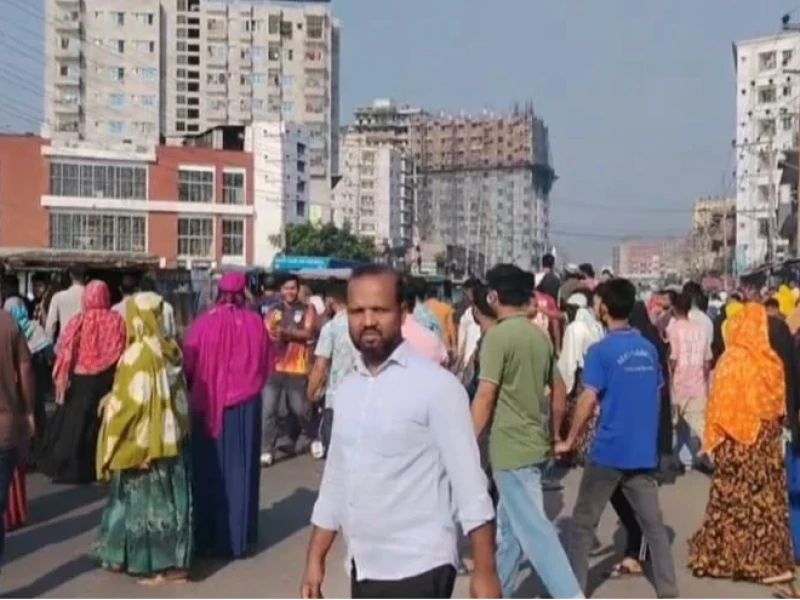
Bangladesh’s readymade garment (RMG) industry is facing mounting operational and commercial pressures amid prolonged labour unrest, factory closures, and broader domestic political instability, prompting major international buyers to urge a swift resolution as shipment schedules and upcoming work orders hang in the balance.
Factory owners and sector experts warn that the disruptions—spanning key apparel hubs including Savar, Ashulia, Jirani, Gazipur, Mymensingh, Mirpur, and Narayanganj—have already cost the sector an estimated Tk 3,000 crore to Tk 4,000 crore, with daily losses calculated at roughly Tk 200 crore to Tk 220 crore.
Concern among buyers
At a meeting with leaders of the Bangladesh Garment Manufacturers and Exporters Association (BGMEA) at its Uttara office, representatives of major European and North American fashion retailers—including H&M and Inditex—expressed concern over shipment delays and production disruptions caused by protests and walkouts.
A BGMEA director, speaking on condition of anonymity, noted that while the current window is a critical period for orders ahead of the lucrative upcoming autumn and winter seasons, many overseas buyers have adopted a "wait-and-see" approach.
Retailers are seeking clarity on Bangladesh’s new minimum wage structure and supply reliability before committing to fresh order volumes.
Tensions have flared over wage demands amid rising living costs and inflation, alongside grievances regarding overdue wages and allowances, job security, and workplace safety. While the existing minimum monthly wage stands at Tk 12,500, some workers and worker representatives have pressed for a hike to Tk 32,000.
On November 1, the government formed a six-member minimum wage board, with a target to bring a new wage structure into effect from December 2026. The workers' side has proposed a Tk 32,000 minimum wage, while owners' representatives are scheduled to submit their proposal at a meeting on November 23.
Industry sounds alarm
Industry leaders have stressed that restoring order and factory security is essential to keep production running and protect Bangladesh's standing as the world's second-largest apparel exporter.
BGMEA President Mahmud Hasan Khan warned that ongoing protests and disruptions have severely hampered production—with an average of around 70 factories shut daily since the unrest began, and peak single-day closures hitting 679 factories across major clusters, and affecting roughly 1.68 million workers (Nov. 2). Even where factories have opened or workers have punched in, go-slows, walkouts, and clashes have disrupted output and raised costs.
"A negative message is going out to foreign buyers, and new orders are declining," Khan said, noting that many buyers are looking to alternative sourcing destinations while rising operating costs squeeze margins and threaten long-term employment.
Both Khan and Bangladesh Knitwear Manufacturers and Exporters Association (BKMEA) President Mohammad Hatem have underlined that sustaining factory operations is difficult without guaranteed security on the shop floor. Some factory owners have pointed to provisions under Section 13(1) of the Bangladesh Labour Act 2006 ("no work, no pay") amid shutdown notices at several units, while industry insiders note that temporary closures or general holidays differ from permanent shutdowns, even as small and medium enterprises face acute cash-flow strain.
Meanwhile, Bangladesh Garment Buying House Association (BGBA) President Md Abdul Hamid told a press conference in Dhaka on Thursday (November 19) that ongoing unrest, closures, and road blockades have already caused losses amounting to Tk 3,000 crore to Tk 4,000 crore. The daily losses amount to between Tk 200-220 crore, he also claimed.
Warning that missed deadlines risk costly air shipments, price discount demands, order cancellations, or shifting to competitors such as India, Vietnam, Cambodia, and Pakistan, Hamid called for urgent government intervention and a pragmatic settlement among the government, BGMEA, BKMEA, buying houses, and worker representatives.
Experts urge dialogue and confidence-building
Sector analysts and economists emphasize that the crisis goes beyond immediate shop-floor grievances, touching export earnings—where RMG accounts for over 80 percent of merchandise exports—foreign exchange inflows, backward and forward linkages, and overall investor sentiment at a time when the economy is already navigating broader political and macroeconomic headwinds.
Dr. Fahmida Khatun, Distinguished Fellow at the Centre for Policy Dialogue (CPD), cautioned that prolonged instability risks delaying export deliveries, eroding buyer confidence, diverting future orders to rival countries, and harming the wider investment climate. She stressed that fair worker demands should be addressed through dialogue while ensuring factory security to restore normal production swiftly.
Similarly, Mohiuddin Rubel, a former BGMEA director and founder and CEO of Bangladesh Apparel Voice, noted that repeated disruptions raise questions about Bangladesh's delivery reliability in global markets.
Highlighting how proactive communication and coordination helped keep production moving in Chattogram's roughly 340 factories, he urged owners and workers to build trust through ongoing engagement and realistic negotiations that balance living costs with production viability.
 Prev Post :