
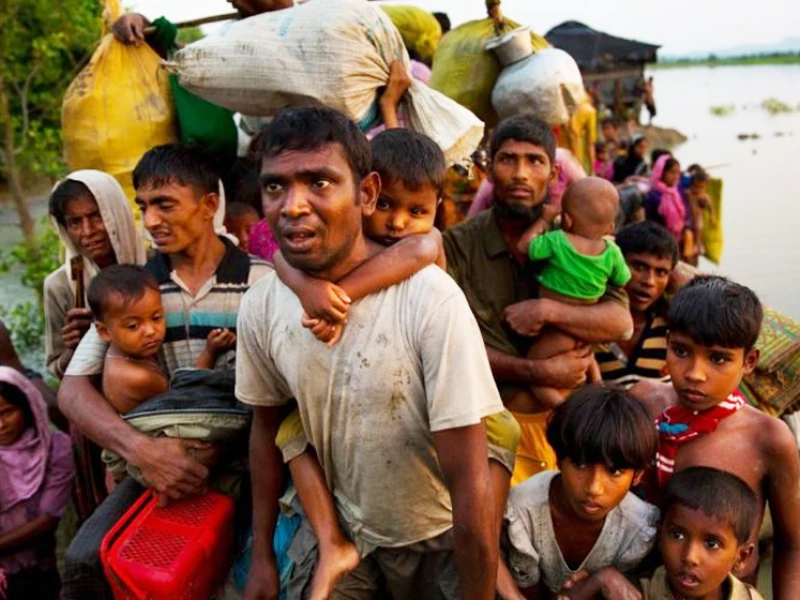
The United Nations’ highest court on Thursday ruled that Myanmar committed genocide against the Rohingya minority during a brutal military crackdown in 2017, marking a historic development in the international effort to secure justice for the persecuted community.
In a 9-6 majority decision, the International Court of Justice (ICJ) found that Myanmar violated its obligations under the Genocide Convention through its actions against the Rohingya in northern Rakhine state.
Reading out the judgment, ICJ President Yuji Iwasawa said Myanmar's security forces killed thousands of Rohingya civilians, committed widespread sexual violence, carried out extreme acts of brutality against children and attacked people fleeing the violence.
The 15-member judicial panel also dismissed Myanmar's argument that the 2017 military campaign was a legitimate operation against insurgents.
The ruling represents the first time the ICJ has declared that a state committed genocide.
"This is a great day for the Rohingya, and it is a great day for all oppressed people, everywhere, who have been told that their suffering does not count and that no one is listening," said Rohingya rights activist Yasmin Ullah, who attended the three-hour court session.
Earlier, the court said the only reasonable conclusion from evidence of widespread atrocities committed by Myanmar's security forces was that they intended to destroy a substantial part of the Rohingya community.
Under international law, the intention to destroy a national, ethnic, racial or religious group, in whole or in part, is a fundamental requirement for establishing genocide.
The proceedings were initiated by The Gambia in 2019, accusing Myanmar of violating the 1948 Genocide Convention. The West African country asked the court to order Myanmar to stop acts of genocide against the Rohingya and ensure that those responsible are brought to justice.
Myanmar has consistently defended the military operation, describing it as a counterterrorism campaign against insurgents and rejecting allegations of genocide.
In August 2017, Myanmar's military launched what it called a clearance operation in northern Rakhine state following attacks by a Rohingya insurgent group. The offensive was accompanied by allegations of mass killings, sexual violence and the burning of thousands of homes.
The crackdown forced hundreds of thousands of Rohingya, most of them Muslims, to flee across the border into Bangladesh.
Around 1.2 million Rohingya refugees are now living in Bangladesh, mainly in overcrowded camps in Cox's Bazar, where they face inadequate sanitation, disease outbreaks, fire hazards, landslides during the monsoon and restrictions on employment.
Gambia has also sought reparations for the Rohingya, including measures to ensure their full citizenship rights in Myanmar and their safe return to their homeland.
The ICJ's judgments are final and legally binding. However, the court has no direct enforcement mechanism and can only refer cases of non-compliance to the United Nations Security Council.
Legal experts believe the verdict could have wider implications for other international cases involving allegations of genocide.
The ICJ is also dealing with a case brought by South Africa accusing Israel of violating the Genocide Convention during its military offensive in Gaza, a charge Israel strongly denies.
Another case was filed by Ukraine against Russia following Moscow's full-scale invasion in February 2022. Kyiv accused Russia of using fabricated genocide allegations to justify its military action.
In 2007, the ICJ ruled that Serbia had breached its obligation to prevent genocide in connection with the 1995 Srebrenica massacre, in which Bosnian Serb forces killed around 8,000 mostly Muslim men and boys.
Ullah, who fled Myanmar with her mother as a young child, said the Rohingya community had long been struggling for recognition, dignity and justice.
She said the community had spent nearly a decade living in uncertain and extremely vulnerable conditions across the Asia-Pacific region.
 Prev Post :