
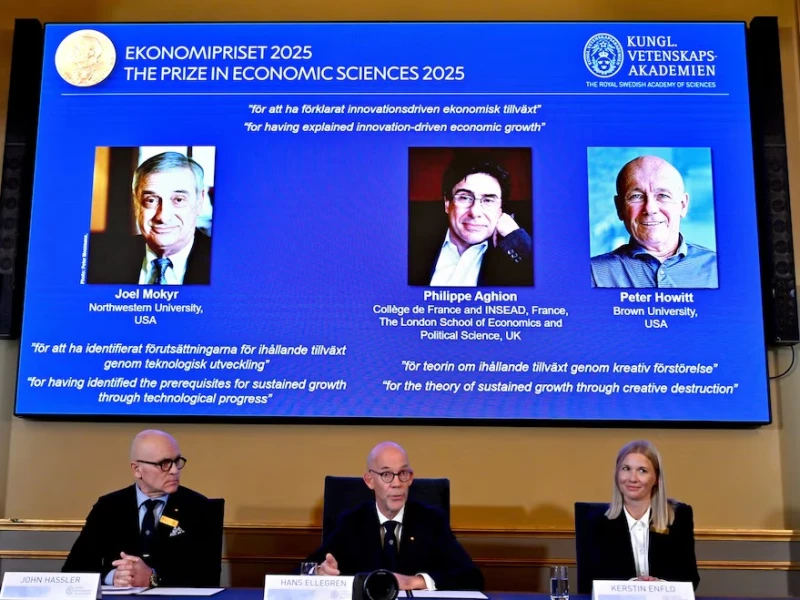
Joel Mokyr, Philippe Aghion, and Peter Howitt have jointly won the 2025 Nobel Prize in Economic Sciences for their groundbreaking research on how innovation and the forces of “creative destruction” drive long-term economic growth, the Royal Swedish Academy of Sciences announced on Monday.
Their work explains how new technologies and production methods continuously replace outdated ones—transforming industries, boosting productivity, and improving living standards around the world.
The prize, officially known as the Sveriges Riksbank Prize in Economic Sciences in Memory of Alfred Nobel, carries a cash award of 11 million Swedish crowns (around USD 1.2 million).
Mokyr, a professor at Northwestern University in the United States, was awarded half the prize, while Aghion, of Collège de France, INSEAD, and the London School of Economics, and Howitt, of Brown University, shared the other half.
Joel Mokyr used historical evidence to identify the factors necessary for sustained growth based on technological innovation,” said Nobel Committee member John Hassler. “Philippe Aghion and Peter Howitt produced a mathematical model of creative destruction — an endless process in which new and better products replace the old.”
The Academy noted that for most of human history, economic stagnation was the norm, and the laureates’ work demonstrates why progress cannot be taken for granted. “Over the last two centuries, for the first time in history, the world has seen sustained economic growth... but it remains fragile,” it said.
Reacting to the award, Aghion said he was “still speechless.” He added that Europe should learn from the United States and China, which have found ways to “reconcile competition and industrial policy,” particularly in key sectors such as defense, climate, artificial intelligence, and biotechnology.
This year’s economics prize concludes the 2025 Nobel season, following last week’s announcements in medicine, physics, chemistry, literature, and peace — the original categories established in Alfred Nobel’s 1895 will.
 Prev Post :
-1760360961.webp)