
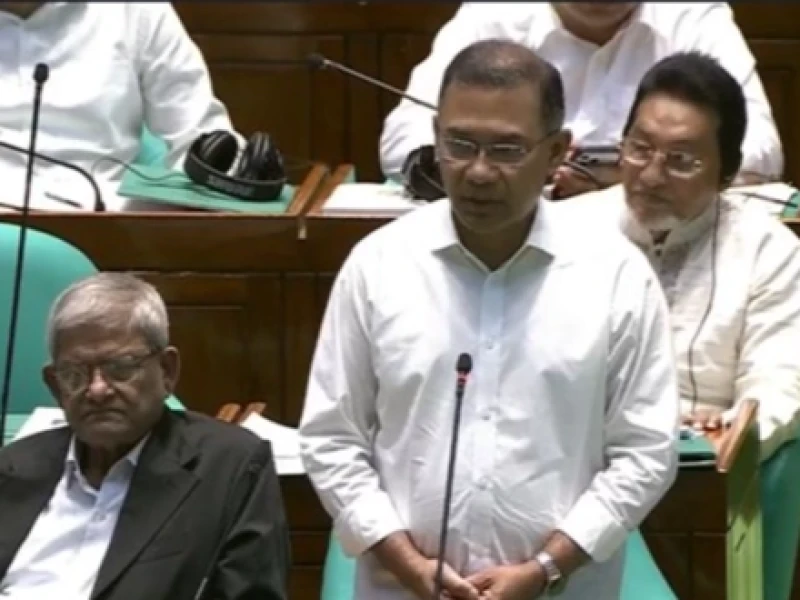
Prime Minister Tarique Rahman on Monday proposed raising the income tax-free threshold for individual taxpayers over the next five fiscal years and urged the Finance Minister to withdraw several controversial provisions in the proposed national budget in response to public concerns.
Taking part in the general discussion on the proposed budget for FY2026-27 in Parliament, Tarique said the tax-free income ceiling should be increased to provide greater relief to individual taxpayers.
He proposed setting the tax-free threshold at Tk 400,000 for FY2026-27 and FY2027-28, Tk 450,000 for FY2028-29 and FY2029-30, and Tk 500,000 for FY2030-31. The budget had proposed thresholds of Tk 375,000, Tk 400,000 and Tk 450,000 respectively for those periods.
The prime minister urged the finance and planning minister to incorporate the revised limits into the budget.
Referring to the proposed provision relating to the disclosure of investments, Tarique said it has generated widespread public concern and misunderstanding.
He explained that the proposal had originally been intended to spare taxpayers from complications arising because many land transactions are registered at mouza values rather than actual market prices.
"Unfortunately, some people have interpreted it as an opportunity to legalise undisclosed money," he said.
He requested the Finance Minister to withdraw the provision respecting public opinion.
He also called for the withdrawal of two other proposed measures that have created confusion among the public – making the submission of Taxpayer Identification Number (TIN) certificates mandatory for opening most bank accounts and for the registration of partition deeds and property mutations.
The Prime Minister proposed reducing the income tax rate for private universities from the existing 10 percent to 5 percent.
At the same time, he urged private universities to invest more in research and development, establish language laboratories to equip students with multilingual skills, and expand tuition-free education opportunities for poor but meritorious students.
He also sought an expansion of tax exemptions for indigenous communities in the three hill districts as well as plain land, proposing that salary income, along with income from business, agriculture and other economic activities, be exempt from tax.
To boost shrimp farming and exports, Tarique proposed withdrawing customs duties, regulatory duties, supplementary duties and VAT on imported shrimp feed, probiotics, vitamins, minerals and other essential inputs, as well as on necessary machinery.
He called for duty concessions on imported raw materials used by local industries and requested the complete withdrawal of the 10 percent supplementary duty on imported honey used by pharmaceutical and other manufacturing industries.
The Prime Minister also proposed reducing the proposed 10 percent import duty on PVC and PET resin, widely used as industrial raw materials, to 5 percent.
He urged the withdrawal of proposed regulatory duties on imported cold-rolled sheets used in fire door manufacturing, coated chromium oxide used in flat steel products, and refined copper wire used by electrical cable manufacturers.
He further proposed abolishing the proposed 15 percent VAT and advance tax on imported fire bricks.
Tarique requested that the customs duty on unprocessed cashew nuts, imported as raw materials for the cashew nut processing industry, be reduced from 15 percent to 5 percent.
He also proposed extending duty concessions on imported raw materials for locally manufactured LED lamps and prefabricated buildings until June 30, 2030.
Highlighting support for entrepreneurship, the Prime Minister said the government had allocated Tk 500 crore for a startup funding initiative in the proposed budget—the first such allocation in the country's history.
He expressed confidence that the fund would help young entrepreneurs build successful startups and create significant employment opportunities for the country's youth.
To encourage formal payment channels for digital advertising, Tarique proposed reducing the existing 15 percent VAT on advertisements placed on social media platforms, OTT platforms, search engines, online marketplaces and other digital media to 5 percent.
He argued that the lower VAT rate would discourage businesses from making informal overseas payments and increase government revenue through greater compliance.
The Prime Minister also requested a review of VAT rates on gold, platinum, diamond and silver jewellery, the complete exemption of the 15 percent VAT applicable to revenue-sharing arrangements with the Bangladesh Telecommunication Regulatory Commission (BTRC), and full VAT exemption at the supplier level for all fish supplies. Bangladeshtravel guide
To promote domestic automobile manufacturing, he proposed reducing VAT on the local production of double-cabin pickup trucks and microbuses from 15 percent to 5 percent.
He also urged the government to relax coefficient filing requirements under the VAT system in selected sectors to simplify compliance for businesses.
 Prev Post :