
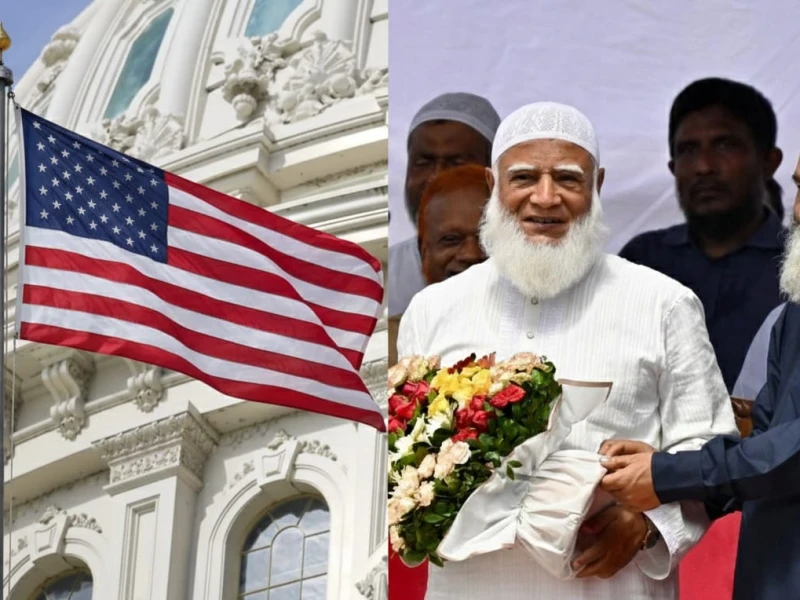
With Bangladesh’s largest Islamist party poised for what analysts expect to be its strongest electoral performance yet, United States diplomats have signaled openness to engaging Jamaat-e-Islami, according to audio recordings obtained by The Washington Post.
The recordings capture remarks made during a Dec. 1 closed-door meeting between a US diplomat based in Dhaka and female Bangladeshi journalists, amid a rapidly shifting political landscape following the ouster of former prime minister Sheikh Hasina in 2024.
During the meeting, the diplomat said Bangladesh has “shifted Islamic” and predicted Jamaat-e-Islami would “do better than it’s ever done before” in the February 12 national election. Referring to potential engagement, the diplomat said of the Islamist party, “We want them to be our friends,” and asked journalists whether they would be willing to bring members of Jamaat’s influential student wing onto their programs.
The diplomat, whom The Post did not name for security reasons, downplayed concerns that Jamaat-e-Islami would attempt to impose its interpretation of sharia law if it gained power. Washington, he said, retained leverage and would respond forcefully if red lines were crossed.
“I simply do not believe that Jamaat can impose sharia,” the diplomat said, adding that if the party took concerning steps, the United States “would have 100 percent tariffs put on them the next day.”
Embassy response
In a statement to The Washington Post, US Embassy spokesperson in Dhaka Monica Shie said the December discussion was a “routine gathering, off-the-record discussion between US Embassy officials and local journalists.”
She said numerous political parties were discussed and stressed that “the United States does not favor one political party over another and plans to work with whichever government is elected by the Bangladeshi people.”
Mohammad Rahman, US spokesperson for Jamaat-e-Islami, said the party would not comment on remarks “reportedly made during a private diplomatic meeting.”
Jamaat’s reemergence
Jamaat-e-Islami has been banned multiple times in Bangladesh’s history, most recently under Sheikh Hasina, the former prime minister who was toppled by a student-led uprising in 2024. Traditionally, the party has advocated governing by Islamic law and previously proposed reducing women’s working hours to allow them to “fulfill their duties toward their children.”
In recent years, however, Jamaat has sought to soften its public image, presenting itself as a mainstream political force focused primarily on anti-corruption, transparency and good governance.
Political analysts say the party has gained momentum since Hasina’s removal and is now firmly back in electoral politics.
“Jamaat is now mainstream,” said Mubashar Hasan, an adjunct researcher and Bangladesh politics expert at Western Sydney University.
Mohammad Rahman said the proposal to reduce women’s working hours remains at a “preliminary stage” and insisted the party has no plans to impose sharia law.
Transition and elections
The uprising against Hasina paved the way for an interim government led by Nobel Peace Prize-winning economist Professor Muhammad Yunus and set the stage for elections widely seen as a decisive test for Bangladesh’s democratic future.
Yunus has repeatedly pledged to restore order and ensure a credible vote. Last week, he said on X that elections would be held on February 12 “— not a day before, not a day after.”
The US diplomat, however, offered a candid assessment of the former premier’s downfall during the December meeting, calling Hasina’s conviction by a Bangladeshi tribunal “politically genius,” though he acknowledged the tribunal was not “free and fair.”
“She’s guilty, and they proved it … within their mandate, which was impressive,” the diplomat said.
Hasina, a long-time ally of India, fled to New Delhi following her ouster. In November, a Bangladeshi tribunal sentenced her to death for overseeing the killing of at least 1,400 protesters. India has not extradited her despite a formal request from Bangladesh’s interim government.
Regional implications
US engagement with Jamaat-e-Islami could strain already tense US-India relations, according to analysts.
“This could potentially drive another wedge between the US and India,” said Michael Kugelman, senior fellow for South Asia at the Atlantic Council. India, he said, views Jamaat as aligned with Pakistan and a threat to its regional security interests.
Relations between Washington and New Delhi are already under strain over disputes ranging from India’s conflict with Pakistan and purchases of Russian oil to stalled trade negotiations and US tariffs on Indian goods.
India-Bangladesh relations have also deteriorated sharply. Recent violence against Hindus in Bangladesh has exacerbated tensions, prompting India to suspend visa operations in Chattogram last month. Bangladesh, in turn, paused visa services at its embassy in New Delhi after protests there.
In her statement, Shie said Bangladesh’s elections would not have “any substantial impact on US-India relations,” adding that Washington’s ties with Dhaka and New Delhi “stand on their own merits.”
Political calculations
Jamaat’s main rival in the upcoming election is the Bangladesh Nationalist Party (BNP). Tarique Rahman, the BNP chairperson who returned to Dhaka from exile in London on December 25, is widely seen as a potential prime ministerial candidate if the party wins.
While Tarique Rahman privately believes Jamaat will outperform expectations, he does not plan to include the party in a coalition government, according to a person familiar with BNP strategy.
Jamaat’s ameer, however, has expressed openness to working with the BNP. “If the parties come together, we’ll run the government together,” Shafiqur Rahman told Reuters in January. Jamaat previously served as a junior partner in a BNP-led government from 2001 to 2006.
Diplomatic outreach
Since Hasina’s ouster, Jamaat-e-Islami has held four meetings in Washington with US officials and several more in Dhaka, Mohammad Rahman said. The party leader also met virtually with US Trade Representative Jamieson Greer last week.
The State Department described meetings in Dhaka as “routine diplomatic work” and declined to comment on those held in Washington. The USTR did not respond to requests for comment.
Rahman also said a senior Indian diplomat met Jamaat’s ameer at his Dhaka residence in August while he was recovering from open-heart surgery. India’s foreign ministry did not comment.
At the December embassy meeting, the US diplomat said mission staff were also considering engagement with other conservative Islamist groups, including Hefazat-e-Islam Bangladesh and Islami Andolan Bangladesh.
“We want them to be our friends, because we want to be able to pick up the phone,” he said.
The diplomat warned that if any future government pursued policies restricting women’s participation in the workforce or imposing sharia law, the US would respond economically, particularly targeting Bangladesh’s garment sector.
“Bangladesh’s entire economy, 20 percent of your exports to the United States, depend on a series of socially liberal clothing chains,” he said, adding that such moves would mean “no more orders” and “no Bangladeshi economy.”
Nevertheless, he said he believed Jamaat would avoid such steps. “There are too many university-educated, smart people to do that,” he said. “We will make exceedingly clear to them what will happen.”
Analysts say such assurances are unlikely to ease Indian anxieties. India has designated Jamaat-e-Islami’s chapter in Indian-administered Kashmir an unlawful group since 2019, renewing the ban in 2024.
“If the US-India relationship were in better shape,” Kugelman said, “Americans might be more attentive to Indian concerns. But with the partnership a real mess, I don’t think US officials feel the need to be that sensitive.”
 Prev Post :