The collection of DNA samples from 114 unidentified bodies buried as unclaimed at Rayerbazar in Dhaka during the July mass uprising marks a significant step toward justice for families of the missing, Chief Adviser Professor Muhammad Yunus said on Wednesday.
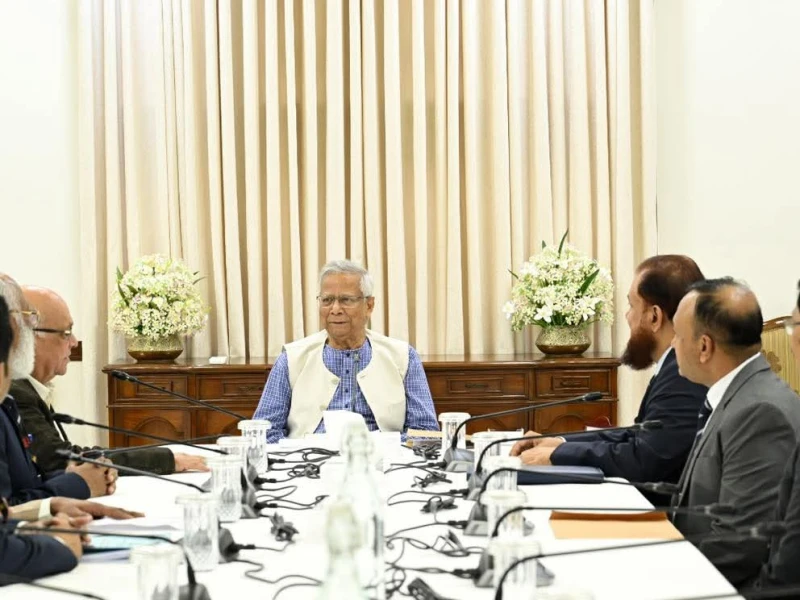
The Criminal Investigation Department (CID) of Bangladesh Police collected the DNA samples, and a report on the process was formally handed over to the Chief Adviser at the State Guest House Jamuna.
The DNA collection programme was conducted under the supervision of the Ministry of Liberation War Affairs, with overall support from the Ministries of Home Affairs and Health. The operation was carried out between December 7 and December 27.
According to the CID, nine families searching for their missing relatives have so far provided DNA samples. Through forensic analysis, the identities of eight martyrs have already been confirmed. All of them were found to have died from bullet injuries.
The identified martyrs are Sohel Rana (38), Rafiqul Islam (52), Asadullah (32), Mahin Mia (32), Faisal Sarkar (26), Parvez Bepari (23), Kabil Hossain (58) and Rafiqul Islam (29).
To ensure transparency, neutrality and adherence to international standards, the CID engaged internationally recognised forensic science expert Dr Morris Tidball-Binz, who provided technical guidance and training in forensic work related to human rights and humanitarian investigations.
The CID has urged families of those who went missing during the July–August mass uprising while participating in the movement to contact its hotline at 01320019999.
After receiving the report, Chief Adviser Professor Yunus thanked all those involved in the initiative. He said the brutality carried out by the then government was rare in world history.
“Killing one’s own citizens and burying them in mass graves is unimaginable in any civilised state,” he said.
The Chief Adviser said the initiative to uncover the truth and restore the identities of the martyrs reflects the state’s moral responsibility and represents a crucial step toward justice for families who have long awaited answers.
He added that the DNA identification process proves that truth cannot be suppressed forever. “The names and identities of the victims will return, and their sacrifice will remain permanently recorded in the nation’s history,” he said.
Calling the initiative more than a forensic exercise, Professor Yunus said it is an effort to wipe away the tears of grieving families, restore the human face of the state, and advance the cause of justice.
“For those who are still searching for their loved ones, this programme is a beacon of hope—one day, the truth will come to light,” he added.
Speaking at the meeting, CID Chief Additional Inspector General Md Shibgat Ullah shared an emotional account, saying a martyr’s mother regularly visited the CID in search of her son and would stand beside a grave under a tree at Rayerbazar.
“Remarkably, her son’s body was later found buried beneath that very tree,” he said.
He added that conducting DNA tests by setting up laboratories at the site has significantly enhanced the forensic capacity of the police.
Others present at the meeting included Liberation War Affairs Adviser Faruk-e-Azam, Professor Dr Kazi Golam Mokhlesur Rahman of Dhaka Medical College Hospital’s Department of Forensic Medicine, CID DIGs Md Jamsher Ali and Mia Masud Karim, CID SSP Mohammad Monirul Islam, Deputy Chief DNA Analyst Ahmad Ferdous, and UN Human Rights Office representative Md Zahid Hossain.
-1767790103.webp) Prev Post :
Prev Post :