
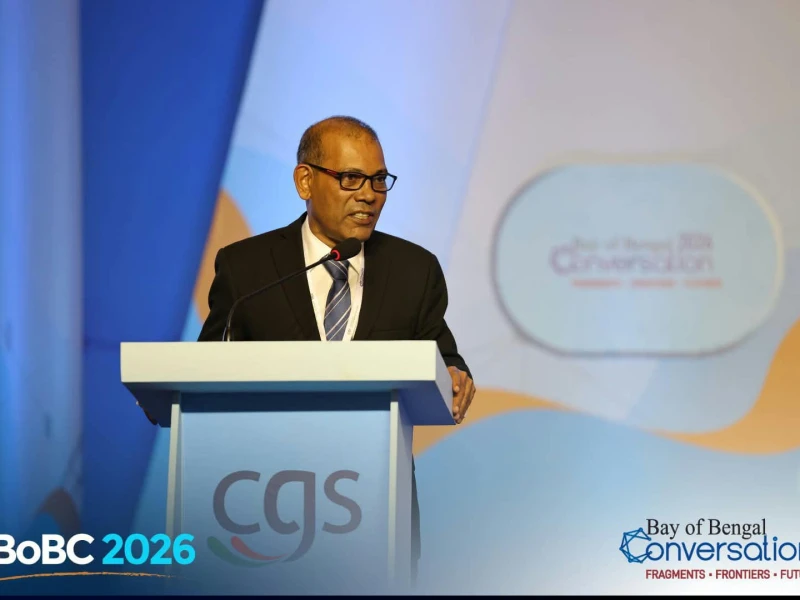
Former Maldivian president Mohamed Nasheed has said countries hit hardest by climate change are not seeking charity or aid, but their rightful due.
"Some countries have enriched themselves by exploiting the planet's resources, and others are paying the price. The rights of climate-vulnerable countries must therefore be ensured in tackling the crisis," Nasheed said Monday while speaking on the concluding day of the Bay of Bengal Conversation 2026 at a city hotel.
The three-day international conference was organised by the research organisation Centre for Governance Studies (CGS).
Nasheed said the people of Nepal have done nothing to deserve devastating floods, just as the people of Maldives have done nothing to cause the alarming rise in sea levels. "Someone will have to bear the cost of this damage."
"I understand prosperity, I understand trade, I understand finance. I know everything in this world depends on money. But to use that money, we first have to survive," he said.
Nasheed called for a development strategy that delivers desired economic outcomes while minimising harm to the planet and the environment.
He said as the earth is changing, people must also change their habits. However, poor countries cannot be asked to remain poor simply to save the planet, he added.
"There are countries that have grown rich by using this planet's resources for their own interests, and that has been done at our expense," he said.
Highlighting the contribution of climate-affected countries, Nasheed said they continue to provide environmental services to the world in the course of their own survival, and should therefore be compensated.
"We are not asking for charity. We are not begging for grants or aid. We are only asking for a fair and rightful due, because we are providing an environmental service to this planet," he said.
The former Maldivian president said humanity cannot survive if nature is not protected.
If a country is ever submerged by rising seas, it will not be enough for its people alone to survive, he said, as questions will also arise over the future of its territory and national boundaries.
Turning to the law of the sea, Nasheed said a country's political boundary extends up to 12 nautical miles from its coast. But as sea levels continue to rise, the fate of a nation's territory and borders will become a critical question if its coastline is submerged.
He said Maldives has an exclusive economic zone of 2,000 nautical miles and can exploit various resources up to 350 nautical miles.
All these calculations are based on the coastline, he said, adding that the rights attached to them must be rethought if rising waters swallow the coast.
"We cannot lose our country because of what you have done, not because of anything we have done," Nasheed said, describing it as a real-life example of the situations the world will face in the future due to climate change.
He also criticised the mindset of viewing climate change as someone else's problem. Many think Maldives will disappear one day, but the issue is not Maldives alone, as climate change is affecting everyone, he said.
"Before Maldives vanishes, your land or your country will disappear. This is happening to everyone. So please wake up," he said.
Nasheed urged relevant international bodies to reconsider the definition of statehood and maritime boundaries in light of climate realities.
 Prev Post :